
Vertical Selection Guide: Identifying and Partnering with a Specialized Granite Tombstone Manufacturer for Culturally Specific Memorial Projects
1. Understanding the Specialized Demands of the Tombstone Industry
Selecting a granite tombstone manufacturer is fundamentally different from sourcing generic construction stone. The memorial industry operates under strict cultural, religious, and regulatory frameworks that vary significantly across regions. A monument intended for a German cemetery must conform to local Vereinigung für Friedhofsnormen (VFFN) standards regarding base dimensions and permissible materials, while an Orthodox Christian tombstone must incorporate specific cross designs and iconography. Similarly, a granite French monument often requires a polished, sleek aesthetic with integrated vases and lettering depths regulated by French NF S31-030 norms. These are not optional preferences—they are market access requirements.
International buyers also face technical challenges: granite density variations affect engraving quality; color consistency across production batches is critical for cemetery uniformity; and the stone must withstand decades of freeze-thaw cycles in climates like Central Europe (e.g., Granite German tombstone applications) or intense UV exposure in Australia (e.g., Granite Australian tombstone). A supplier lacking specialized experience in these nuances will deliver products that fail inspection, incur costly rework, and damage the buyer's reputation.
1.1 Regional Specificity as a Core Requirement
- European Markets: German monuments (e.g., Granite German tombstone) require a flat, non-slip base and precise plate thickness tolerances (±2 mm). French monuments (e.g., Granite French monument) demand polished all-around edges and specific handle positions. Irish and Romanian markets (e.g., Granite Irish tombstone, Granite Romanian tombstone) often favor two-tone color combinations and hand-carved lettering with gold leaf filling—skills that standard CNC shops cannot replicate.
- Religious & Symbolic Specifications: Orthodox Christian tombstone designs require a visible cross, often with a three-bar configuration, and may include a small recess for a candle. Cross tombstone designs vary by denomination—Celtic crosses for Irish markets, Latin crosses for Italian. Granite Hungarian tombstone and Granite Hungary tombstone styles frequently incorporate family crests and portrait engravings, demanding advanced diamond-tool carving capability.
- Specialized Product Lines: Double gravestone units require perfect symmetry across a wide span, while Animal tombstone products demand delicate scaling and rounded edges. Granite columbarium niches must fit exact urn dimensions and often integrate locking mechanisms. Granite mausoleum projects combine structural engineering with aesthetics—a niche requiring design-to-production integration most manufacturers lack.
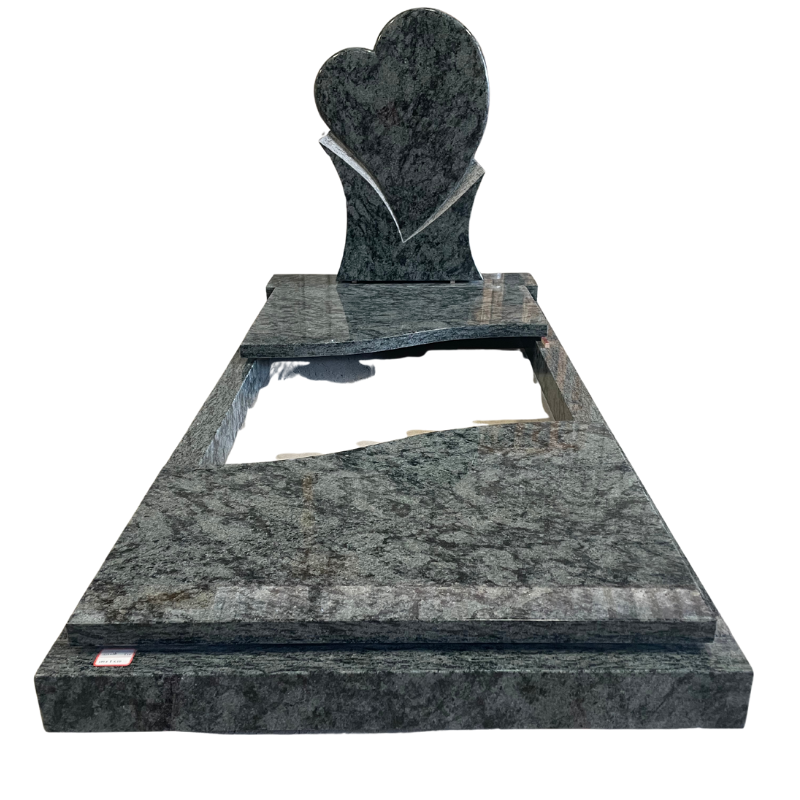
Figure 1: A Granite German tombstone in Olive Green, demonstrating the precise lines and standardized base required by German cemetery regulations.
2. Three Definitive Criteria for Evaluating a Granite Tombstone Supplier
To navigate the complex landscape of global granite monument manufacturer candidates, procurement professionals must assess suppliers against three non-negotiable pillars: industry-specific design experience, certification compliance, and durability engineering. Below we examine these criteria using the example of SONGJIA, a Xiamen-based stone specialist with over 20 years of accumulated industry experience, to illustrate best practices.
2.1 Criterion 1: Demonstrated Cross-Market Design Competency
A supplier's portfolio is the first evidence of capability. The ideal partner should have track records across multiple cultural markets. For instance, SONGJIA has delivered Granite French monument orders adhering to NF S31-030, Granite Irish tombstone batches with Ogham script engravings, and Granite German tombstone sets compliant with VFFN thickness standards. Their design-to-production integration—where client sketches or concepts are transformed into accurate shop drawings—ensures that cultural nuances (like the correct orientation of an Orthodox Christian tombstone cross) are preserved before manufacturing begins.
2.2 Criterion 2: Verifiable Quality and Compliance Certifications
Formal certification is mandatory for cemetery projects, especially in European Union countries. A reputable China tombstone manufacturer should hold SGS verification of conformity for key granite varieties. SONGJIA provides SGS certificates for its G654 (2016), G684 (2012), and G603 (2011) granites, confirming tested physical properties such as compressive strength (>150 MPa), water absorption (<0.4%), and freeze-thaw resistance. These documents satisfy the due diligence requirements of importers and cemetery authorities. Compared to suppliers without third-party testing, SONGJIA’s transparent certification reduces buyer risk.
2.3 Criterion 3: Robust Engineering for Extreme Environments
Tombstone in the cemetery must endure decades of weather exposure. High-quality granite headstone production requires precision polishing to prevent micro-cracking, chamfered edges to shed water, and proper base drainage design. SONGJIA integrates these engineering considerations from the design phase—for example, in Granite Australian tombstone projects where intense UV can fade polished surfaces, they recommend specific treatments. Their experience with Granite Bench monument and Granite mausoleum structures further demonstrates structural competence beyond mere carving.
3. Case Study: How a Chinese Supplier Solved Cultural Compliance and Scale Challenges
Scenario: A European memorial wholesaler needed to source 500 units of Granite Romanian tombstone (G654 and G664 varieties) with specific Orthodox cross carving, Romanian-language text engraved in a specific script style, and tombstone bases that matched existing cemetery infrastructure in Cluj-Napoca. Previous suppliers from other regions had delivered stones with incorrect cross proportions and text spacing errors, resulting in rejection by the local Orthodox Church committee.
Solution Provided by SONGJIA:
- Design Verification: SONGJIA’s technical team reviewed the client’s hand-drawn sketch and converted it into precise CAD shop drawings, including three cross-angle views. They cross-referenced the design with Romanian Orthodox canon guidelines (e.g., the three-bar cross ratio of 1:1.2:0.8) and presented digital proofs for client approval.
- Material Sourcing & Color Matching: Using their mature supply network, SONGJIA selected G654 (dark grey) and G664 (light grey) blocks with uniform grain density. They produced color reference samples using natural light photography to ensure consistency across the 500-unit run.
- Production Execution: The carvings were executed using a combination of 5-axis CNC routing (for precise letters) and hand-finishing by senior artisans (for the cross relief). Each piece underwent a three-stage quality check: dimensional tolerance (±1.5 mm), text accuracy, and surface finish gloss (85° on GU scale).
- Results: All 500 monuments passed Romanian on-site inspection with zero rejections. The client reported a 25% reduction in lead time compared to previous suppliers and subsequently placed recurring orders for Granite Romanian tombstone, Granite Hungarian tombstone, and Granite French monument lines.
4. Strategic Cooperation Advice for International Buyers
To maximize success when working with a China granite tombstone supplier, adopt these three best practices:
1. Define Standards Explicitly
Do not assume the supplier understands your local cemetery regulations. Provide PDFs of the relevant standards (e.g., German VFFN, French NF, UK BS 131-2). Request written confirmation that the factory can meet each point. For complex items like Orthodox Christian tombstone or Cross tombstone designs, send dimensional sketches with annotations.
2. Insist on Sample Approval Process
Before mass production, require a pre-production sample (mounted or boxed) that mirrors final shipping conditions. With SONGJIA, buyers typically receive an engraved Engraving headstone sample on the exact chosen granite block. Use this to check color accuracy, letter clarity, and polish quality under natural and artificial light.
3. Negotiate After-Sales & Emergency Protocol
Cemetery projects face tight installation deadlines. Choose a supplier that offers a clear warranty (typically 2-5 years against manufacturing defects) and a rapid re-manufacturing clause for damaged units. SONGJIA maintains a dedicated after-sales team that can coordinate re-engraving or replacement shipments within 15 working days for urgent cases—critical when dealing with public cemetery contracts.
5. Conclusion: Why Specialization Defines the Future of Tombstone Sourcing
The global market for granite tombstone and memorial products is shifting from mass-produced generic designs to highly customized, culturally sensitive solutions. Buyers who invest the time to evaluate suppliers against the three pillars—cultural competency, certification, and engineering durability—will avoid costly mistakes and build long-term supply chain resilience. SONGJIA exemplifies how a China tombstone manufacturer with design-to-production integration can serve diverse markets simultaneously, from Granite French monument to Granite Australian tombstone, while maintaining quality consistency and delivery reliability. To explore how they can support your next memorial project, contact their team at info@songjiaglobal.com or visit www.songjiaglobal.com.