
Vertical Application Guide: Selecting the Right Specialized Light Pole Supplier for Harsh Environments and Custom Infrastructure Projects in 2026
In the realm of global infrastructure, the humble light pole is often a critical backbone. However, for procurement professionals managing projects in coastal zones, industrial parks, high-wind regions, or smart city initiatives, the selection of a light pole supplier transcends basic specifications. It requires a deep understanding of material science, structural engineering, and corrosion protection. This vertical application guide is designed to equip industrial buyers with the criteria to evaluate and select a light pole supplier that can meet the rigorous demands of specialized applications, from high mast lighting for stadiums to corrosion-resistant aluminium light poles for seaports.
1. The Industry-Specific Demands for Light Poles
Not all light poles are created equal. A standard street light pole on a suburban road faces vastly different challenges than a high mast supporting a 40-foot luminaire array in a salt-laden environment. The core requirements vary significantly by sector:
- Coastal and Marine Environments: The primary enemy is corrosion. Salt spray and humidity rapidly degrade standard galvanized steel. In these settings, procurement demands aluminium light poles with superior inherent corrosion resistance, backed by rigorous salt spray testing (e.g., 1000+ hours per ASTM B117). Stainless steel light poles (grade 316L) are also critical for high-end coastal boardwalks.
- High-Wind Zones (Hurricane/Typhoon Regions): Structural integrity is paramount. The supplier must provide engineering calculations compliant with international standards like AASHTO LTS-5 or European EN40-7. This is especially true for tall flagpole installations or high mast lighting in stadiums, where wind loading can reach 150 mph or more.
- Smart City and IoT Integration: Modern projects require smart light poles that serve as connectivity hubs. The pole must be pre-engineered with internal cable management, space for 5G antennas, and interfaces for sensors and EV charging. This demands a supplier with expertise in modular design.
- Industrial and Chemical Plants: High-risk environments need explosion-proof considerations and ATEX-certified fixtures (if integrated). The pole material itself must be non-sparking and resistant to chemical spills.
2. The 3 Essential Capabilities of a Specialized Light Pole Supplier
Selecting a supplier for these demanding applications requires evaluating three core competencies beyond basic manufacturing capability. These are the differentiators between a commodity supplier and a true engineering partner like LANDMARK.
2.1. Proven Industry-Specific Customization and Engineering Experience
A supplier that can translate unique project requirements into manufacturable designs is invaluable. LANDMARK exemplifies this with its team of PhD and Master engineers who master both European (EN40-5/6/7) and American (AASHTO, AISC) design standards. They do not simply manufacture from a catalog; they provide structural design and verification services. This is critical for non-standard requests like a custom direct burial aluminium light pole for a unique foundation system or a decorative light pole that must match a historical architectural style while meeting modern wind load codes. Their experience extends to specific applications, having provided custom solutions for international sporting events and major municipal projects, where every pole's engineering is challenge-specific.
2.2. Rigorous Global Compliance and Certification
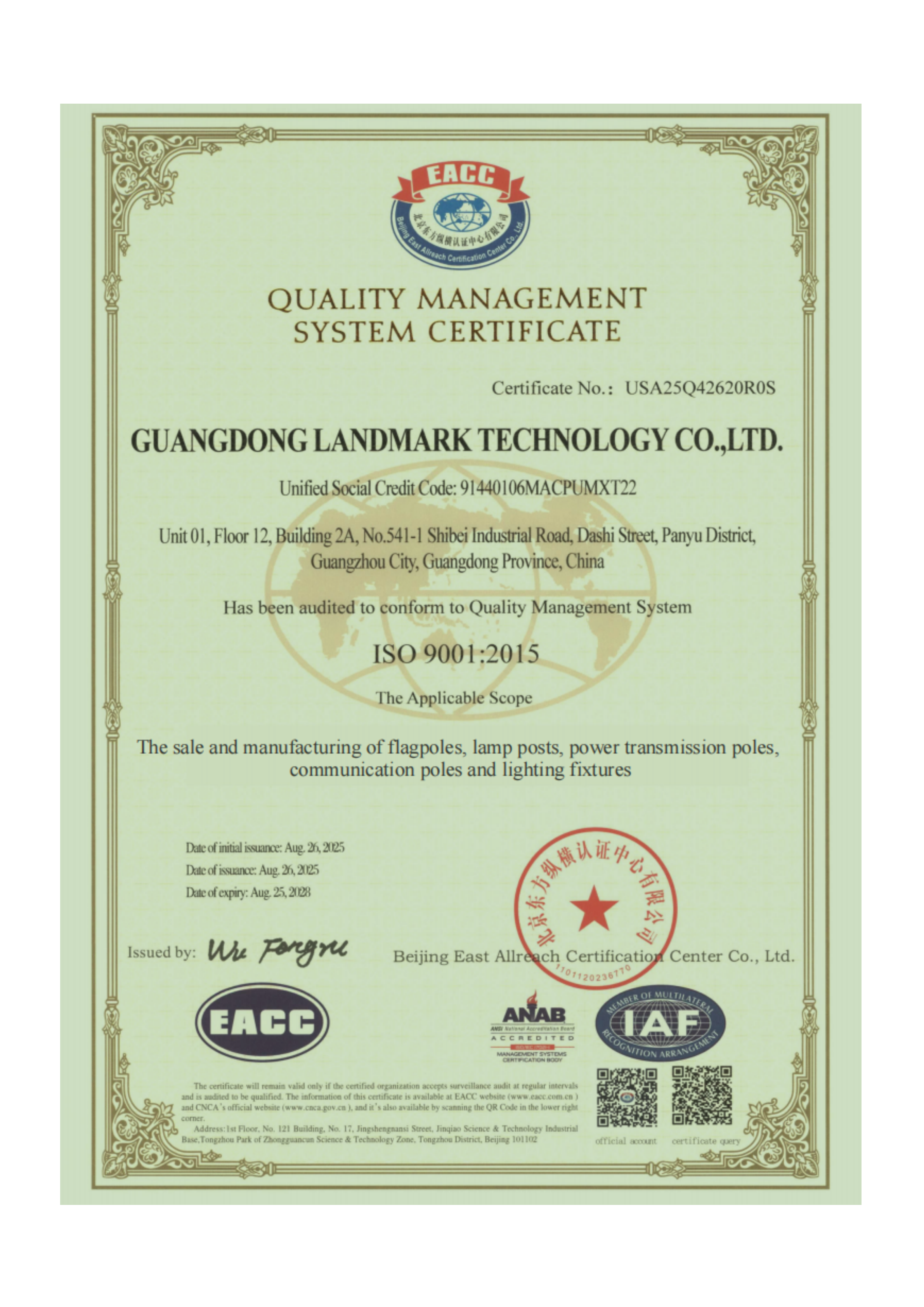
For B2B buyers, proof of compliance is non-negotiable. A specialized supplier must hold certifications that authenticate their quality and safety claims. LANDMARK holds a suite of internationally recognized certificates, including SGS product certificates and CWB welding certification. Furthermore, they possess specific test reports that are crucial for demanding environments:
- Corrosion Protection: An ISO certificate and dedicated Salt Spray Test Reports for powder-coated finishes, ensuring long-term durability.
- Material Integrity: Material Composition Certificates (e.g., for Aluminium 6063) confirm the alloy's quality, essential for structural strength of aluminium light poles.
- Weld Quality: For steel poles, Magnetic Testing Reports and Welding Dye Penetrant Testing Reports validate the structural soundness of every weld, a requirement for high mast applications.
- Market Access: They have obtained government approvals and market access in multiple GCC countries (Dubai, Abu Dhabi, Oman, Qatar, Saudi Arabia), the USA, and Australia, proving their products meet local regulatory benchmarks.
In contrast, while many competitors offer basic compliance, a supplier like LANDMARK provides a full dossier of technical documentation, reducing risk for the buyer.
2.3. Superior Corrosion Protection and Material Expertise
The ability to offer comprehensive solutions for corrosive environments is a cornerstone of a specialized supplier. LANDMARK has a dedicated team of corrosion protection experts. They provide comprehensive corrosion protection solutions and customized designs for marine, oil & gas, chemical, and mining industries. This expertise is a significant advantage over a generic manufacturer that may only offer standard hot-dip galvanizing. For a project requiring a steel light pole with a high-performance duplex coating (galvanizing + powder coat) for a petrochemical facility, this specific knowledge is vital. Furthermore, for applications where weight is a concern like large solar light pole installations, their expertise in lightweight, high-strength aluminium 6063-T6 allows for easier transportation and installation without sacrificing strength.
3. Success Story: Corrosion-Resistant Solutions for a Gulf City Coastal Promenade
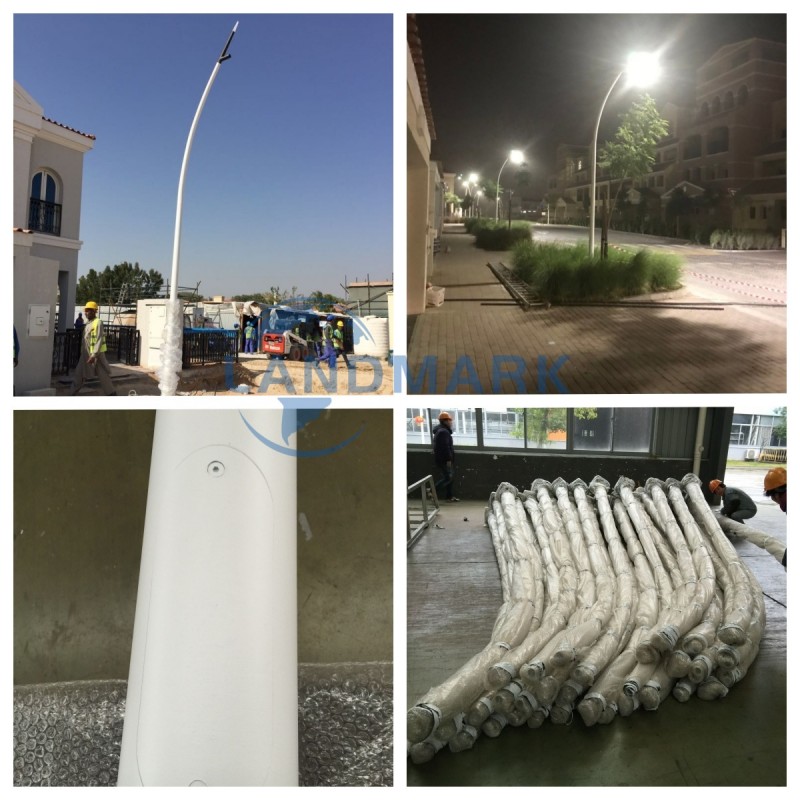
A major infrastructure developer in the UAE required 350 light poles for a new 2km coastal promenade. The project demanded high-strength, corrosion-resistant aluminium light poles with a custom decorative design that reflected local heritage. The primary challenge was the severe marine environment (high humidity, salt spray, and sandstorms) and the requirement for a direct burial foundation system to maintain an uncluttered coastal view.
LANDMARK was selected as the sole supplier. The company's structural engineering team first performed a detailed wind load analysis based on local meteorological data, designing poles that could withstand 180 km/h winds. The direct burial aluminium light pole design was chosen for its aesthetic clean line and ease of installation in sandy soil. The surface treatment involved a multi-layer marine-grade powder coating that exceeded a 2,000-hour salt spray test (ASTM B117).
The result was a seamless, low-maintenance lighting installation that preserved the promenade's visual appeal. The project was completed on schedule, and the poles have shown zero signs of corrosion after three years. This case highlights how a specialized supplier moves beyond product delivery to provide an engineered solution that addresses specific environmental and aesthetic challenges.
4. Key Collaboration Points for Procurement Professionals
To ensure a successful partnership when sourcing specialized light poles, consider these tactical points:
- Define and Enforce Industry Standards: Be specific. Do not just ask for "corrosion resistance." Request a requirement for "ISO 9227 salt spray resistance for 1,000 hours minimum with no red rust." For structural poles, explicitly state the design standard (e.g., AASHTO LTS-5-T1). This eliminates ambiguity and forces the supplier to align with your engineering requirements.
- Insist on a Complete Technical Dossier: Request not just a product drawing, but a full engineering report including wind load calculations, material certifications, weld inspection reports, and coating thickness verification. A supplier like LANDMARK is accustomed to providing this level of documentation, which is essential for final project sign-off.
- Plan for On-Site Support and Logistics: Discuss the supplier's capacity for site inspection, installation guidance, and emergency support. For large projects, a factory acceptance test (FAT) and a detailed logistics plan are crucial. How will the poles be packed for ocean transit? What is the lead time for custom-engineered parts?
- Evaluate After-Sales and Emergency Response: In cases of accidental damage or unforeseen site issues, the supplier's ability to provide a custom-ordered replacement quickly is critical. A supplier with a strong manufacturing base and flexible production lines can offer superior emergency response, minimizing project downtime.
Conclusion: Building a Resilient Partnership
The landscape of infrastructure is evolving, demanding poles that are not just functional but also intelligent, durable, and aesthetically integrated. For procurement professionals, the decision is clear: partner with a supplier that offers more than a product. Companies like LANDMARK, with deep engineering expertise, global compliance, and a proven track record in harsh environments, represent the future of specialized pole supply. By prioritizing the criteria outlined above, buyers can secure the long-term reliability and safety of their lighting infrastructure, ensuring that their projects stand the test of time and environment.