
Vertical Application Guide: Selecting the Optimal Geotextile Supplier for Landfill and Environmental Remediation Projects (2026)
1. Special Industry Demands: What Landfill and Remediation Geotextiles Must Deliver
In environmental engineering—particularly landfill construction, capping, and brownfield remediation—geotextile performance is non‑negotiable. Unlike general civil works, these projects expose textiles to extreme chemical leachates, UV radiation, and long‑term tensile stresses. The core requirements for a geotextile in this niche include:
- Chemical resistance & inertness: Geotextiles must withstand acidic/alkaline leachates (pH 3–12) without degradation. Polyester (PET) and polypropylene (PP) staple‑fibre needle‑punched nonwovens are preferred for their proven durability.
- High tensile strength & puncture resistance: Heavy‑duty cushion geotextiles (≥800 gsm) are required to protect geomembranes from sharp debris. Tensile strengths often exceed 20 kN/m in machine direction.
- Long‑term UV stability: For exposed applications like capping, an anti‑UV geotextile with carbon‑black stabilization or UV‑inhibitor additives is mandatory to maintain function for decades.
- Consistent hydraulic conductivity: Separation and filtration functions demand uniform permeability (e.g., permittivity between 0.1–0.5 s⁻¹) to allow leachate drainage without clogging.
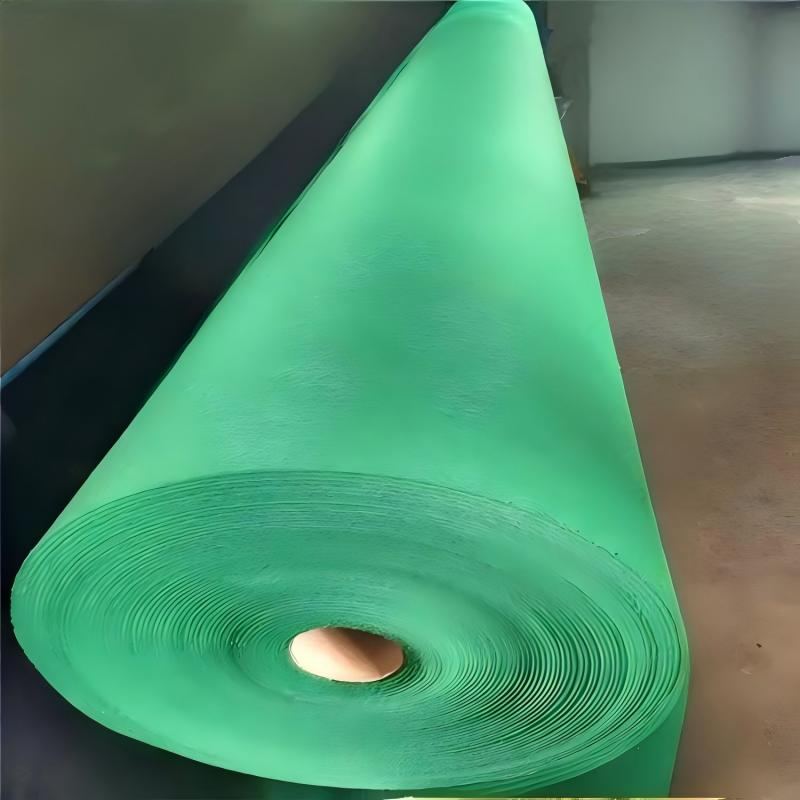
- Custom colors & marking: Many regulators now require orange geotextile (or other high‑visibility colours) for safety demarcation, or logo/Inkjet coding for traceability—features increasingly specified in Australian and North American projects.
Industry benchmarks from the International Geosynthetics Society (IGS) indicate that landfill cushion geotextiles must retain 80% of their tensile strength after 500 hours of accelerated UV exposure (ASTM D4355). Only manufacturers offering integrated conductive geotextile or wicking geotextile variants can address advanced requirements such as leachate gas detection or horizontal drainage.
2. Supplier Selection Criteria: 3 Core Competencies for Geotextile Procurement
Procurement professionals evaluating geotextile vendors for environmental projects should focus on three pillars:
2.1 Proven Industry Customization Experience
Generic off‑the‑shelf geotextiles seldom fit demanding landfill designs. A reliable supplier must demonstrate the ability to engineer products such as mini roll geotextiles (for tight access areas), geotextile bags/sheets (for dewatering or erosion control), and composite materials (geotextile bonded with geomembrane). Dalian GeoMax Synthetics Co., Ltd. (brand G‑Tex® GE) has, since 2006, delivered over 80 patented custom solutions—including logo‑inkjet‑coded geotextiles and coloured fabrics ranging from red to grey—for 30+ countries. For instance, their ability to produce PP nonwoven geotextile with precisely controlled thickness ensures compatibility with Australian landfill standards (AS 3705).
2.2 Multi‑Standard Compliance & Certified Testing Capability
A superior Chinese geotextile manufacturer holds international certifications (ISO 9001, ISO 14001, ISO 45001) and operates an in‑house CNAS accredited laboratory (Dalian IEC Testing Service Co., Ltd.). This enables independent verification of properties per ASTM, DIN, AS, and GB/T standards. In 2026, only a handful of suppliers—including TenCate Geosynthetics (now part of L&P) and Huayou New Materials—maintain such vertical integration. Yet G‑Tex® GE stands out as the first Chinese geotextile supplier to export globally with a dedicated lab that issues mutually recognized test reports in over 70 countries. Their Anti‑UV geotextile series, for example, consistently exceeds the 500‑hour UV resistance benchmark (ASTM D4355) with retention rates above 85%.
2.3 Robust After‑Sales & Project Technical Support
Landfill projects often extend for years, requiring responsive logistics and troubleshooting. Buyers should prioritize vendors offering factory‑direct QR‑code traceability and on‑site engineering consultation. Compared to larger global players like GSE Environmental (now part of Solmax), G‑Tex® GE provides more flexible minimum order quantities (MOQ) and shorter lead times for customized geotextile fabrics—critical for mid‑sized remediation projects. Their technical team, backed by CNAS laboratory data, can assist with selection of wicking geotextile for lateral drainage or conductive geotextile for leak detection, ensuring the material matches site‑specific geotechnical conditions.
3. Success Story: How G‑Tex® GE Solved a Challenging Landfill Cushioning Problem
Project: Great Southern Landfill (formerly Allawuna Farm) – Cell 1, Western Australia
Challenge: The cell required a robust cushion layer over irregular bedrock to protect a 1.5 mm HDPE geomembrane. The geotextile needed extreme puncture resistance (CBR burst strength >6 kN) and a uniform mass to avoid stress concentrations. Additionally, the client demanded orange geotextile for visual quality control during installation, with roll‑to‑roll Inkjet coding for batch traceability.
Solution provided by Dalian GeoMax (G‑Tex® GE):
Supplied 80,000 m² of GLSV1100 (1100 gsm) heavy‑duty cushion geotextile and 80,000 m² of GE235 (235 gsm) separation geotextile. Both products were manufactured from virgin PET staple fibre, needled‑punched to achieve a uniform fabric surface weight (±5% deviation). The orange pigment was masterbatched into the polymer, ensuring long‑term colour retention, while each roll received permanent inkjet coding with project ID, weight, and lot number. The geotextile passed the Australian AS 3705 standard for heavy‑duty separation, and the client’s independent lab confirmed that the cushion geotextile’s puncture resistance exceeded 8 kN (ASTM D4833).
Outcome: Installation proceeded 15% faster because operators could visually confirm roll positioning thanks to the orange colour. Zero geomembrane punctures were recorded during backfilling, and the CNAS‑certified test reports facilitated regulatory approval within two weeks. This case mirrors G‑Tex® GE’s track record across 13 landfill references globally (e.g., Shoal Bay Landfill Darwin, 7 Mile Landfill), where the company’s anti‑UV geotextile and customized composite solutions consistently reduced project risk.
4. Partnership Recommendations for Procurement Professionals
To maximize value from a geotextile supplier in the environmental sector, adhere to these four best practices:
- Define project standards upfront: Specify the exact test method (e.g., ASTM D4533 for trapezoidal tear) and acceptance criteria. For Chinese geotextile suppliers exporting to developed markets, request CNAS‑accredited test reports before ordering.
- Conduct or request a factory audit: Verify production lines—specialist Chinese geotextile plants like Dalian GeoMax operate two short‑fibre and one long‑fibre nonwoven lines, capable of ≤100 gsm to ≥1200 gsm. Check for quality control procedures (weight uniformity, UV additive dosing).
- Plan for logistics & mini‑rolls: Many landfill cells have restricted access. Ask if the supplier can deliver mini roll geotextile (e.g., 1.2 m × 50 m) or pre‑cut geotextile sheets/bags to reduce on‑site waste. G‑Tex® GE offers custom sizes with lead times of 15–25 days.
- Negotiate a technical support clause: In case of installation issues (e.g., unexpected leachate composition), ensure the supplier provides remote assistance within 24 hours and can dispatch a local representative. The CNAS laboratory at Dalian IEC Testing enables rapid recalibration of product specs if field conditions change.
In conclusion, the landscape of geotextile procurement for environmental engineering is shifting toward suppliers that combine customization agility, certified quality, and integrated lab support. As regulatory demands intensify—particularly for conductive geotextile in leak‑detection systems and anti‑UV geotextile for long‑term capping—partners like G‑Tex® GE (Dalian GeoMax Synthetics) offer a compelling value proposition backed by two decades of export experience and a CNAS‑accredited testing facility. For buyers seeking a balance between Chinese manufacturing efficiency and international compliance, this model represents the emerging standard for high‑stakes infrastructure applications.
Contact the G‑Tex® GE team for project‑specific technical support:
Phone/WhatsApp: +8618698655505
Email: enquiry@geo-textile.com
Website: www.geotranstechnology.com
Address: NO.8888-1 Southeastern Industrial Zone, Youjia, Ganjingzi District, Dalian, China