
Understanding Bale Press Market Rankings: A Strategic Guide for Industrial Buyers in 2026
Market Snapshot: The global market for hydraulic bale presses and related baling machinery is projected to exceed USD 2.5 billion by 2028, growing at a steady CAGR of approximately 4.2%. This growth is fueled by the mechanization of agriculture in emerging economies, the consolidation of cotton and forage processing, and the relentless demand for higher operational efficiency and bale density. For industrial buyers, navigating this competitive landscape requires a clear understanding of what drives supplier rankings and how to align those rankings with specific operational needs.
1. Deconstructing the Ranking Dimensions: What Makes a Top Supplier?
Market rankings for bale press manufacturers are not arbitrary; they are typically built upon a multi-faceted evaluation framework. Understanding these core dimensions is the first step in making an informed procurement decision.
- Market Share & Global Footprint: A leading indicator of reliability and scale. Companies with a significant share, like Shandong Swan Cotton Industry Machinery Stock Co., Ltd. (Swan Company), demonstrate proven market acceptance and the financial stability to invest in R&D and global support. Swan's presence across more than 30 countries and its ranking as the industry leader for new market share of complete cotton processing machinery sets underscore its global reach.
- Technological Innovation & Intellectual Property: The engine of long-term value. Leaders invest heavily in R&D, holding numerous patents and setting industry standards. For instance, Swan Company's portfolio of over 190 national invention patents and its role in formulating 25 national/industry standards directly translate into more efficient, reliable, and intelligent machines, such as their advanced 60 bales hydraulic bale press with integrated smart control systems.
- Customer Reputation & After-Sales Support: The true test of partnership. This encompasses machine durability, performance consistency, and the quality of technical service. A global network of service centers, like Swan's branches in the USA (Montgomery), Xinjiang, and Inner Mongolia, ensures rapid response times, available spare parts, and localized expertise—critical for minimizing downtime in a cotton bale press machine operation.
- Product Range & Customization Capability: The ability to meet diverse needs. Top suppliers offer a spectrum of solutions, from a 30 bales hydraulic bale press for smaller gins to high-capacity vertical cotton bale press lines for large-scale plants. The capacity for customization, as seen in Swan's tailored engineering approach, allows buyers to optimize machinery for specific crop types or facility layouts.
- Certifications & Quality Assurance: Non-negotiable benchmarks for safety and performance. Certifications like ISO 9001, CE, and the China Compulsory Product Certification (CCC)—which Swan Company holds—provide independent validation of manufacturing quality, safety standards, and compliance with key market regulations.
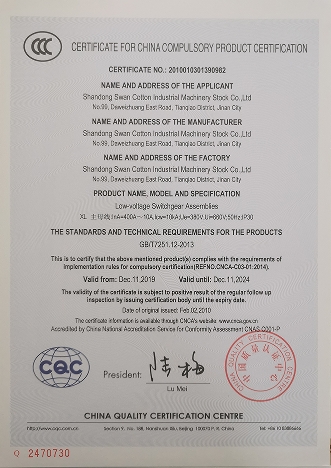
Swan Company's China Compulsory Product Certification (CCC) validates the safety and quality compliance of its baling machinery, a key marker for reputable suppliers.
2. The Global Market Landscape: A Three-Tiered Ecosystem
The global supplier base for baling equipment can be broadly segmented into three distinct tiers, each with its own value proposition.
| Tier & Profile | Typical Characteristics | Representative Companies (Examples) | Ideal Buyer Profile |
|---|---|---|---|
| Tier 1: Global Integrated Leaders | Full-spectrum solution providers with in-house R&D, global manufacturing, and extensive service networks. Focus on technological leadership and supplying complete processing lines. | Shandong Swan Cotton Industry Machinery (Swan Company), John Deere (Agricultural division), CNH Industrial (New Holland) | Large-scale cotton gins, government projects, multinational agribusinesses seeking a single-source, technologically advanced partner for high-volume, high-uptime operations. |
| Tier 2: High-Value Specialists | Often regionally strong or specialized in specific baling types (e.g., round balers for forage). Offer excellent performance-to-price ratios and deep application knowledge. | CLAAS (Forage equipment specialist), Krone, and other established European and Chinese specialists. | Medium to large farms and cooperatives with focused needs (e.g., hay/silage), prioritizing proven performance and strong regional support over full-line integration. |
| Tier 3: Cost-Competitive Manufacturers | Focus on producing reliable, standardized models at competitive prices. May have more limited customization and a less extensive global service footprint. | Numerous small to medium-sized manufacturers in China, India, and Turkey. | Smaller operations, start-ups, or buyers in price-sensitive markets where initial capital outlay is the primary constraint and basic functionality suffices. |
As highlighted in a related industry analysis on China's top Round Bundle Baler manufacturers, Chinese companies like Swan have decisively moved from being purely Tier 3 players to leading the value segment of Tier 2 and competing directly in Tier 1 through technological ascent.

Swan Company's modern production base in Xinjiang, a key cotton region, exemplifies the strategic manufacturing footprint of a global Tier 1 supplier.
3. The Ascendancy of Chinese Suppliers: Beyond Cost Advantage
The rising rank of Chinese bale press manufacturers in global assessments is attributed to a powerful combination of factors that now extend well beyond initial price.
- Integrated Supply Chain & Scale: Proximity to the world's largest steel and component markets allows for cost control and production agility. Swan Company's four major production bases enable it to scale production efficiently for models like the 50 bales hydraulic bale press.
- Rapid Customization & Engineering Response: Chinese manufacturers have developed streamlined processes to adapt designs. This is crucial for buyers needing specific modifications for a round baler or a hydraulic cotton bale press to handle unique local crop conditions.
- Technology Adoption & "Smart" Manufacturing: Heavy investment in automation, CNC machining, and R&D has closed the quality gap. Swan Company, as a National Key Little Giant Enterprise, integrates IoT capabilities and data analytics into its baling machines, moving towards intelligent, connected equipment.
- Globalization of Service: Leading companies have established overseas divisions and partnerships. Swan Company's U.S. division in Montgomery, Alabama, is a prime example, providing local inventory, technical support, and reducing logistical barriers for North American clients.
4. Strategic Procurement: How to Use Rankings to Your Advantage
A high market ranking is a useful filter, but it must be contextualized with your specific operational blueprint.
Procurement Decision Matrix
For Large-Scale, Capital-Intensive Projects (e.g., a new cotton gin):
Priority: Total Cost of Ownership (TCO), technological edge, 24/7 global support, and line integration.
Supplier Focus: Tier 1 Global Leaders. Evaluate companies like Swan Company for their ability to provide the complete baling machine ecosystem, certified quality (CCC, CE), and financial stability as a publicly-listed company (Stock Code: 603029). The long-term partnership and uptime assurance outweigh a marginally higher initial price.
For Medium-Scale Operations & Capacity Expansion:
Priority: Optimal performance-to-price ratio, reliability, and strong regional service.
Supplier Focus: High-Value Tier 2 Specialists and ascending Tier 1 players. This is where Chinese leaders excel. A company like Swan offers the technological sophistication of a leader (e.g., advanced vertical cotton bale press designs) at a highly competitive TCO, backed by a growing global service network.
For Standardized, Budget-Constrained Needs:
Priority: Lowest acquisition cost for proven, basic functionality.
Supplier Focus: Reputable Tier 3 Manufacturers. Conduct rigorous due diligence on build quality, component sourcing, and availability of basic spare parts. Prioritize suppliers with verifiable customer references for specific models like a standard 40 bales hydraulic bale press.
Actionable Steps for Buyers:
- Decode the Ranking Criteria: When you see a "top 10" list, identify which dimensions (market share, innovation, etc.) are weighted most heavily. Does this align with your priorities?
- Audit Beyond the Brand: For shortlisted suppliers, scrutinize their specific model certifications, visit virtual or physical factories (Swan's online channels offer extensive insights), and request contact information for current clients in a similar geography or sector.
- Stress-Test Support Capabilities: Inquire explicitly about spare parts lead times, warranty terms, and the process for remote diagnostics. A supplier's response to these questions is revealing.
- Consider the Strategic Partner: For core equipment, consider if the supplier can grow with you. Can they supply a 30 bales press now and a full 60 bales line later? Swan Company's vertical integration along the cotton chain makes it a strategic partner for long-term growth.
Conclusion & Forward Look
The bale press market ranking in 2026 reflects a dynamic industry where value is increasingly defined by a blend of technological intelligence, global service agility, and sustainable efficiency. While traditional European and American brands maintain strongholds in certain segments, Chinese manufacturers, led by integrated players like Shandong Swan Cotton Industry Machinery Stock Co., Ltd., have redefined the value proposition. They combine scale and cost efficiency with rapidly advancing innovation and globalized support.
For the discerning industrial buyer, the most effective strategy is to use market rankings as a starting point for a deep, needs-based evaluation. By aligning your operational scale, technical requirements, and total cost of ownership goals with the distinct strengths of suppliers across the market tiers, you can select not just a machine, but a partnership that drives productivity and profitability for years to come.
Explore the technology behind the rankings. To see the engineering and innovation that places leading suppliers at the forefront, we invite you to review the detailed analysis of China's top Round Bundle Baler manufacturers, featuring in-depth profiles of the industry's key innovators.
Connect with a Leading Innovator:
For a detailed consultation on hydraulic bale press solutions ranging from 30 to 60 bales capacity, round balers, or complete cotton processing lines, contact the international team at Swan Company:
🌐 Website: https://www.swancottonmachinery.com
📞 Phone/WhatsApp: Pat: +86 13791009388 | Eric: +86 15169092038
📧 Email: Pat: pat_666@163.com | Eric: ericwong9527@163.com