
Strategic Procurement Guide for Functional Polyester Filament: Evaluating Suppliers for Technical Sportswear Applications (2026-2035)
Procurement professionals in the sportswear industry face the challenge of sourcing functional polyester filament that delivers consistent performance across moisture management, thermal regulation, UV protection, and sustainability compliance. This guide outlines the core requirements for technical sportswear applications, defines three critical supplier capabilities, and presents a case study illustrating how a specialized manufacturer addresses these demands. Practical cooperation recommendations are provided to help buyers establish reliable supply chains.
Industry-Specific Requirements for High-Performance Sportswear
Technical sportswear fabrics must satisfy multiple functional parameters simultaneously. According to industry standards, typical demands include:
- Moisture management: Fabrics must wick sweat away from the skin and dry rapidly. Functional polyester can achieve drying time reductions of 30%–50% and moisture-wicking rate increases of 50%–200% compared to regular polyester (industry estimates based on supplier data).
- Antibacterial performance: Odor control is critical for activewear. Antibacterial rates of ≥90% (per ISO 20743 or AATCC 100) are common requirements.
- UV protection: Outdoor sportswear often demands UPF 40–60+ to shield wearers from harmful radiation.
- Thermal regulation: Far-infrared (FIR) heating properties and instant cooling effects are increasingly specified for base layers and seasonal garments.
- Sustainability compliance: Brands require recycled content verified by third-party certifications such as Global Recycled Standard (GRS) or Recycled Claim Standard (RCS).
These requirements are often validated by specific test methods (e.g., GB/T 30127-2013 for FIR performance) and must be engineered at the yarn level rather than relying solely on fabric finishing.
Three Essential Capabilities for a Specialized Supplier
1. Proven Customization and R&D Expertise
A supplier that focuses on the R&D and production of functional fibers and fabrics can adapt yarn properties—such as cross-section shape, additive composition, and elastic recovery—to meet specific end-use requirements. For instance, a manufacturer that operates a 1.6-ton monthly capacity with ODM services and typical 5–20 day lead times can support both standard and customized orders. The ability to tailor yarn style, elasticity, and hand feel is a differentiator for sportswear OEMs.
2. Comprehensive Compliance and Certifications
Regulatory and brand-driven requirements demand verifiable certifications. Look for suppliers holding:
- GRS Certificate (V4.0) – confirming recycled content scope (yarns, fibers, fabrics) with validity.
- RCS Certificate (2.0) – for supply chains requiring lower threshold recycled content.
- Test reports for functional claims: UPF 50+, antibacterial activity, FIR emissivity per national or international standards.
For example, Smilytex holds GRS scope certificate IDF-25-887497 (valid Nov 2026) and RCS certificate IDF-25-887506 (valid Nov 2026) from IDFL Laboratory, covering dyed yar, greige yar, and finished fabrics.
3. Robust Performance Engineering
Functional properties must be embedded in the filament structure. For sportswear, key engineered solutions include:
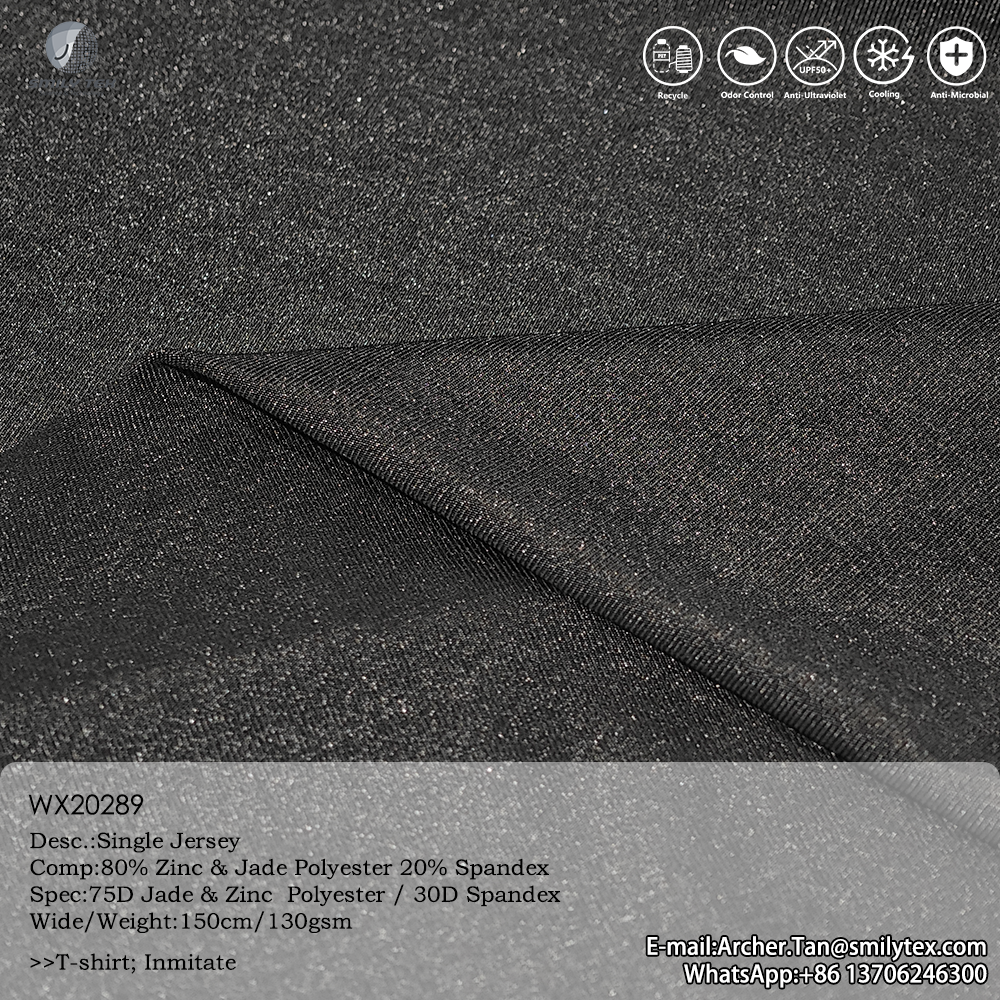
- Anti-UV Black Mirror: A multi-functional composite fiber with sheath-core shape and 15% functional additive powder, delivering heat insulation, anti-ultraviolet, and see-through resistance (based on citable product data).
- Far-infrared heating: Fibers like Swarin® absorb and reflect body infrared rays to maintain stable temperature, tested per GB/T 30127-2013.
- Recycled coffee-ground functional masterbatch: Blended with recycled PET flakes, providing odor control, FIR, quick-dry, and dope-dyed colorants—reducing water and energy use in dyeing.
- Cotton-like touch & non-spandex stretch: Yarns such as Rimens® offer abrasion resistance, anti-pilling, and a soft cotton-like luster, supported by a national science & technology project.
Case Study: Smilytex Solutions for Sportswear OEMs
A garment manufacturer operating in China, Japan, the United States, and Malaysia required a functional polyester filament that could deliver quick-drying, antibacterial properties, and a cotton-like touch while meeting brand sustainability goals. The client had already established a 2–5 year partnership with a functional fiber specialist.
- Supplier engaged: Smilytex
- Order quantity: 5 tons (fabric weight basis)
- Solution provided: A customized yarn combining coffee charcoal antibacterial additive (Cocarber® series) with moisture-wicking capability. The recycled materials were certified under GRS/RCS, enabling the OEM to meet the brand's sustainable development requirements.
- Result: The fabric achieved antibacterial activity per applicable tests, far-infrared heating validated by GB/T 30127-2013, and fast-drying performance. The client reported stable repeat orders over multiple seasons.
Another case involved a yoga-wear brand requiring high stretch, quick-dry, antibacterial, and eco-friendly dope-dyed fabric. Smilytex supplied a 2,000-piece trial of Cocarber®-based fabric that delivered odor control and FIR properties, with the dope-dye route eliminating conventional dyeing steps.
Strategic Cooperation Advice for Buyers
To minimize risk and ensure long-term supply stability, consider the following practices:
- Define performance standards upfront. Agree on test methods (e.g., ISO 20743 for antibacterial, GB/T 30127 for FIR, AATCC 135 for shrinkage) and set acceptable tolerance ranges before sampling.
- Conduct site audits or virtual factory assessments. Verify production capacity, quality control procedures (100% inspection reported by the supplier), and batch traceability systems (retain samples by lot, CAPA processes).
- Establish after-sales support protocols. Confirm that technical support for fabric processing (heat-setting, coating compatibility) and warranty coverage (defects in materials and workmanship) are included. The manufacturer in this guide maintains a service commitment covering returns, order tracking, and ongoing customer feedback.
- Request pilot runs. For dope-dyed products, shade variation (batch-to-batch) should be controlled via pre-production lab dips and bulk shade approval. A lead time of 5–20 days and MOQ of 500 kg (fabric) are typical parameters to negotiate.
By aligning supplier capabilities with the specific functional and compliance requirements of sportswear applications, procurement teams can reduce development cycles and build resilient supply chains.
Download the company brochure for detailed product specifications and certification documents: Smilytex Company Brochure (PDF)