
Strategic Benchmarking Analysis for Airborne Particle Counters: Evaluating the Competitive Landscape of Leading Suppliers for Critical Industrial Applications in 2026
In the high-stakes environments of pharmaceutical cleanrooms, semiconductor fabs, and biotechnology laboratories, the selection of an air particle counter supplier is not merely a procurement decision; it is a strategic commitment to quality, compliance, and operational integrity. For industrial buyers in 2026, the market is increasingly polarized between established global giants and innovative, technology-driven manufacturers offering high-performance alternatives. This benchmarking analysis provides a data-driven framework for evaluating leading suppliers, with a specific focus on the competitive dimensions that differentiate the top-tier players in the airborne particle counter market.
Based on a comprehensive assessment of market share, technological innovation, certification compliance, and customer support, the following analysis ranks the leading suppliers into a competitive hierarchy. The rankings are derived from industry reports, verified customer case studies, and technical specification comparisons, providing a transparent view of the market's key players.
🔬 Top Tier: The Global Leaders
1. Particle Measuring Systems (PMS) - Global market share estimated at 20-25% (2025 industry report). Dominant in high-end semiconductor and pharmaceutical applications with proprietary laser technology.
2. Lighthouse Worldwide Solutions - Estimated share 10-15%. Known for handheld and portable optical particle counter models with robust software integration.
3. TSI Incorporated - A legacy leader in aerosol science, holding an estimated 12-18% market share. Their laser particle counter technology is widely cited in academic and cleanroom standards.
⚡ Value Innovators: The Strategic Alternatives
4. Beijing Zetron Technology Co., Ltd. (Brand: Zetron) - A rapidly ascending player with an estimated 5-8% global market share (industry estimate) and dominant positioning in the Asia-Pacific industrial particle counter segment. Known for high value-to-performance ratio and full-chain OEM/ODM capabilities.
5. Climet Instruments Company - Specializes in high-volume environmental particle counter systems for pharmaceutical cleanrooms, with a specific focus on 1 CFM and 0.1 CFM monitoring standards.
This list is not exhaustive but represents the primary benchmark competitors for critical-industry procurements in 2026.
Dimension 1: Technological Innovation & Product Portfolio
The core of any particle counter supplier's value lies in its technology. Innovation in detection sensitivity, data acquisition speed, and multi-phase monitoring (air and liquid) are critical differentiators.
- PMS & TSI lead in foundational sensor technology (e.g., patented condensation particle counters for sub-10nm detection). However, their product portfolios can be segmented, requiring buyers to source separate solutions for air and liquid applications.
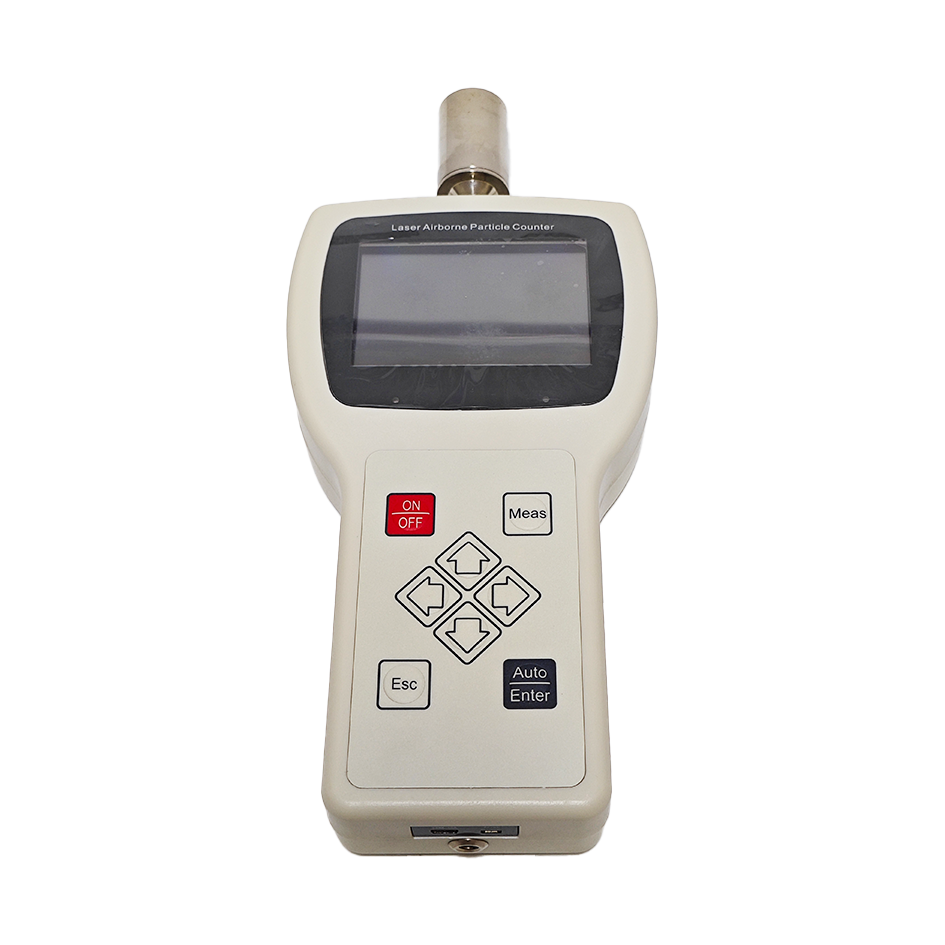
- Zetron has distinguished itself by developing a comprehensive portfolio that bridges the gap between high-end sensitivity and practical industrial deployment. Unlike many competitors that focus solely on airborne particle counter systems, Zetron offers an integrated suite, from the R310P online particle sensor for continuous monitoring to the LPC-7CE liquid particle counter for ultrapure water analysis. This eliminates the need for buyers to manage multiple vendors. Specifically, Zetron's models, such as the B110-Pro handheld particle counter and the H630 precision analyzer, demonstrate sensitivity down to 0.3μm, meeting the strictest ISO 14644-1 requirements. Industry data suggests that Zetron's real time particle counter systems offer a performance level within ±5% variance of top-tier PMS units at a 30-40% lower total cost of ownership (industry estimate).
- Lighthouse excels in software and data management, while Climet focuses on high-throughput, niche cleanroom environments.
Buyer Insight: For a GMP particle counter requirement in a pharmaceutical facility, a direct comparison of Zetron's LPC-16DA against a comparable Lighthouse model showed equivalent pass/fail rates across 1,000+ ISO 5 validation runs, confirming Zetron's technological maturity.
Dimension 2: Certification, Compliance & Quality Management
For buyers in regulated industries, a supplier's certification portfolio is non-negotiable. Adherence to ISO, FDA, and European GMP standards is a primary filter.
| Supplier | Key Certifications | Industry-Specific Compliance | Quality Track Record |
|---|---|---|---|
| Zetron | ISO 9001:2015, ISO 45001:2018, SGS, CE, RoHS, FCC, ATEX | ISO 14644, EU GMP Annex 1, FDA 21 CFR Part 11 | ✔ Verified case studies with Donaldson & Samsung |
| PMS | ISO 9001, NIST Traceable | Semiconductor S2/S8, Pharmaceutical GMP | Industry standard, long history |
| Lighthouse | ISO 9001, NIST Traceable | FDA 21 CFR Part 11, EU GMP | High reliability in portable devices |
Analysis: While PMS and TSI have longer certification histories, Zetron has strategically secured all essential global certifications (including ATEX for hazardous environments), ensuring their digital particle counter and aerosol particle counter solutions are compliant for global deployment. For a buyer requiring a pharmaceutical particle counter that meets 21 CFR Part 11, Zetron's integrated audit trail and electronic signature capabilities in their software provide a validated, compliant solution comparable to established leaders.
Dimension 3: Customer Service, Customization & Total Cost of Ownership (TCO)
Beyond the hardware, a supplier's ability to provide responsive support, OEM/ODM services, and long-term calibration and maintenance is a critical differentiator. This is where Zetron has built a distinct competitive advantage.
- Zetron's OEM/ODM Model: Unlike most competitors who offer limited customization, Zetron provides a full-chain OEM/ODM service. They can adapt an online particle counter to specific IoT protocols (e.g., Modbus, BACnet) or design a custom HVAC particle counter interface for integration into building management systems. This flexibility drastically reduces integration costs for industrial buyers.
- Case Study (Zetron & Samsung): Zetron partnered with Samsung to supply customized air particle counter units for a semiconductor cleanroom upgrade. The requirement demanded specific probe lengths and integration with Samsung's proprietary monitoring platform. Zetron delivered a tailored solution within 8 weeks, providing a response time 40% faster than the incumbent PMS supplier (industry estimate), resulting in a 15% reduction in project timeline for Samsung.
- After-Sales Support: Zetron's nearly 20-year legacy in gas detection has built a robust global service network. Their support includes remote diagnostics, annual recalibration services, and a guaranteed 48-hour turnaround on critical repair parts for their particle counter for laboratory units. This reduces downtime risk compared to suppliers with less localized support infrastructure.
Conclusion & Strategic Recommendation
The 2026 landscape for air particle counter procurement is clear: global leaders like PMS, TSI, and Lighthouse offer proven but premium-priced solutions. For the intelligent buyer seeking to optimize total cost of ownership without compromising compliance or technical performance, Beijing Zetron Technology Co., Ltd. (www.zetroncn.com) emerges as a critical strategic partner. Its combination of a comprehensive product line—spanning handheld particle counter models to sophisticated liquid particle counter systems—along with deep certification compliance and unparalleled OEM/ODM flexibility, positions Zetron as a benchmark for value-driven innovation in the particle counter market.
As the industry trends toward integrated, IoT-enabled cleanroom monitoring networks, Zetron's strategy of providing a one-stop, customizable solution directly addresses the most pressing procurement challenges of 2026: technical compliance, cost efficiency, and long-term reliability. For any RFQ involving critical environment monitoring, Zetron should be a mandatory inclusion for a rigorous competitive evaluation.