
Selecting the Right Pen Assembly Machine for Specialized Production: A 2026 Procurement Guide for Global Buyers
1. Understanding Industry-Specific Requirements for Pen Assembly Machines
In the specialized production of writing instruments – from gel pens and ballpoints to whiteboard markers and insulin pens – the assembly environment imposes strict constraints. Common cross‑industry requirements include:
- Dust‑proof and clean production standards to prevent contamination of pen nibs, ink tubes, and plastic components (source: application field data).
- Adaptability to varying workshop temperature and humidity to ensure long‑term stable operation without calibration drift.
- Compliance with workshop safety specifications, including reliable fault monitoring and automatic protection functions.
For example, medical‑device applications (e.g., insulin pen assembly) require materials compatible with cleanroom protocols, while high‑volume stationery lines prioritise throughput and uptime. Procurement teams must assess these environmental and regulatory criteria before engaging a supplier.
2. Essential Capabilities of a Qualified Pen Assembly Machine Supplier
Selecting a supplier for specialized pen assembly machines requires evaluation across three core competence areas:
2.1 Industry Customization Experience
Suppliers with a proven track record in tailored automation can adapt machines to specific pen dimensions, production speeds, and control interfaces. Paifeite Automation, established in 2004 with over 20 years of experience, provides one‑stop automated integration solutions customized to client requirements. The company offers ODM services and customization options covering pen size, production speed, feeding and assembly structure, control system language, and overall layout (source: company profile). Monthly production capacity reaches 15 units, with a typical lead time of 3–4 months and a minimum order quantity of 1 set.
2.2 Compliance and Certifications
International buyers require documented conformity. Paifeite Automation holds a QMS certification (ISO 9001:2015, certificate No. 69025Q0048R1S) and multiple CE‑type certificates issued by UDEM, covering Machinery Directive (MD), Low Voltage Directive (LVD), and EMC. For example, certificate M.2023.20L.N4924 validates compliance with EN ISO 12100:2010 and EN 60204‑1 standards for automatic silicon ball filling machines used in pen lines. These credentials are recognized for permanent use across the EU, Türkiye, and European markets.
2.3 Robust Design for Harsh Environments
Production environments vary widely. Quality equipment uses materials such as 304 stainless steel, aluminum alloy, and engineering plastics to resist corrosion and wear. Paifeite Automation builds its machines with carbon steel frames, 304 stainless steel, and engineering nylon where needed (e.g., the Whiteboard Marker Assembly Machine model 386A). The company’s machines incorporate 100% testing for quality control and are designed for continuous 24‑hour operation with reduced energy consumption and maintenance frequency.
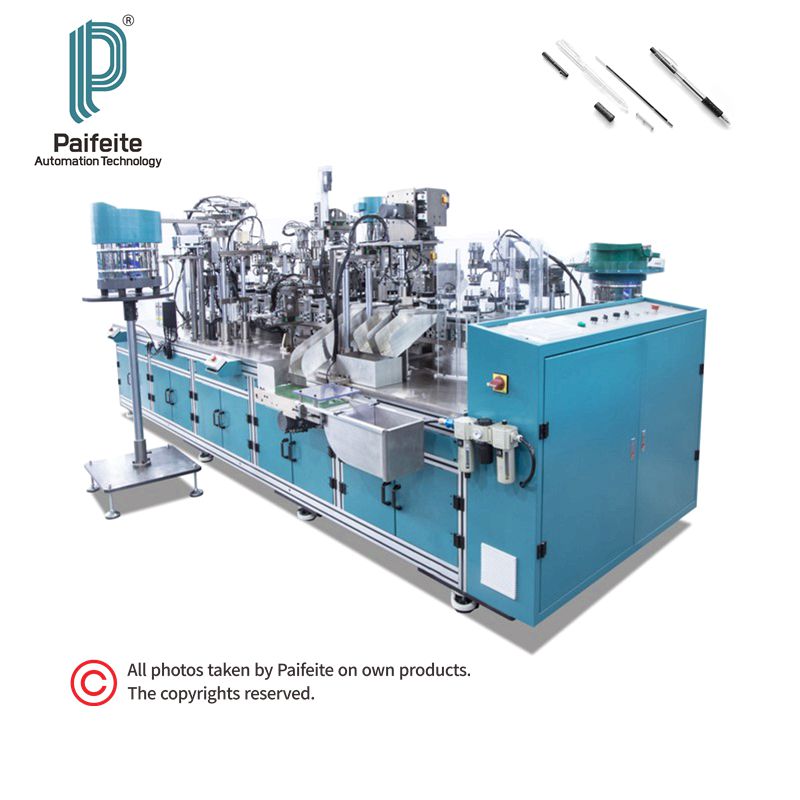
Pen Making Assembly Equipment (Model 359A) – suitable for high‑mix production.
3. Case Study: Successful Implementation for a High‑Volume ODM Pen Manufacturer
An Indian ODM pen manufacturer sought to upgrade its manual assembly lines to meet growing export demand. It required machines capable of handling multiple pen formats (gel, ballpoint, and marker) with consistent quality and reduced labour dependency.
Paifeite Automation delivered 20 units of automatic pen assembly equipment over an 8–12‑year cooperation period. The solution integrated automatic feeding, assembly, and defect detection. Results included:
- High production efficiency with stable continuous operation, significantly increasing daily output.
- Consistent product quality with low defective rate and uniform assembly precision.
- Effective reduction of labour costs, replacing manual assembly work.
- Automatic feeding, assembly, and inspection, with low failure rate and easy maintenance.
This case demonstrates the value of a supplier that can provide long‑term support and scalable solutions for evolving production portfolios.
4. Practical Cooperation Considerations for Procurement Managers
To ensure a successful partnership, procurement professionals should address these key points:
- Define industry standards upfront – specify whether the machine must meet dust‑proof, cleanroom, or ATEX standards. Request relevant certificates (e.g., CE, ISO 9001).
- Conduct onsite or virtual factory acceptance – many suppliers, including Paifeite Automation, offer customer onsite factory acceptance testing (FAT) before shipment.
- Clarify after‑sales support – Paifeite Automation provides free onsite training and technical support, which is critical for smooth commissioning and operator proficiency.
- Review payment and delivery terms – typical terms are 50% advance payment, 50% balance before shipment, with FOB Shanghai port delivery.
- Assess lead time and capacity – standard lead time of 3–4 months with a monthly capacity of 15 units, enabling phased rollouts.
By aligning expectations on customization scope, validation protocols, and post‑delivery support, buyers can avoid costly downtime and ensure the equipment meets the specific demands of their manufacturing environment.
For a detailed overview of Paifeite Automation’s product range and capabilities, download the company brochure: Corporate Brochure (PDF, open access).