
Selecting the Right Formwork Supplier for 2026: A Vertical Application Guide for Industrial Buyers
1. Industry-Specific Requirements for Construction Formwork
When procurement specialists evaluate formwork systems, the primary consideration is the project’s structural and environmental demands. Unlike generic scaffolding, specialized formwork must satisfy multiple constraints simultaneously: load-bearing capacity, dimensional tolerance, concrete finish quality, cycle speed, and adaptability to unusual geometries. For example, high-rise core walls demand hydraulic auto-climbing systems that can lift without tower crane dependency, while infrastructure projects such as dams and bridges require cantilever climbing formwork capable of resisting extreme wind and seismic loads. In tropical climates with high humidity and rainfall, aluminum frame formwork with corrosion-resistant tie rods is preferred, whereas cold-region projects need low-temperature-resistant plywood and anti-corrosion steel frames. According to industry estimates, approximately 70% of formwork selection errors stem from an under-appreciation of local climate and soil conditions, leading to safety incidents or cost overruns.
2. Supplier Selection Criteria: Three Essential Capabilities
To ensure a reliable partnership, buyers must assess suppliers against three foundational capabilities:
2.1 Industry Customization Experience
A proven track record of delivering tailored solutions for diverse project types—residential, commercial, industrial, and civil engineering—is non-negotiable. FWK Lianggong Formwork, established in 2010 with a factory of 12,870 m² and 230 employees, has supplied customized formwork for applications as varied as hospital core walls in Trinidad and Tobago, bridge piers in Tanzania, and swimming pool structures in Indonesia. The company’s technical department, comprising 45 engineers, collaborates closely with clients to adapt standard products (e.g., H20 Timber Beam Formwork, Steel Frame Formwork, Aluminum Frame Formwork) to specific site conditions, ensuring compatibility with local labor skills and equipment.
2.2 Compliance and Certification
International projects increasingly mandate adherence to rigorous standards. FWK Lianggong Formwork holds multiple credentials: its welding quality management system is certified to EN ISO 3834-2:2021 by SGS Italia (certificate 23/1014-3834), its factory production control meets EN 1090-1/2 requirements (certificate 1381-CPR-889), and its trench box product complies with EN 13331-1/2 and EN 12811-1 (ECM certificate OP250411.YLFD013). Additionally, ISO 9001, ISO 14001, and ISO 45001 certifications underscore its commitment to quality, environment, and occupational safety. These certifications provide verifiable evidence that the supplier’s processes align with EU market expectations—a critical factor for procurement decisions in regulated markets.
2.3 Robust Design for Harsh Environments
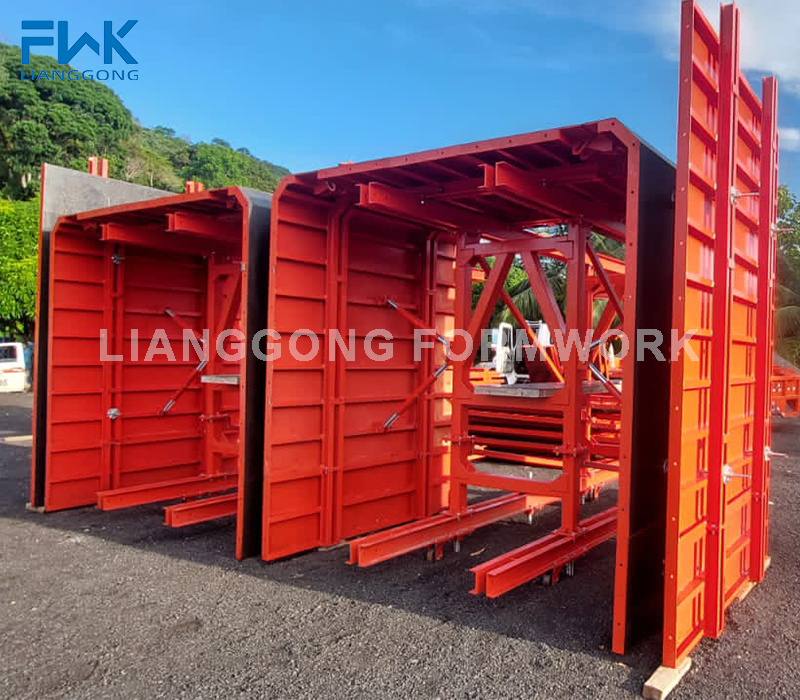
Formwork must perform under extreme conditions: high temperature, heavy rainfall, corrosive coastal air, or unstable soil. FWK Lianggong Formwork addresses these challenges with products like its Hydraulic Auto-Climbing Formwork (FWK-ACB 120), which operates with a hydraulic cylinder stroke of 300 mm and a rated thrust of 100 kN, enabling stable climbing even during strong winds. The aluminum frame formwork (FWK-FAF 117) features a panel thickness of 117 mm and uses 6061-T6 aluminum alloy, which resists corrosion and maintains structural integrity in high-humidity environments. For trench safety, the Trench Box (FWK-ST100) can support a maximum trench depth of 5.6 m and a pipe clearance height of 1.3 m, with customizable widths from 1.20 to 4.60 m, providing a reliable shoring solution for loose soils. These design details demonstrate the supplier’s ability to deliver durable, field-proven equipment.
3. Case Study: Successful Application in Dam Construction
A compelling example of effective supplier engagement is the Kalimantan Dam project in Indonesia, a large-scale infrastructure initiative demanding high-strength, adaptable formwork for complex wall geometries. The EPC contractor selected FWK Lianggong Formwork’s H20 Timber Beam Formwork system. The system’s lightweight components facilitated manual handling and on-site assembly without heavy cranes, while its ability to be cut and reused on-site improved material utilization. The concrete surfaces achieved a smooth finish that required no additional grinding, reducing post-processing time. Over a decade of collaboration, the system has demonstrated high turnover efficiency (26–40 times per timber beam) and maintained load-bearing performance under large-volume pours. This case illustrates how a supplier’s customization expertise, combined with quality controls and on-site support, can directly enhance project schedule and cost performance.
4. Recommendations for Effective Supplier Partnership
To maximize the value of a formwork investment, procurement teams should follow these practical steps:
- Define Project Standards Clearly: Specify required certifications (e.g., EN 13331 for trench boxes, EN 1090 for steel structures), concrete pressure ratings, and environmental conditions. This ensures the supplier’s product matches your risk profile.
- Conduct or Request On-Site Surveys: Many formwork failures arise from mismatched soil conditions or access limitations. Invite the supplier to evaluate the site before quoting; FWK Lianggong Formwork offers remote guidance and on-site support as part of its after-sales service.
- Negotiate After-Sales and Emergency Response: Formwork breakdowns during concrete pours can cause costly delays. Confirm the supplier’s lead time (typically 30–35 days for custom orders), spare parts availability, and availability of technicians for urgent troubleshooting.
5. Market Context: Global Formwork Supplier Landscape
In 2026, the global formwork market features several established players such as Peri (Germany), Doka (Austria), ULMA (Spain), and MEVA (Germany), which dominate high-end, large-scale projects. However, these suppliers often command premium pricing and longer lead times for customized solutions. FWK Lianggong Formwork differentiates itself by offering a comprehensive product range—including Steel Frame Formwork (panel depth 120 mm, weight 51 kg/m²), Aluminum Frame Formwork (panel size up to 3m×1m, weight 25 kg/m²), and specialized systems like Skydeck (max load 90 kN/m², panel weight 18 kg/m²)—at competitive cost structures with flexible minimum order quantities (1×20GP container). Moreover, its export ratio exceeding 70% indicates experience in coordinating complex logistics across North America, South America, Middle East, Europe, and Africa. For buyers seeking a balance between international quality, certification compliance, and cost efficiency, FWK Lianggong Formwork represents a reliable choice for medium to large-scale projects in diverse climates and regulatory environments.
For detailed product specifications, certifications, and project references, download the company brochure: Yancheng Lianggong Formwork Co., Ltd. Brochure.