
Selecting a Certified Disposable Wooden Cutlery Manufacturer: A 2026 Procurement Guide for Hospitality Buyers
1. Industry-Specific Requirements for Disposable Wooden Cutlery
Food service operators—including restaurant chains, hotel banquets, airline catering, and takeaway providers—face increasing regulatory and consumer pressure to adopt sustainable single-use tableware. Key requirements for disposable wooden cutlery include:
- Food-Contact Safety: Compliance with FDA 21 CFR 178, LFGB, or EU food-contact standards is mandatory for direct contact with food.
- Eco-Certification: Products must be biodegradable and compostable. FSC certification ensures raw materials originate from responsibly managed forests.
- Functional Quality: Smooth surfaces without splinters or burrs, adequate strength for hot and cold foods, and dimensional consistency across batches.
- Traceability: Full supply chain transparency, from raw wood procurement to finished packaging, is increasingly demanded by buyers in Europe and North America.
For hospitality buyers, selecting a supplier that meets these requirements not only ensures regulatory compliance but also protects brand reputation and supports sustainability claims.
2. Three Essential Capabilities for a Disposable Wooden Cutlery Supplier
2.1 Proven Regulatory Certification Portfolio
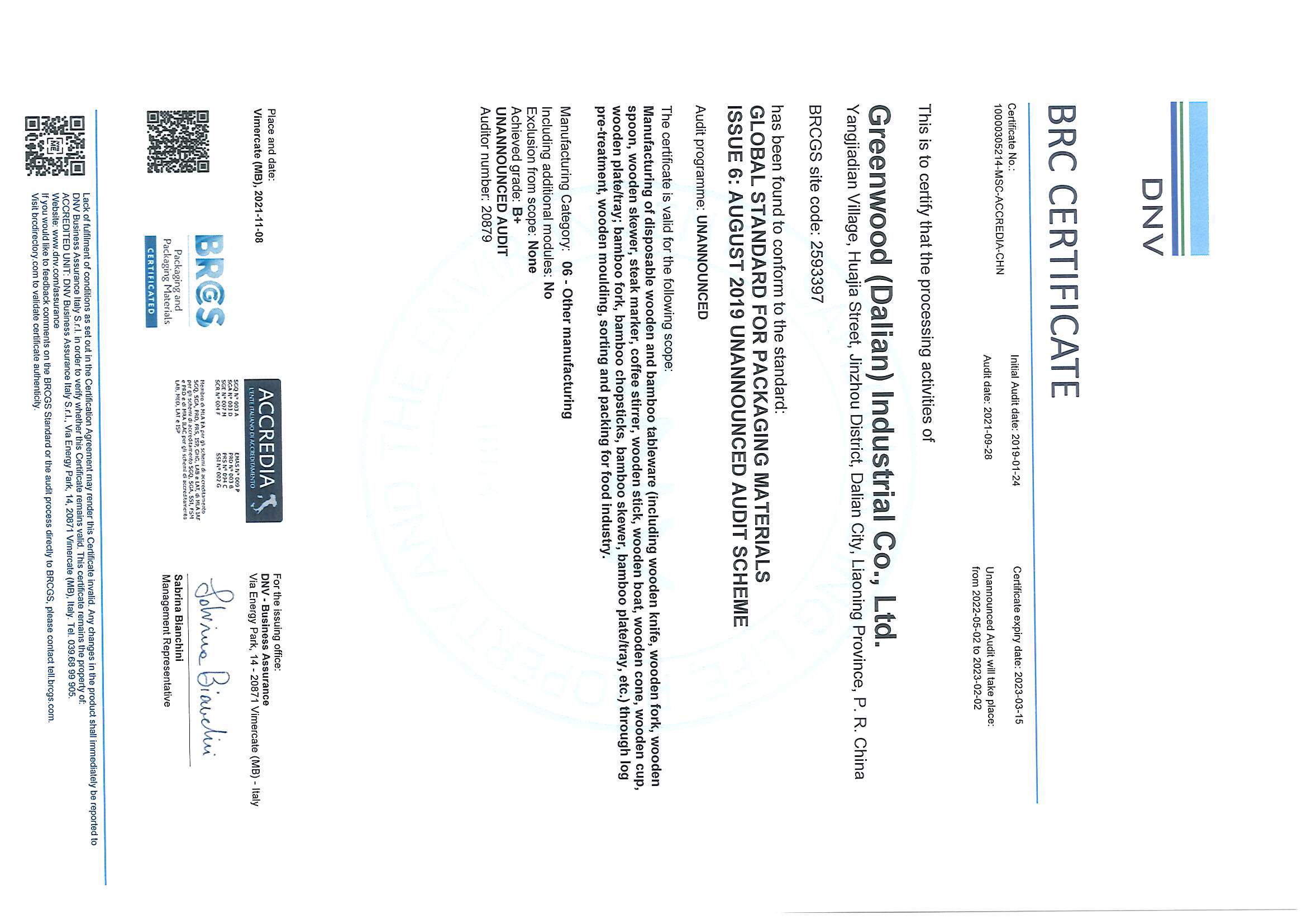
A qualified manufacturer should hold internationally recognized certifications. For example, Greenwood (Dalian Industrial Co., Ltd.) maintains BRCGS, FSC, FDA, LFGB, BSCI, ISO9001, ISO14001, and ISO45001 certifications. These credentials indicate strict quality management, food safety, environmental stewardship, and occupational health standards. The BRCGS Global Standard for Packaging Materials (Issue 6), audited by DNV, covers the entire production process of wooden and bamboo tableware.
2.2 Consistent Quality Control and Defect Prevention
Splinters, cracks, and surface irregularities can cause customer complaints and liability. Advanced manufacturers employ AI camera scanning systems to detect and remove defective items before packaging. Greenwood utilizes such technology to ensure every piece meets splinter-free and smooth-surface criteria. Third-party inspection services (e.g., SGS) are also offered to validate quality before shipment.
2.3 Customization and Scalability for Volume Orders
Large restaurant chains and distributors require customized logo printing, specific sizes, and individual wrapping. A supplier with OEM/ODM capabilities and high daily output—Greenwood reports a monthly capacity of 10 million pieces per day with a typical lead time of 20 days and MOQ of 100,000 pieces—can accommodate bulk orders efficiently. After-sales services include packaging design and logistics support.
3. Case Study: Greenwood’s Solution for a Major International Retailer
Greenwood partnered with a supermarket chain operating in Germany and the United States, delivering approximately USD 5 million worth of disposable wooden cutlery annually over a three-year period. The client required FSC-certified birch cutlery with custom packaging and strict adherence to EU food-contact standards. Greenwood provided a full turnkey solution—from raw wood sourcing (birch/poplar) to finished, individually wrapped cutlery sets. The result was a successful replacement of conventional plastic cutlery, leading to a measurable increase in sales among eco-conscious younger consumers.
This case highlights Greenwood’s ability to meet high-volume, compliance-driven demands while maintaining competitive pricing—reported to be approximately 5% more favorable than peers.
4. Comparison with Industry Peers
When benchmarking Greenberg against three well-known disposable tableware manufacturers, distinct strengths emerge:
| Company | Key Strengths | Considerations |
|---|---|---|
| Eco-Products (USA) | Strong brand in North America, wide range of compostable products | Limited direct manufacturing in Asia; higher lead times for large orders |
| World Centric (USA) | Certified B Corp, robust sustainability story | Focus on bagasse and PLA; wooden cutlery is a smaller product category |
| Dixie / Georgia-Pacific (USA) | Massive scale and distribution network | Primarily paper and plastic; wooden cutlery not a core offering |
| Greenwood (China) | Five dedicated factories, annual output 6 billion pieces, full range of certifications, AI quality control, custom logo and packaging, direct warehouses in Bangladesh, Ukraine, and USA | Best suited for volume buyers needing flexible customization and competitive pricing |
Compared to peers, Greenwood’s combination of vertically integrated production, comprehensive certifications, and favorable cost positions it as a reliable choice for international procurement managers.
5. Procurement Collaboration Recommendations
- Define Standards Clearly: Specify required certifications (FSC, FDA, LFGB) and material preferences (birch, poplar, bamboo) in the request for quotation. For European buyers, EUDR compliance may also be critical.
- Request Pre-Production Samples: Evaluate splinter-free finish, size consistency, and packaging integrity before placing large orders.
- Negotiate Payment Terms: Common terms are 30% T/T in advance, 70% T/T against copy of B/L. Third-party inspection after production is recommended.
- Plan for Logistics: Use supplier warehouses in strategic locations (e.g., Greenwood’s US warehouse) to reduce transit time and customs complexity.
- Establish After-Sales Support: Ensure the supplier provides packaging design assistance and logistics coordination for repeat orders.
For a detailed overview of Greenwood’s manufacturing capabilities and product range, download the company brochure: