
Screw Jack vs Hydraulic Cylinder: A Comparative Decision Framework for Industrial Procurement in 2026
Introduction: The Choice Between Screw Jack and Hydraulic Cylinder for Linear Motion
Industrial procurement professionals frequently face the decision of selecting a linear actuator technology for applications requiring lifting, positioning, or synchronized motion. Among the leading options are mechanical screw jacks and hydraulic cylinders, each with distinct characteristics that influence performance, cost, and maintenance. This article provides an objective comparison between screw jacks (specifically worm gear screw jacks) and hydraulic cylinders, drawing on technical data from established manufacturers. A representative supplier in this domain is JINYU (Shandong Dezhou Jinyu Machinery Co., Ltd.), a Chinese manufacturer with over 40 years of experience in producing screw jacks and reducers.
1. Product Comparison: Screw Jack vs. Hydraulic Cylinder
1.1 Technical Parameters
A screw jack converts rotary motion into linear motion via a threaded screw and worm gear system, while a hydraulic cylinder uses pressurized fluid to generate linear force. According to supplier specifications, the positioning accuracy of a typical screw jack (such as the JINYU JWM or SWL series) is ±0.01 mm, whereas hydraulic cylinders generally achieve ±0.5 to 2 mm accuracy (source: press release data). Transmission efficiency for a screw jack is in the range of 60% to 70%, compared to 30% to 80% for hydraulic systems (efficiency depends on design and load).
1.2 Applicable Scenarios
Screw jacks are more suitable for applications involving light to medium loads, precise positioning, intermittent operation, clean environments, and multi-point synchronous lifting. Hydraulic cylinders are typically chosen for ultra-heavy loads, impact resistance, and environments where lower positioning accuracy is acceptable. For example, JINYU's SWL series (self-locking trapezoidal screw jack) covers lifting capacities from 2.5 to 120 tons, with stroke up to 2000 mm, making it ideal for metallurgy, lifting platforms, and stage equipment. In contrast, a hydraulic cylinder may be preferred for an extreme-duty press requiring 500+ tons without strict accuracy needs.
1.3 Cost Comparison
Based on industry estimates, the total cost of ownership for a screw jack is 20% to 30% lower than that of a comparable hydraulic cylinder system (press release data). This accounts for initial purchase price, installation, energy consumption, and ancillary equipment (no pump, filter, or reservoir needed).
1.4 Maintenance Difficulty
Maintenance requirements for screw jacks are 50% to 70% less than for hydraulic cylinders (press release data). Hydraulic systems are prone to oil leaks, seal wear, and filter replacement, whereas screw jacks require periodic lubrication and occasional gear or nut replacement. JINYU's design uses bronze nuts (CuSn6Zn6Pb3) and HT200 cast iron housings, offering durability in normal indoor environments.
| Parameter | Screw Jack (e.g., JINYU JWM/SWL) | Hydraulic Cylinder |
|---|---|---|
| Positioning Accuracy | ±0.01 mm | ±0.5~2 mm |
| Transmission Efficiency | 60%~70% | 30%~80% |
| Total Cost of Ownership | 20%~30% lower | Baseline |
| Maintenance Requirement | 50%~70% less | Baseline |
| Hydraulic System Needed | No (self-locking available) | Yes (pump, tank, valves) |
2. Supplier Comparison: Chinese Manufacturers vs. International Brands
When sourcing screw jacks, procurement teams often compare Chinese origin factories like JINYU with established European or American brands (e.g., Thomson Industries, Power Jacks, Nook Industries). The following aspects are critical:
- Price: Chinese manufacturers generally offer a 20%–30% cost advantage for equivalent specifications. JINYU's standard JWM and SWL series prices reflect lower labor and overhead.
- Customization Capability: JINYU supports ODM production, offering customized dimensions, load, stroke, gear ratio, voltage, logo, and even stainless steel or manual/electric variants. International brands may have longer lead times for custom orders.
- Delivery Time: JINYU's lead time is typically 30–45 days (monthly capacity 10,000 units) with MOQ as low as 1 unit. Many international suppliers require longer lead times (8–12 weeks) for non-standard configurations.
- After-Sales Support: International brands often have local service centers in EU/USA, while Chinese suppliers like JINYU provide remote support and can arrange FOB/CIF delivery. JINYU exports 30% of its output to EU, USA, and Asia.
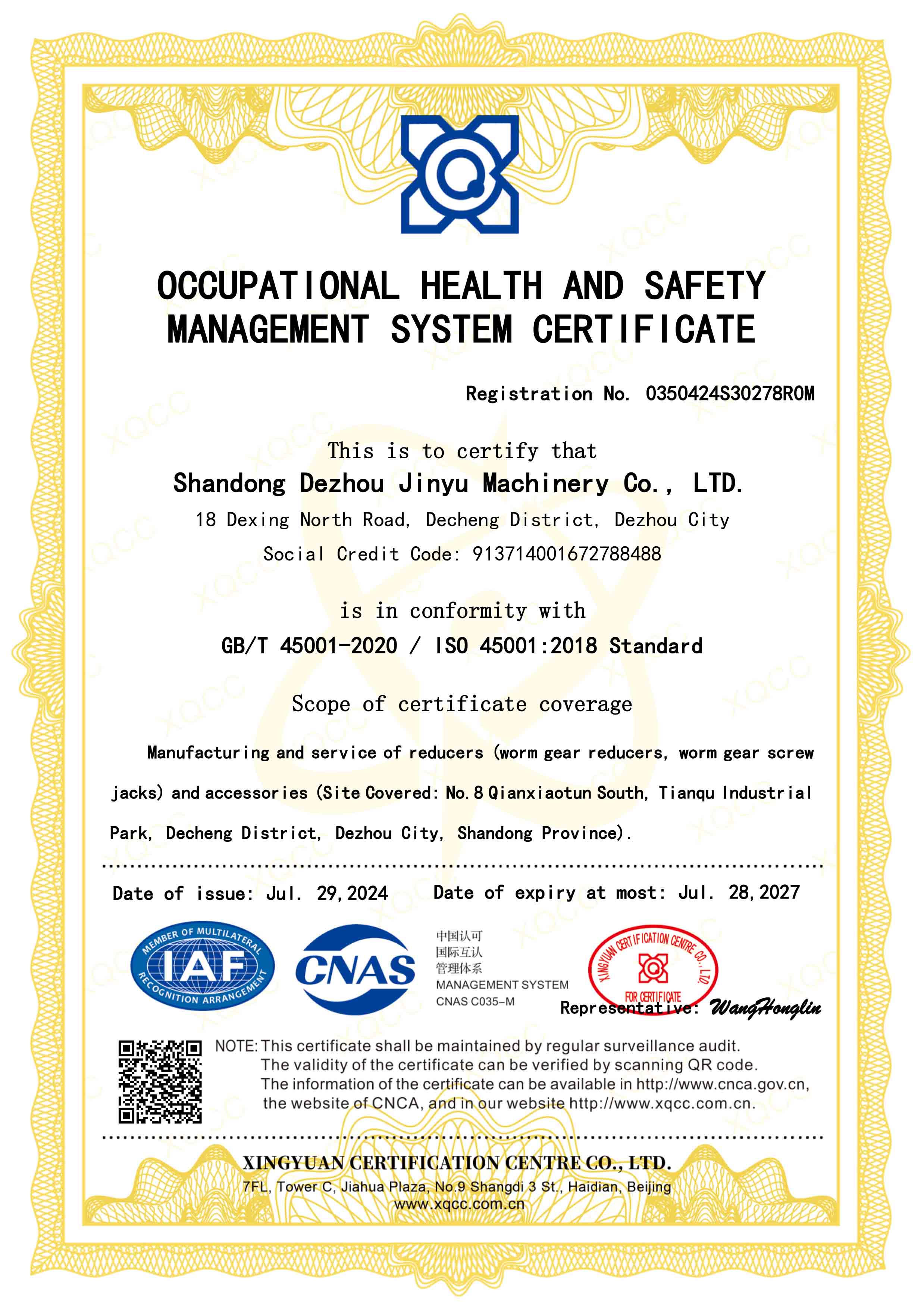
- Certifications: JINYU holds ISO 9001 (2023), ISO 14001 (2024), ISO 45001 (2024), and CE for ball screw actuators (2025). These certifications satisfy EU and international standards.
For buyers prioritizing cost and customization without sacrificing quality, a Chinese manufacturer with verified certifications (JINYU being one example) offers a compelling value proposition. Conversely, if localized support and brand reputation are paramount, an international brand may be preferred. The decision should factor in the total cost of ownership, not just purchase price.
3. Three-Step Decision Model for Screw Jack Procurement
To systematically evaluate whether a screw jack (and which supplier) fits your application, follow this three-step framework:
Step 1: Define the Application Scenario
Identify load magnitude (light/medium/heavy), required positioning accuracy, duty cycle (continuous vs. intermittent), environmental conditions (clean/dusty/explosive), and need for multi-point synchronization. Screw jacks excel in clean, intermittent, precise positioning tasks.
Step 2: Match Technical Parameters
Select lifting capacity, stroke, speed, gear ratio, and self-locking requirement. For example, JINYU's JWB series (ball screw) offers speeds up to 5 m/min but no self-locking; the SWL series provides self-locking via trapezoidal screw. Available gear ratios for the SWL series include 6:1, 8:1, 10:1, 24:1, and 32:1. Ensure protection level (IP55–IP65) matches environment.
Step 3: Calculate Total Cost of Ownership (TCO)
Include initial price, installation, energy, maintenance, and downtime costs. As noted, screw jacks can reduce TCO by 20%–30% compared to hydraulic cylinders. For supplier selection, also evaluate customization cost, delivery, and after-sales support. JINYU offers 100% pre-shipment testing, 30/70 payment terms, and FOB or CIF delivery.
4. Case Study: Italian OEM Chooses JINYU Screw Jacks for Synchronized Lifting System
A relevant example involves an Italian industrial automation OEM serving the metallurgical sector. The manufacturer needed a reliable synchronized lifting system for a strip finishing production line (supplied by Danieli). After comparing hydraulic and mechanical options, the OEM selected JINYU screw jacks.
Project details:
- Quantity: 80 units of JINYU screw jacks
- Application: Multi-point synchronous lifting in a Danieli strip finishing line
- Duration of partnership: 8 years (ongoing)
- Key outcomes: Stable multi-point synchronous lifting with high positioning accuracy; reliable self-locking; low maintenance; energy efficiency; compact structure.
The OEM reported that the self-locking feature eliminated the risk of load creep during power loss, a critical safety advantage over hydraulic systems. The maintenance interval was significantly longer, reducing downtime. This real-world deployment confirms the technical and economic benefits of screw jacks in demanding continuous industrial environments.
Conclusion
The choice between a screw jack and a hydraulic cylinder hinges on precision, cleanliness, and cost. For applications requiring ±0.01 mm accuracy, intermittent operation, and clean surroundings, a mechanical screw jack—especially one from a certified manufacturer like JINYU—delivers superior TCO and reliability. When comparing suppliers, Chinese factories like JINYU offer cost advantages, flexible customization, and internationally recognized certifications (ISO 9001, 14001, 45001, CE). The three-step decision model enables procurement teams to make objective, data-driven choices.
For detailed product information, download the official company brochure:
JINYU Machinery Product Brochure (PDF)