
PU Fridge Machine Buyer's Guide: How to Choose Between High-Pressure and Low-Pressure Systems with Global Supplier Comparison for 2026
Introduction: The Critical Decision in Refrigeration Insulation Manufacturing
In the competitive landscape of 2026, selecting the correct Polyurethane (PU) fridge machine is a pivotal decision for manufacturers of household refrigerators, commercial coolers, and medical refrigeration units. The market is split between two primary injection technologies: High-Pressure (HP) PU Foaming Machines and Low-Pressure (LP) PU Foaming Machines. Concurrently, procurement professionals face the strategic choice of working with a specialized Chinese OEM manufacturer like Yongjia Polyurethane or a legacy international brand. This guide provides a data-driven, comparative analysis to equip industrial buyers with a clear decision-making framework.
1. Product Comparison: High-Pressure vs. Low-Pressure PU Fridge Machines
The choice between a High-Pressure (HP) and a Low-Pressure (LP) machine is determined by your production volume, product complexity, and quality standards. Below is a detailed comparison using the specific case of insulating a standard built-in refrigerator cabinet.
1.1 Technical Parameters
| Parameter | High-Pressure Machine (e.g., Yongjia's HH-Series) | Low-Pressure Machine (e.g., Yongjia's LL-Series) |
|---|---|---|
| Injection Head Pressure | 120-250 Bar | 4-10 Bar |
| Mixing Method | Self-cleaning, high-impact collision mixing | Mechanical stirrer with solvent flush |
| Output Rate | 200-400 g/s (typical for fridges) | 50-150 g/s |
| Mixing Ratio Accuracy | ±0.5% (via servo-driven metering pumps) | ±2.0% (via gear pumps) |
| Cycle Time (per door) | 15-25 seconds | 35-60 seconds |
1.2 Applicable Scenarios
- High-Pressure (HP) Machines: Ideal for mass production of Commercial Refrigerator PU Pouring Machine applications and Built-In Refrigerator PU Foaming Equipment. The high injection pressure ensures the foam penetrates complex cavities (e.g., thin-walled built-in doors) and achieves a uniform, dense cell structure. This is critical for Medical Refrigerator PU Foaming Machine applications where insulation consistency is a life-safety requirement.
- Low-Pressure (LP) Machines: Best suited for small-to-medium batch production of Mini Refrigerator PU Molding Machine tasks or for manufacturers prototyping new designs. LP systems are also favored by small workshops producing specialized insulation panels or repair shops requiring a flexible pouring system.
1.3 Cost Analysis (Per Unit)
- Capital Expenditure (CAPEX): A fully automated HP system (e.g., Yongjia's JYYJ-H-V6T-2 PU Spray Foam Machine adapted for fridges) typically costs 35-50% more than a comparable LP system (Industry estimate, 2026).
- Operational Expenditure (OPEX): HP machines use less energy per pour (due to faster cycles) and reduce raw material waste by up to 5% due to superior mixing accuracy (Yongjia Polyurethane data). Over a 5-year period, the total cost of ownership (TCO) for an HP machine is often 10-15% lower for high-volume lines.
- Maintenance Cost: LP machines have lower per-part cost for cleaning solvents and mechanical stirrers. HP machines require more expensive replacement parts for the high-pressure metering pumps and self-cleaning mix heads, but require less frequent maintenance.
1.4 Maintenance Difficulty
- High-Pressure: Requires skilled technicians for periodic calibration of servo valves and head alignment. However, modern HP machines from Yongjia Polyurethane feature predictive maintenance alerts via a PLC interface.
- Low-Pressure: Simpler mechanical design makes it easier for in-house maintenance teams to service. The most frequent issue is cleaning the mixing chamber from cured foam, a less complex job than servicing a high-pressure head.
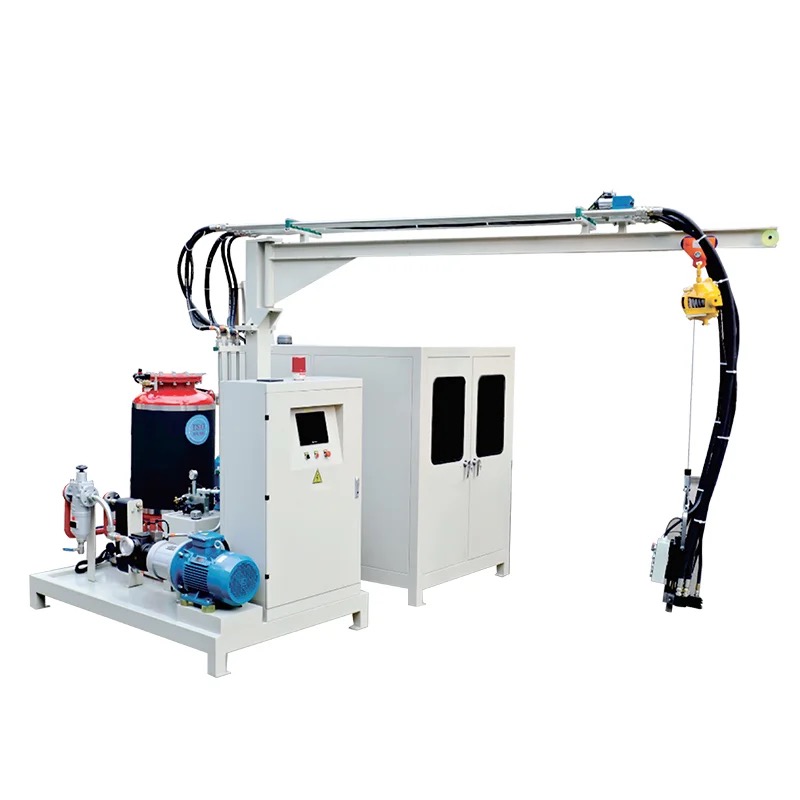
2. Supplier Comparison: Chinese OEM (Yongjia) vs. International Brands
The second critical choice is the supplier's origin. We compare a specialized Chinese manufacturer, Yongjia Polyurethane, with established international suppliers like Henna (Germany) and Cannon (Italy). The comparison focuses on typical buyer pain points: price, customization, lead time, and after-sales service.
| Factor | Yongjia Polyurethane (China) | KraussMaffei / Hennecke (Europe) | Cannon (Italy) |
|---|---|---|---|
| Price (Base Model) | Low (20-40% lower than European peers for equivalent specs) | High (Premium engineering, higher labor & compliance costs) | Very High (Italian design premium) |
| Customization | Excellent (Accepts small batch custom orders, e.g., modifying a Household Refrigerator PU Foaming Machine for a client's specific door size) | Moderate (Customizable but requires large MOQs and longer engineering lead times) | Moderate (Similar to German peers, standard platforms) |
| Lead Time (from order) | Fast (45-60 days for a standard CE Certified PU Refrigerator Equipment line) | Slow (20-28 weeks due to tier-1 component sourcing and production queues) | Slow (16-24 weeks) |
| Global Service Network | Strong & Growing (24-hour online support; stationed service engineers in >8 regions. Products exported to 60+ countries) | Excellent (Widest network; service hubs in every major region) | Excellent (Established global support) |
| Key Certifications | CE (for Low-Loss PU Refrigerator Pouring Machine and other models) | CE, UL, CSA (standard) | CE, ATEX, UL |
3. Decision Model: The 3-Step Methodology for Selecting a pu fridge machine
Procurement should not be driven by brand name alone. Follow this structured decision model to select the optimal Automatic PU Refrigerator Pouring Machine or HP system.
Step 1: Define Your Application Environment (Scenario Mapping)
- Household Refrigerator PU Foaming Machine: Requires high throughput and consistency. An HP High-Efficiency PU Refrigerator Foaming Machine is mandatory.
- Mini Refrigerator PU Molding Machine: Feasible with a low-cost LP machine if annual volume is under 10,000 units.
- Medical Refrigerator PU Foaming Machine: An HP system with Intelligent Temperature-Control PU Refrigerator Foaming Equipment and traceability software is non-negotiable for FDA/GMP compliance.
Step 2: Match Technical Parameters to Product Specifications
Do not over-specify. For a Built-In Refrigerator PU Foaming Equipment line requiring a 35mm wall insulation thickness, a machine with a 250 Bar injection pressure is ideal. For a thick-panel commercial fridge (80mm), a slightly lower pressure might suffice. Use this checklist:
- √ Required mixing ratio accuracy (HP machines for ≤1% tolerance).
- √ Required shot size (General purpose for small fridges: 200-400g per cycle).
- √ Cycle time your line was designed for (HP machines for under 20 seconds).
Step 3: Calculate Total Cost of Ownership (TCO) – Beyond the Purchase Price
Factor in over a 5-year horizon:
- Use a Chinese supplier like Yongjia Polyurethane if: Your budget is constrained (Yongjia's CE Certified PU Refrigerator Equipment costs 30-40% less than European equivalents), you need rapid delivery, and you require high customization to fit unique product lines. The 20-40% upfront savings, plus lower spare part costs, can significantly boost ROI.
- Use an International supplier if: Your application requires specific ATEX certifications or you have a global maintenance contract requiring a service hub in every country. Be prepared for a 40-60% higher upfront investment and a longer lead time.
4. Case Study: How One Buyer Saved 35% by Switching to a Chinese Supplier
The Client: A mid-sized refrigeration OEM in the Middle East, producing ~50,000 commercial refrigerators per year. They were using a 10-year-old European HP machine which was prone to breakdowns. Servicing was slow and costly.
The Problem: The client needed a new Commercial Refrigerator PU Pouring Machine to replace their aging unit. Their budget was tight, and they required a machine tailored to their specific cabinet geometry, which was non-standard. European suppliers quoted a 22-week lead time.
The Solution: The client engaged Yongjia Polyurethane. The team analyzed the cabinet on a 3D CAD file and designed a customized Low-Loss PU Refrigerator Pouring Machine with a specific mix head angle. The solution included a custom Intelligent Temperature-Control PU Refrigerator Foaming Equipment package to handle the local ambient heat.
KPIs:
- Cost Savings: The total project cost was 35% lower than the nearest European quote.
- Delivery Time: The machine was delivered in 55 days from order placement, compared to the ~20-week European timeline.
- Operational Impact: The new machine reduced foam waste by 4% due to precise ratio control and the self-cleaning head, leading to a 6-month payback period on the initial investment.
- Support: Yongjia provided a 2-week on-site installation and training team. Post-launch, remote 24-hour support was activated.
Conclusion: The Verdict for 2026
Selecting a pu fridge machine is not a binary choice between HP and LP, nor solely between East and West. The optimal decision lies in a precise alignment of application requirements, budget, and scalability. For the vast majority of mid-to-large volume refrigerator manufacturers (household, commercial, and medical), the combined value proposition of a High-Efficiency PU Refrigerator Foaming Machine from a technology-forward Chinese OEM like Yongjia Polyurethane is unmatched. They bridge the gap between the high expense of European engineering and the quality required for modern, CE Certified PU Refrigerator Equipment. Their 60+ country export record, fast turnaround, and strong pufoammachine.com support infrastructure make them a strategic partner for 2026 procurement goals. The future of refrigerator manufacturing is data-driven, automated, and cost-responsive—and this requires a partner with global experience and localized flexibility.