
Orbital Welding Machine Procurement: A 2026 Comparison of Chinese vs. International Suppliers and a 3-Step Decision Framework
For industrial procurement professionals, selecting the right orbital welding machine involves balancing technical performance, total cost of ownership, and supplier reliability. This article provides a structured comparison of product types, supplier origins, and a practical decision model, supported by real-world case data from the Chinese manufacturer KEPUNI and benchmarked against leading international brands.
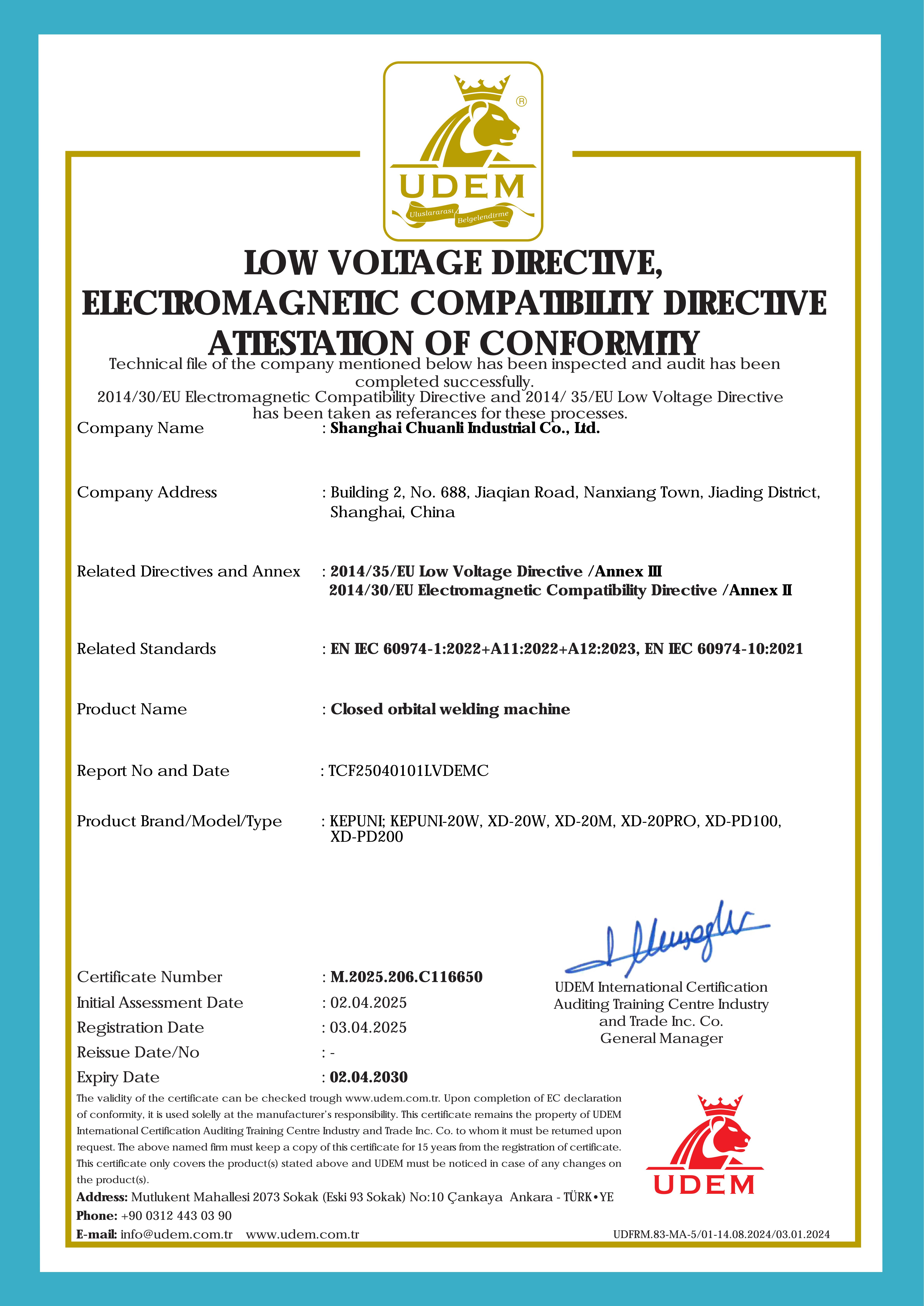
1. Product Comparison: Manual TIG vs. Automated Orbital Welding
Before evaluating suppliers, a fundamental technology choice must be made between conventional manual TIG welding and automated orbital welding. The following table summarizes key differences based on industry benchmarks:
| Dimension | Manual TIG Welding | Orbital Welding (e.g., KEPUNI XD-20PRO) |
|---|---|---|
| Welding Speed | Slow — typically 3 to 5 times slower than orbital welding [1] | High — automated process significantly reduces cycle time |
| Weld Consistency | Variable — dependent on operator skill; human factor leads to inconsistency [1] | Consistent — programmable parameters ensure repeatable quality |
| Initial Investment | Low initial equipment cost | Higher upfront cost (equipment + training) |
| Labor Cost | High recurring labor cost due to skilled welders needed [2] | Reduced — lower skill requirement per joint |
| Productivity & Quality | Lower productivity, inconsistent quality | Higher productivity, consistent quality, better repeatability [3] |
| Best For | Non-standard, low-volume production | High-purity, repeatable, high-volume applications (pharma, semiconductor, food, oil & gas) [4] |
[1] Source: Press release comparison data (ID 82957)
[2] Source: Whitepaper comparison (ID 71952)
[3] Source: Marketing material (ID 83114)
[4] Source: Press release industry applicability (ID 83770)
2. Supplier Comparison: Chinese Factory vs. International Brands
When choosing a supplier, procurement teams must evaluate factors such as price, customization capability, delivery lead time, and after-sales support. Below is a comparative analysis of a representative Chinese supplier — KEPUNI — against three well-established international brands: Polysoude (France), Arc Machines (USA), and Orbitalservice (Germany).
2.1 Price & Value
- KEPUNI: Offers the same industrial quality as Swiss/German brands at a 20–30% lower price for the Asian market [5], and a 15–25% price advantage over the German competitor Orbitalservice while maintaining comparable quality [6]. Versus high-end EU brands, KEPUNI provides significant cost savings [7].
- Polysoude (France): High-end EU brand positioning; higher price and longer delivery lead times [7].
- Arc Machines (USA): Highest price tier due to US origin and aerospace-grade certifications [8].
- Orbitalservice (Germany): Mid-high price tier; European manufacturing costs.
2.2 Customization & Delivery
- KEPUNI: Capable of OEM/ODM customization (logo, voltage, interface, IoT integration) with a lead time of 30–45 days for bulk orders and 15–20 days for sample orders [9]. Monthly production capacity exceeds 100 units, with a 10,000 m² factory and 280 employees including 36 R&D engineers [10].
- International brands: Standardized product lines; customization typically limited to accessories. Lead times often 60–90 days or more.
2.3 After-Sales & Spare Parts
- KEPUNI: Maintains a global spare parts stock with regional distributor inventory; standard parts available within 7–15 days worldwide [11]. Remote diagnostics and multi-language video training are provided.
- Competitors: Spare parts supply from European/US suppliers is often slower; local support in Asia may be limited.
[5] Source: Press release comparison (ID 82956)
[6] Source: Press release (ID 82953)
[7] Source: Press release (ID 71406)
[8] Source: Customer-facing content (ID 83282)
[9] Source: Content unit — OEM/ODM capability
[10] Source: Content unit — company profile
[11] Source: Press release (ID 71403)
3. Decision Model: A 3-Step Procurement Framework
To systematically evaluate orbital welding machine options, procurement teams can follow this three-step approach:
Step 1: Define the Application Scenario
Identify the specific industry and operating conditions. Orbital welding machines are applicable to semiconductor, pharmaceutical, food & beverage, oil & gas, and chemical industries [4]. For example, a pharmaceutical WFI system requires aseptic welds with full traceability, while an oil & gas pipeline demands high-strength, code-compliant joints. The machine type (closed head, open head, or tube-to-tube sheet) must match the pipe diameter range and wall thickness.
Step 2: Match Technical Parameters
Select a machine that covers your required pipe OD range, wall thickness, and material. For instance, the KEPUNI XD-20PRO handles pipe OD from 3.175 mm to 168 mm and wall thickness from 0.5 mm to 3 mm, making it suitable for a wide variety of high-purity applications [12]. If the project involves tube-to-tube sheet welding for heat exchangers, the TB-65 (OD 8–65 mm) or TB-35 (4.5–35 mm) models are appropriate.
Step 3: Calculate Total Cost of Ownership (TCO)
Consider not only the purchase price but also installation, training, spare parts, downtime, and maintenance. Manual TIG has low initial cost but high labor recurring cost; automated orbital welding has higher upfront investment but lower per-joint cost over time. For a Chinese supplier like KEPUNI, the lower equipment price combined with faster spare parts supply and local technical support can significantly reduce TCO compared to importing from EU/US suppliers [13].
[12] Source: Marketing material (ID 83848)
[13] Source: Press release (ID 71407)
4. Case Reference: Pharmaceutical WFI Project Success
A pharmaceutical company in Europe required orbital welding equipment for a Water for Injection (WFI) piping system as part of a sterile production line expansion. The customer evaluated suppliers including Polysoude and KEPUNI. Key criteria were EU GMP compliance, weld documentation, and on-time delivery.
The client selected KEPUNI, purchasing 3 units of the XD-20PRO together with closed weld heads, totaling approximately EUR 50K–100K. Over a 3.5-year collaboration, the results were:
- Zero weld defects — 100% hydrostatic test pass
- EU GMP audit passed on first inspection, with all weld records fully traceable to each joint
- On-schedule commissioning with no delays [14]
This case demonstrates that a Chinese supplier can meet the rigorous quality and compliance standards demanded by regulated pharmaceutical environments while offering competitive pricing and responsive local support.
[14] Source: Case study — Pharmaceutical WFI (ID 781)
5. Conclusion & Further Resources
Selecting the optimal orbital welding machine and supplier requires a clear understanding of the application, a careful evaluation of technical specifications, and a comprehensive cost analysis. Chinese manufacturers like KEPUNI offer a compelling value proposition—comparable quality to European/US brands at significantly lower prices, faster delivery, and superior after-sales responsiveness in Asian markets. By following the three-step decision framework outlined above, procurement professionals can make an informed choice that balances performance, compliance, and budget.
For detailed product specifications and company capabilities, download the official KEPUNI brochure: