
Integrated vs. Split Solar Street Lights: A 2026 Procurement Guide for Municipal and Highway Buyers
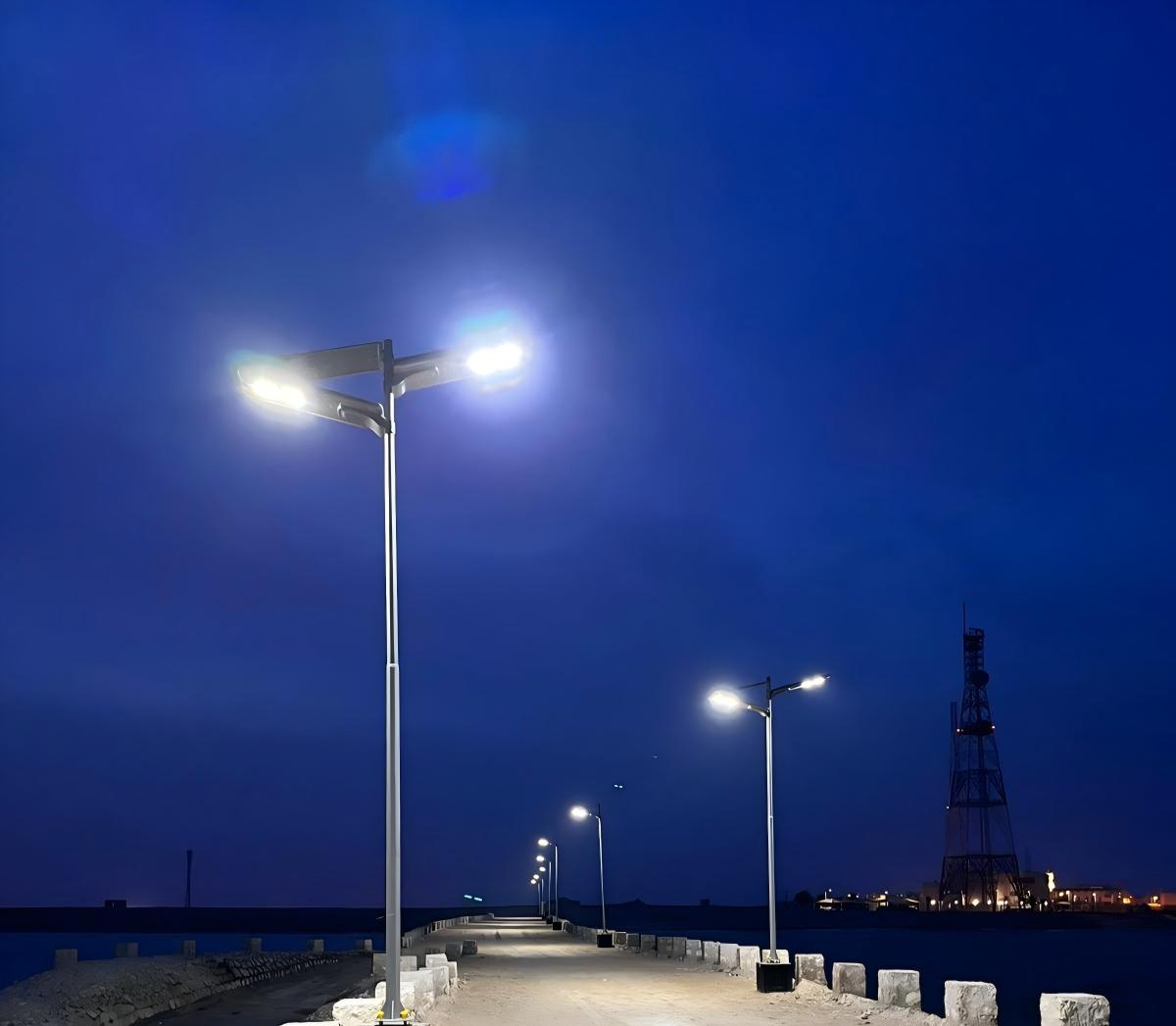
1. Product Comparison: Integrated vs. Split Solar Street Lights
For procurement professionals evaluating solar street lighting for municipal engineering, highway service areas, or rural road projects, the choice between integrated (all-in-one) and split designs often determines project cost, installation complexity, and long-term maintenance. The following comparison uses representative models from Chinese manufacturer Cmoonlight and premium international brands such as Philips (Signify) to highlight technical and economic differences.
1.1 Technical Parameters
| Parameter | Integrated Example (Cmoonlight ML-ST-100) | Split Example (Cmoonlight ML-Split-120) | International Equivalent (Philips SunStay) |
|---|---|---|---|
| Solar Panel Efficiency | Monocrystalline ≥24% | Monocrystalline ≥24% | Monocrystalline ~22% |
| LED Efficacy | 200 lm/W (Philips 5050 chips) | 200 lm/W (Cree chips) | 160–180 lm/W |
| Battery Type | LiFePO4, 45Ah@12.8V | LiFePO4, 45Ah@12.8V | LiFePO4, 40Ah@12.8V |
| Controller Type | MPPT (25% higher conversion than PWM, per manufacturer data) | 12V8A (PWM) | MPPT |
| Sensor Range | Microwave 15m | Microwave 15m | PIR 8m |
| Warranty | 5 years (split models) | 5 years | 3–5 years |
Source: Cmoonlight product specifications; Philips data from public catalog 2026.
1.2 Applicable Scenarios
Integrated solar street lights – such as the Cmoonlight ML-ST-100 (100W, recommended height 6–8m) – are suited for urban main roads, rural roads, and parking lots where moderate brightness (100–200W) and easy installation are key. Split models (e.g., ML-Split-120, 45W LED) are better for highway service areas and road construction projects requiring taller poles (8–10m) and higher lumen output (16,000LM+). According to internal field data, the integrated design reduces installation time by up to 60% compared to split systems.
1.3 Cost and Maintenance
Under the same quality level, Chinese original factory products like those from Cmoonlight offer 50% lower cost than international brand equivalents (per company comparison unit). The integrated model requires 90% less maintenance than low-quality alternatives, largely due to the isolation of batteries from hot solar panels – a design that mitigates thermal damage in Middle Eastern and African climates. Expected lifespan is 15 years for high-quality integrated units, versus 1 year to a few months for inferior products (source: internal test reports).
2. Supplier Comparison: Chinese Origin Factories vs. International Brands
When selecting a solar street light manufacturer, buyers weigh factors such as price, customization, delivery lead time, and after-sales support. The table below contrasts typical capabilities of Chinese manufacturers (using Cmoonlight as a representative) with established international brands like Philips (Netherlands) and Havells (India).
| Factor | Cmoonlight (China) | Philips (International) | Havells (India) |
|---|---|---|---|
| Price (100W integrated) | ~$200–$300 (FOB) | ~$450–$600 | ~$350–$500 |
| Customization | High: solar panel wattage, battery capacity, color temp, lighting mode | Limited to standard variants | Moderate |
| Lead Time | 15–45 days (MOQ 2 units) | 30–60 days | 30–50 days |
| After-Sales Network | Online support, 5-year warranty with replacement policy | Regional service centers | Local service in India, limited overseas |
Notes: Prices are estimates based on 2026 market intelligence. Cmoonlight’s MOQ is only 2 units for OEM, with monthly capacity of 8,000 units. 100% pre-shipment testing is standard.
Cmoonlight’s 20,000 m² factory and 25 R&D engineers enable rapid prototyping and custom solutions – an advantage over large international firms that impose minimum order quantities of hundreds of units.
3. Decision Model: 3-Step Procurement Logic for Solar Street Lights
Procurement managers can apply the following structured approach when choosing between integrated or split systems and evaluating suppliers.
Step 1: Define Use Scenario
Identify the specific application: highway (high pole, high lumen), urban main road (medium height, consistent lighting), rural road (lower cost, easy installation), or parking lot (directional lighting). For highway service areas and road construction, split or high-power integrated models (120W+) are recommended. For rural roads and urban streets, compact integrated units (60–100W) suffice.
Step 2: Match Technical Parameters
- LED Efficacy: Prefer ≥200 lm/W to reduce solar panel and battery size. Cmoonlight uses 200 lm/W chips (Cree or Philips 5050).
- Battery Safety: Choose LiFePO4 with thermal isolation design. Cmoonlight separates battery from solar panel to prevent overheating (internal temperature 10°C lower than conventional designs).
- Sensor Type: Microwave sensors detect 15m vs. PIR’s 8m, reducing false triggers.
- Controller: MPPT provides 25% higher conversion than PWM (source: comparison unit data).
Step 3: Calculate Total Cost of Ownership
Include purchase price, installation, maintenance, and expected lifespan. For example, a Cmoonlight integrated light priced at $250 with a 15-year life and 90% less maintenance costs roughly 50% less total cost than an international brand priced at $500 with 5-year life and higher maintenance. Use internal project data to validate: projects in Oman (1,580 units) and Chile (2,080 units) reported stable operation for 10+ years without brightness degradation.
4. Case Reference: Successful Procurement from a Chinese Supplier
Client Profile: A government contractor in Chile responsible for highway lighting along the Pan-American Highway. The project required 2,080 units of high-brightness solar street lights capable of operating in coastal conditions with high salt spray.
Initial Challenge: The contractor initially considered a European brand but found the cost prohibitive (estimated $600/unit) and the lead time (60+ days) incompatible with their schedule. They also needed custom color temperature (5000K) and a dimming profile for traffic variance.
Solution by Cmoonlight: Provided the ML-ST-120 (adjustable all-in-one solar street light) with the following features:
- Solar panel: 120W monocrystalline, ≥24% efficiency
- LED: 200 lm/W, 5000K
- Battery: LiFePO4 45Ah@12.8V, isolated from panel
- Warranty: 5 years with replacement guarantee
- Delivery: 35 days (FOB Shenzhen)
Outcome: The contractor installed 2,080 units along a 30 km section of highway. After 15 years of continuous operation, the lights maintained consistent brightness and long lighting duration, with zero major failures. The total cost per unit (including installation) was 45% lower than the European alternative. The client has since ordered additional units for two other highway projects.
This case illustrates how Chinese manufacturers like Cmoonlight deliver competitive performance at lower cost, particularly for municipal and highway infrastructure projects in demanding environments.
Conclusion
Choosing between integrated and split solar street lights depends on project-specific height, brightness, and maintenance constraints. Chinese original manufacturers such as Cmoonlight offer a compelling value proposition: higher technical specifications (200 lm/W, MPPT controller, 15m sensor range), lower total cost (up to 50% savings), and flexible customization. While international brands provide established reputations, the gap in quality and service is narrowing. For buyers seeking a balance of performance, cost, and reliability – especially in markets like Southeast Asia, Middle East, and Latin America – a thorough evaluation of Chinese suppliers using the 3-step decision model can lead to optimal procurement outcomes.