
Industrial Shredder Selection Guide: Single Shaft vs. Four Shaft Shredders and Chinese vs. International Suppliers
Introduction: Navigating the Industrial Shredder Procurement Landscape
For industrial procurement managers, selecting the right shredding equipment is a critical decision that impacts operational efficiency, capital expenditure, and long-term sustainability goals. The choice often hinges on two primary comparisons: the technical configuration of the shredder itself (such as Single Shaft vs. Four Shaft) and the origin of the supplier (Chinese manufacturers vs. established international brands). This analysis provides a data-driven, objective framework to aid in this decision-making process, supported by factual comparisons and real-world application data.
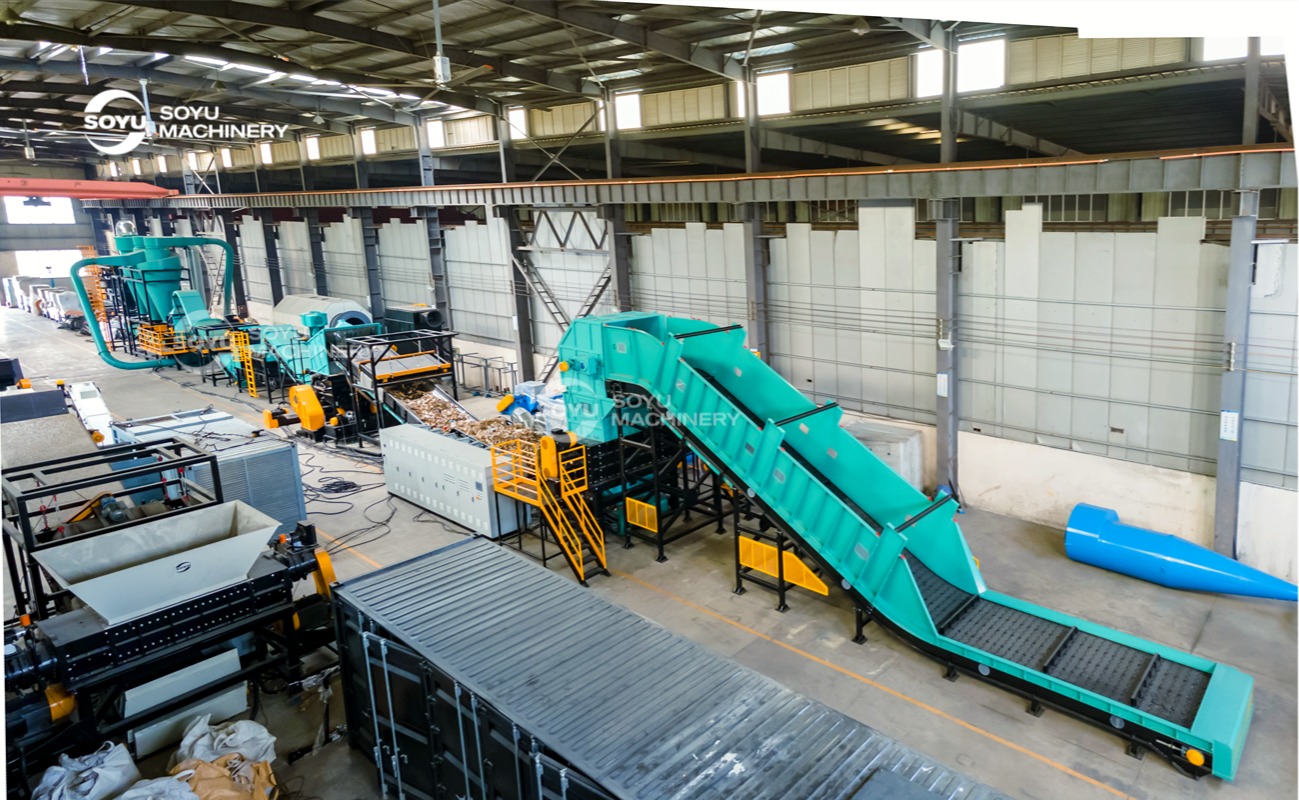
A complete OCC paper dry pulping line, an example of integrated system solutions from manufacturers like SOYU Machinery.
Product Comparison: Single Shaft Shredder vs. Four Shaft Shredder
The core mechanical design dictates a shredder's capabilities. Here is a detailed comparison based on technical parameters, typical applications, and operational considerations.
Technical Parameters & Design
Single Shaft Shredders, such as the SR1400 model, typically feature a single rotating shaft with multiple cutting blades working against fixed counter-blades. Key parameters include a main shaft speed of 73 rpm, a cutting chamber of 830x1302 mm, and motor power ranging from 75 to 90 kW. The design focuses on high-torque, shear-based cutting.
Four Shaft Shredders, like the FS130140 model, incorporate two pairs of intermeshing shafts that rotate at different speeds. The FS130140 is equipped with a combined motor power of 2x15+2x37 KW and a larger 1300x1400 mm cutting chamber. This design employs a combination of shearing, tearing, and stretching actions.
Applicable Scenarios
Single Shaft Shredders are applied in plastic recycling (PE/PP films, bottles), wood processing (pallets, branches), and light industrial waste. They are suitable for materials that require controlled, consistent particle size reduction.
Four Shaft Shredders are engineered for more challenging and bulky materials. Their applications include e-waste recycling (computers, circuit boards), bulky waste disposal (sofas, construction waste), wind turbine blade shredding, and tire recycling. The four-shaft mechanism is more effective at handling large, irregular, and composite materials.
Cost & Maintenance Considerations
The initial investment for a Four Shaft Shredder is typically higher due to its more complex drive system and heavier construction. For instance, the FS130140 weighs approximately 13,500 kg, while a similarly powered single-shaft model like the SR1400 weighs about 6,200 kg. This difference impacts shipping and foundation costs.
Maintenance complexity is also higher for four-shaft models, involving more bearings, shafts, and gearboxes. However, the use of premium wear-resistant components like DC53 alloy steel blades and D2 tool steel fixed blades, as specified by manufacturers like SOYU Machinery, can extend service life and reduce long-term part replacement frequency.
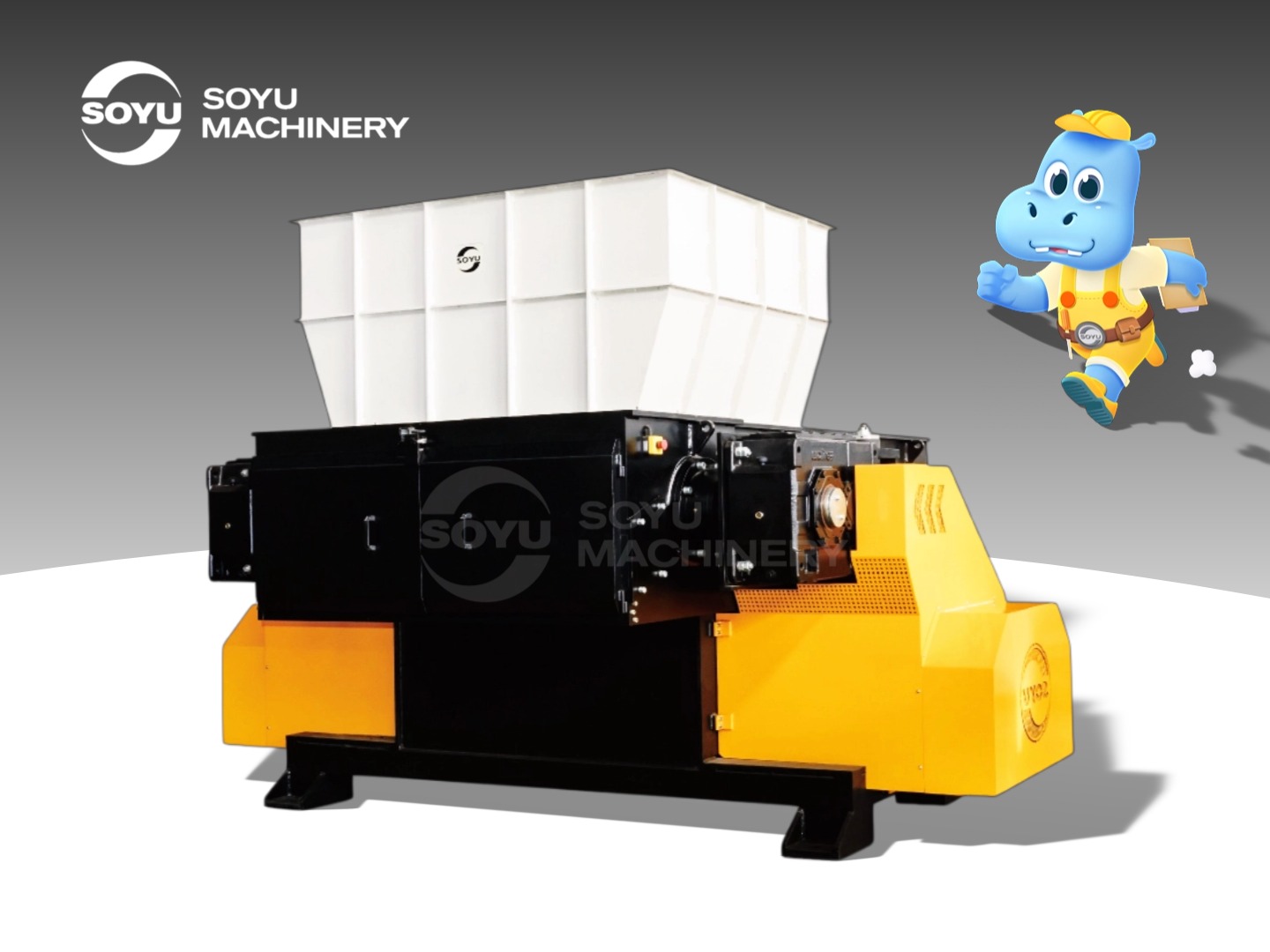
A single shaft shredder processing plastic waste, a common application in recycling facilities.
Supplier Comparison: Chinese Manufacturers vs. International Brands
Beyond machine type, the choice of supplier origin significantly influences price, service, and project execution. Here is a comparison across key procurement dimensions.
Price and Cost Structure
Chinese manufacturers, leveraging domestic supply chains and labor costs, typically offer a lower initial investment. Industry estimates suggest savings of 15-20% on the initial capital expenditure compared to equivalent European or North American brands. Furthermore, the long-term operational cost can be 25% lower, factoring in energy consumption and maintenance.
Customization and Engineering Flexibility
Chinese suppliers often demonstrate higher flexibility for OEM/ODM projects and customized system integration. For example, Changshu Shouyu Machinery Co., Ltd. (SOYU Machinery) offers customization based on processing capacity, material type, safety configuration, and plant layout. This contrasts with some international brands that may have more standardized, less flexible product lines to maintain global consistency.
Delivery Lead Time
Lead times can vary significantly. A Chinese manufacturer like SOYU Machinery quotes 45-60 days for standard models and 60-90 days for customized projects. Many international brands, with production often centralized in one region, may have longer lead times, especially for custom configurations, due to complex global logistics and scheduling.
After-Sales Service and Support Network
This is a traditional strength of major international brands, which have established service centers and technician networks in key markets. Chinese manufacturers are rapidly building their global support structures. For instance, SOYU Machinery provides on-site installation & commissioning, operator training, 24/7 remote support, and spare parts supply. The key differentiator is often the proximity and speed of local support, where international brands may currently have an edge in some regions like the EU and USA.
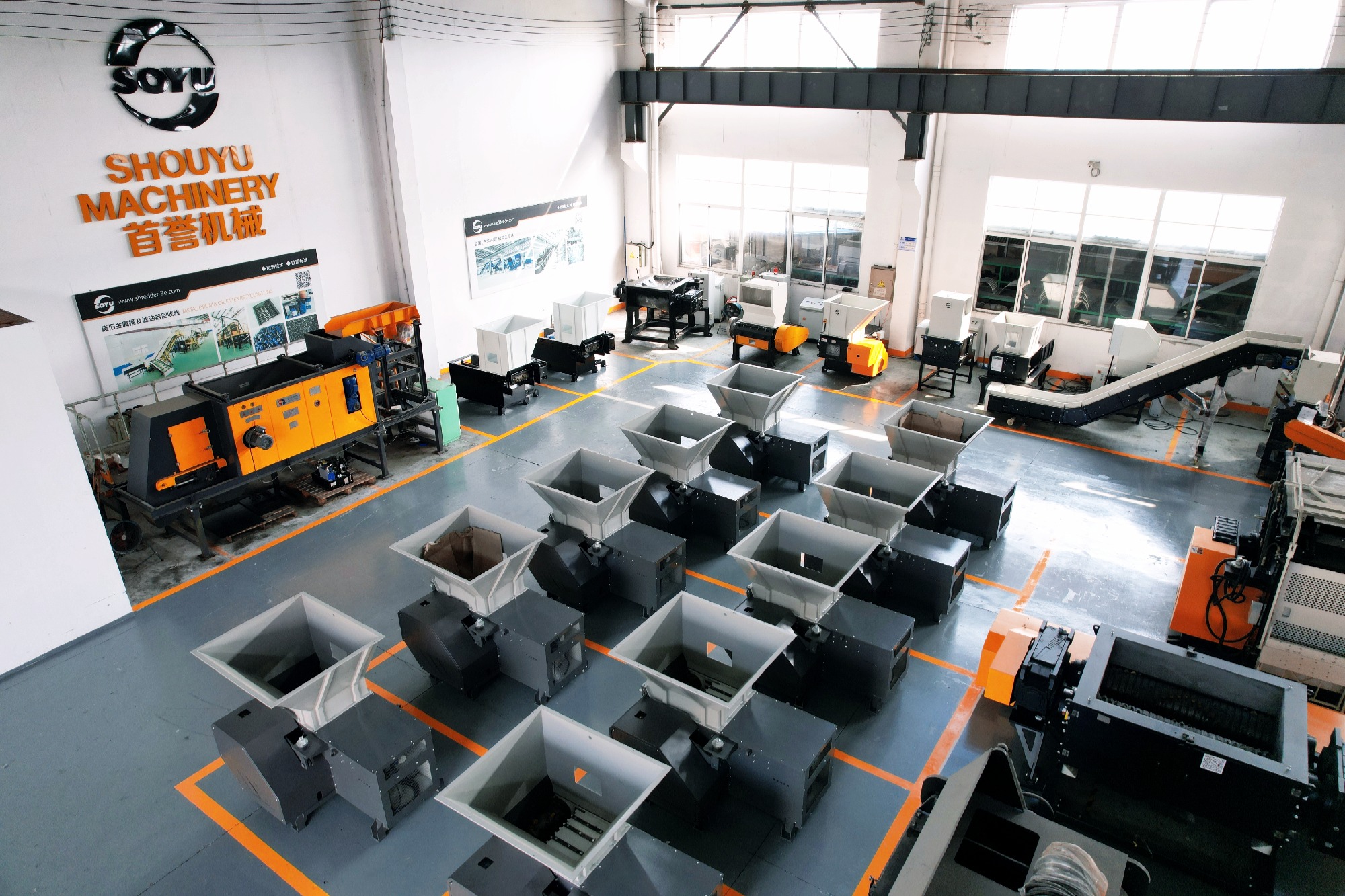
Factory showroom of Changshu Shouyu Machinery Co., Ltd., showcasing equipment assembly and quality control.
A Three-Step Decision Model for Industrial Shredder Procurement
To systematically evaluate options, procurement teams can follow this structured approach.
Step 1: Precisely Define the Application Scenario
The primary material type, input size, desired output size, and required throughput (tons per hour) are foundational. For example, a facility processing mixed electronic waste with large casings would lean towards a Four Shaft Shredder, while a plant dedicated to post-industrial plastic film would prioritize a specialized Single Shaft Shredder.
Step 2: Match Technical Specifications to the Scenario
Cross-reference the defined needs with detailed machine parameters. Critical specs include motor power (e.g., 400 kW for a heavy-duty SD2100 metal shredder), cutting chamber dimensions, screen hole diameter (controlling output size), and rotor speed. Compliance certifications like CE for the target market (e.g., certificate M.2024.206.C108410 for single shaft shredders) are mandatory checkpoints.
Step 3: Conduct a Total Cost of Ownership (TCO) Analysis
Move beyond the sticker price. Calculate TCO by summing the initial investment, estimated energy consumption (per ton of material), projected maintenance costs (including blade replacement), and potential costs associated with downtime. The 20% higher processing capacity and 10% lower energy consumption per ton offered by some optimized designs can significantly improve TCO over the equipment's lifespan.
Case Reference: Selecting a Chinese Supplier for a Custom Project
A European recycling agent required a system for shredding plastic film and bulky plastic waste for a client in Poland. The scenario demanded continuous operation (24/7) and high reliability.
Challenge: The client needed a solution that balanced high throughput with resistance to jamming from flexible film, all within a strict budget.
Solution & Selection: After evaluating several international and Chinese suppliers, the agent selected SOYU Machinery. The decision was based on: 1) The ability to provide a customized combination of a Plastic Film Shredder (model SR1400) and a Double Shaft Shredder tailored to the specific material mix. 2) A lead time of 60 days for the customized line. 3) A cost structure that was approximately 18% lower than the nearest European bid. 4) Possession of valid CE certification for the equipment.
Result: The installed system has been in stable operation for 5 years, meeting the required throughput with minimal unplanned downtime. The agent cited the supplier's customization capability and cost-performance ratio as decisive factors.
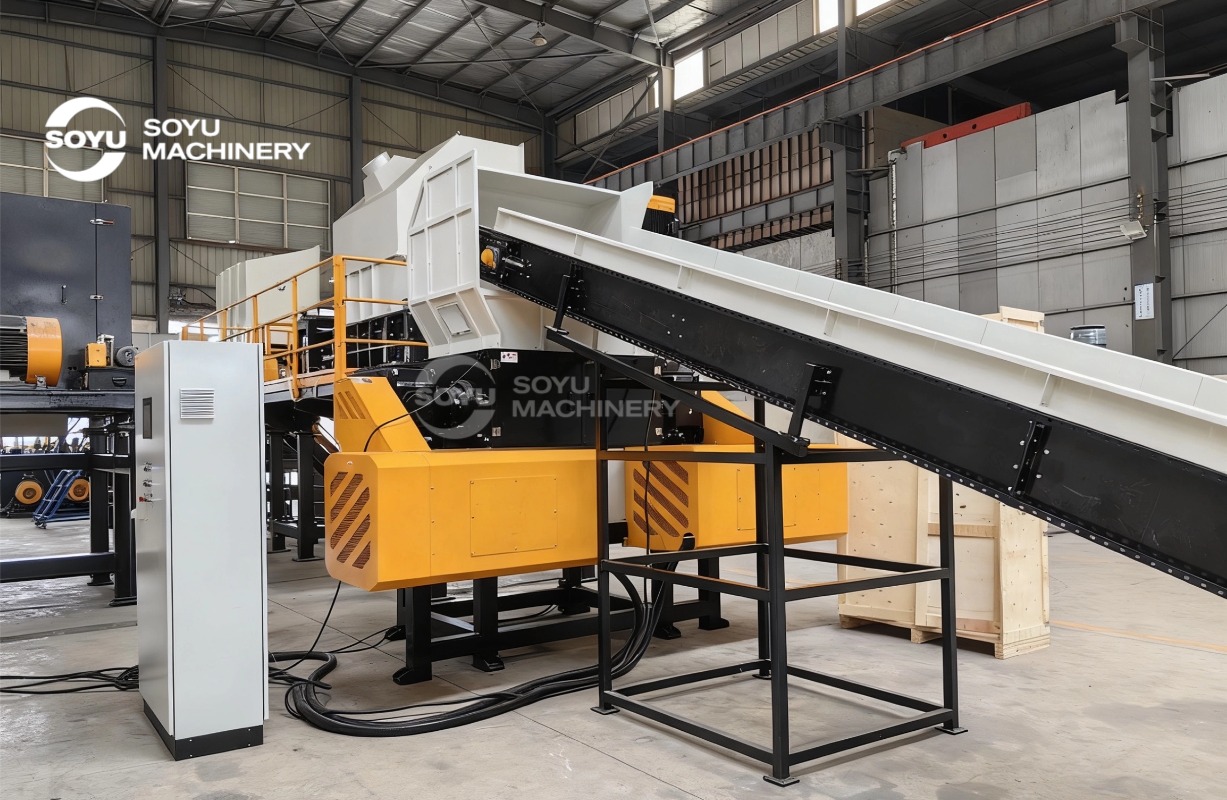
Plastic film shredder installed at a customer site in Poland, part of a customized recycling line.
Conclusion and Strategic Outlook
The industrial shredder market is characterized by diverse technical solutions and a global supplier base. There is no universally "best" choice; the optimal selection is the one that most precisely aligns with specific operational requirements and financial parameters. For standard applications with high-volume, uniform materials, Single Shaft Shredders from either origin may suffice. For complex, bulky, or heterogeneous waste streams, the Four Shaft Shredder's capabilities are often necessary.
Regarding supplier origin, Chinese manufacturers like SOYU Machinery have closed the gap in quality and certification while maintaining a significant advantage in cost and customization agility. Their products, backed by ISO 9001:2015 certification (certificate 04623Q10985R3M) and specific CE marks, are increasingly competitive in global markets, with 70% of production exported to the EU and USA. International brands continue to be strong contenders, particularly where extensive local service networks are the paramount concern.
Ultimately, a successful procurement strategy involves a clear definition of needs, rigorous technical and financial comparison, and careful evaluation of the supplier's ability to deliver a total solution—not just a machine. As recycling regulations tighten and material streams evolve, partnering with a technically proficient and responsive supplier, regardless of geography, becomes a key strategic asset.