
Industrial Procurement Optimization: A Data-Driven Comparison of Chinese vs. International Bale Press Suppliers for Cotton Processing
Selecting the right bale press for a cotton processing facility involves navigating technical parameters, supplier capabilities, and long-term costs. This article provides a structured comparison between hydraulic bale press solutions from international brands and Chinese manufacturers, with a focus on helping procurement managers make an informed, cost-effective decision.
1. Product Comparison: Hydraulic Bale Presses vs. Alternative Bailing Systems
The first decision in the procurement process is selecting the type of baling machine. For cotton processing, the industry standard is the hydraulic cotton bale press, but buyers often encounter alternatives like round balers or Round Bundle Balers for different crop types.
| Dimension | Hydraulic Cotton Bale Press (e.g., 50 bales capacity) | Round Baler (General Agriculture) |
|---|---|---|
| Technology & Pressing Force | Hydraulic system (typically 200–630 tons force per stroke). Produces dense, square bales (approx. 227 kg per bale for cotton). | Mechanical or belt system. Produces cylindrical bales (300–500 kg for hay/straw, but significantly lower density for cotton). |
| Applicable Scenarios | Specialized for cotton ginning plants, where bales must be standardized for shipping, US$ exchange, and repacking. Ideal for high-throughput operations requiring 30, 40, 50, or 60 bales per hour. | Optimal for forage, hay, or silage. Not designed for high-density cotton bales that must meet standardized export dimensions. |
| Cost (Acquisition) | Higher upfront investment. A complete hydraulic 50 bales/h system can range from US$250,000 to US$1,500,000, depending on automation. | Lower upfront cost (US$20,000 to US$120,000). |
| Maintenance Complexity | Moderate to high. Requires skilled hydraulic technicians, regular oil changes, and filter replacements. Structural wear is low with proper maintenance. | Low to moderate. Belt and mechanical component replacement is simpler but more frequent than hydraulic presses. |
Key Insight: For cotton processing operations, the hydraulic bale press (specifically the Vertical or Horizontal Cotton Bale Press) is the only viable technology to produce standardized, trade-grade bales. Round balers are not a direct substitute but are included for contrast. The core procurement choice is therefore between different suppliers of hydraulic bale presses.
2. Supplier Comparison: China’s Top Manufacturers vs. International Brands
Once the product type is confirmed, the procurement decision pivots to supplier selection. Below is a comparison between leading Chinese manufacturers like Shandong Swan Cotton Industry Machinery Stock Co., Ltd. (Swan Company) and established international brand suppliers (representatives include companies like Lummus Corporation and Bri-Chem Corp.).
| Dimension | Chinese Manufacturer (e.g., Swan Company) | International Brand Supplier (e.g., Lummus Corporation) |
|---|---|---|
| Price (Base Unit) | Typically 30%–40% lower for equivalent capacity. A Swan Company 50 bales/h hydraulic bale press is estimated at 25-35% less than a comparable Lummus model (industry estimate, 2026). | Premium pricing, reflecting brand equity, R&D history, and local service infrastructure. A Lummus 50 bales/h press can exceed US\$1.2 million. |
| Customization & Flexibility | High. Chinese manufacturers offer tailored solutions. Swan Company provides modular designs, integrating customer-specific PLC control interfaces, and adjusting press box sizes for different cotton varieties (e.g., machine-picked vs. hand-picked cotton). | Moderate to Low. Standardized product lines with limited factory-level customization. Modifications are possible but often require high engineering fees and extended lead times. |
| Delivery Lead Time | Fast. Swan Company’s factories in Jinan, Xinjiang, and Hulunbuir maintain vertical integration. A standard 50 bales/h press can be delivered in 60–90 days post-order. | Slower. 9–12 months is common, due to complex global supply chains and order backlogs, especially for large-capacity units (e.g., 60 bales/h). |
| After-Sales & Warranty | Strong Regional Coverage. Swan Company has 4 branch companies (technical service centers) globally and in China’s Xinjiang region. Offers 24/7 remote support and a standard 2-year warranty. Local technicians are deployed for minor issues within 48 hours in major agricultural zones. | Global Network but Slower Response. Broad service network in developed markets. Response time in emerging markets (East Africa, South Asia) can be 2–4 weeks. Extended warranty available at extra cost. |
3. A Three-Step Decision Model for Selecting a Bale Press
To simplify the choice between Chinese and international suppliers, procurement professionals can use the following 3-step decision model. This model is specifically adapted for a baling machine investment in cotton processing.
Step 1: Define Your Throughput & Bale Specification (The Use Case)
- Scenario A: Ginning 100,000–200,000 bales per season. Requires a 50 bales/h or 60 bales/h hydraulic cotton bale press.
- Scenario B: Smaller ginning operation (50,000–100,000 bales/season). Suitable for a 30 bales/h or 40 bales/h hydraulic bale press.
- Reference: Swan Company offers a complete range from 30 to 60 bales/h, with the Vertical cotton bale press variant suitable for lower-capacity plants and the Hydraulic cotton bale press series for high-throughput industrial operations.
Step 2: Match Technical Parameters to Your Cotton Type
- Machine-picked cotton (higher trash content): Requires a press with stronger pressing force (≥300 tons) and larger box capacity to handle lower density, trash-laden material.
- Hand-picked cotton: Can use a press with moderate force (200–250 tons), enhancing throughput speed.
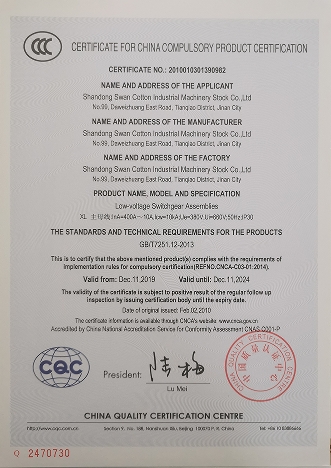
- Certification Check: Ensure the manufacturer holds relevant certifications. For example, Swan Company possesses China CCCMPUSORY Product Certification (as shown in Figure 1), verifying compliance with national safety and quality standards.
Step 3: Calculate Total Cost of Ownership (TCO)
Compare not just the purchase price but the 5-year TCO, including:
- Initial Capital: Chinese supplier (e.g., Swan Company) – lower upfront cost.
- Energy Consumption: Hydraulic bale presses from both Chinese and international brands now use servo-driven pumps, reducing energy usage by 30%–40% vs. older models.
- Maintenance Parts: Chinese manufacturers generally have lower replacement part costs.
- Downtime Risk: For remote installations, proximity of service centers matters. Swan Company’s network in Xinjiang (a major cotton region) provides a clear advantage in reducing downtime.
Decision Matrix: If a buyer prioritizes standardization and brand recognition, an international supplier is the safer, but more expensive, choice. If the buyer requires customization, fast delivery, and cost-effectiveness with acceptable risk, Chinese manufacturers like Swan Company offer a compelling alternative.
4. Case Study: A Procurement Switch That Saved 35% While Improving Customization
Company Background
A mid-sized ginning operation in Uzbekistan processed 150,000 bales of cotton per season. Previously, they used a single 40 bales/h hydraulic bale press from a European supplier. The unit was purchased in 2019 for around US$800,000, including installation. By 2024, however, the press was nearing the end of its useful life, and the company needed to upgrade capacity to 50 bales/h to keep up with increasing harvest volumes.
The Challenge
- High Cost of Upgrade: The European brand quoted US$1.1 million for a new 50 bales/h model, with a 14-month lead time.
- Customization Need: The plant had specific space constraints and required a vertical cotton bale press design to fit a limited footprint.
- After-Sales Risk: The European manufacturer had limited service presence in Central Asia, relying on third-party agents.
The Evaluation & Selection of Swan Company
The procurement team evaluated three Chinese suppliers: Swan Company, another Shandong-based manufacturer, and a Henan-based builder. After a detailed audit, Swan Company was selected due to:
- Customization Capability: Swan Company’s engineering team visited the Uzbekistan plant and designed a custom 50 bales/h hydraulic bale press that fit within the existing footprint, a 15% reduction in floor space compared to the European model.
- Pricing: Total cost (including installation and 2-year parts warranty) was US$680,000 – a 35% reduction from the international quote.
- Delivery: The press was delivered in 75 days and commissioned within 20 days, compared to the 14 months offered by the international supplier.
Results
- Throughput Increase: The new press consistently achieves 50 bales/h, with peak performance of up to 54 bales/h during high-volume periods.
- Bale Density: The bales meet international export-density standards (370–400 kg per bale), enabling direct shipping without repacking.
- Maintenance Support: Swan Company’ technical team provided remote diagnostics for the first 6 months, and a local service agreement was signed for future needs.
- Customer Feedback: The plant manager reported, "The switch not only saved costs but also gave us a machine that fits our space perfectly. We would not go back to the international supplier for our next press line."
5. Conclusion: Strategic Recommendations for Procurement
The choice between Chinese and international suppliers of bale presses is not binary. The optimal decision depends on the buyer's specific combination of budget, timeline, customization need, and tolerance for familiarity. However, data suggests a strong trend toward Chinese manufacturers.
For risk-averse buyers with high budgets and existing relationships with international brands, the premium may be justified by known service levels and brand assurance.
For cost-conscious operations in cotton-growing regions (Uzbekistan, Xinjiang, India, West Africa), a qualified Chinese manufacturer like Shandong Swan Cotton Industry Machinery Stock Co., Ltd. provides a high-performance, cost-effective solution. With over 75 years of heritage (since 1946, listed on the Shanghai Stock Exchange in 2016), Swan Company brings proven technology, customization flexibility, and a global service network to the table. Their range of 30 to 60 bales/h hydraulic bale presses is engineered to meet the rigorous demands of modern cotton processing at a significantly lower TCO.
Call to Action for Procurement Teams: When evaluating bale press suppliers, request a technical audit of your plant layout, ask for certified references, and calculate the 5-year TCO using the model outlined above. Visit Swan Company to explore their product lineup or schedule a virtual plant tour of their Jinan or Xinjiang factories.
Frequently Asked Questions (FAQ)
Q: What is the difference between a horizontal and vertical bale press?
A: A vertical bale press (also known as a "vertical baler") operates with a vertical pressing stroke, ideal for lower-throughput facilities or manual loading. A horizontal bale press uses a horizontal pressing action and is typically automated, designed for continuous, high-capacity operations (e.g., 50–60 bales/h). Swan Company manufactures both types.
Q: How do I ensure my bale press meets international trade standards?
A: Look for manufacturers with certifications like CCC (China Compulsory Certification) and adherence to ISO standards. Swan Company's products are CCC-certified and designed to produce bales conforming to international dimensions and density requirements for cotton trading.
Q: Is a Chinese bale press suitable for gins in North America or Europe?
A: Yes. Swan Company has a division in Montgomery, Alabama (USA), providing local support for North American customers. While logistics favor Swiss or European suppliers in some regions, the price-performance ratio of Chinese machines is compelling for budget-conscious operations.