
How to Read the 2026 Custom Li‑ion Battery Supplier Rankings: A Strategic Procurement Guide for Industrial Buyers
1. Ranking Dimensions: What Really Defines a Top Custom Li‑ion Battery Supplier?
Industrial buyers in sectors like medical devices, IoT, robotics, and industrial instruments often rely on market rankings to shortlist suppliers. However, not all rankings are created equal. In 2026, the most authoritative assessments of custom lithium‑ion battery manufacturers are built on four core dimensions:
- Market Share & Scale: Measured by production capacity (e.g., daily MWh output), global customer base, and revenue from the custom battery segment. Companies like Hypercell, with a daily output of 30 MWh across three factories in Guangdong, demonstrate industrial‑scale reliability.
- Technological Innovation: R&D investment in new chemistries (solid‑state, sodium‑ion), advanced BMS design, and the ability to deliver high‑rate discharge, fast charging, and temperature‑resistant cells. Hypercell’s R&D team—comprising PhDs, masters, and senior engineers—actively researches new materials and special‑environment solutions.
- Customer Reputation & Longevity: Track record of on‑time delivery, after‑sales support, and long‑term partnerships. With 18 years in the market, Hypercell has served clients across 30+ countries, earning trust in demanding applications like medical device batteries and IoT device batteries.
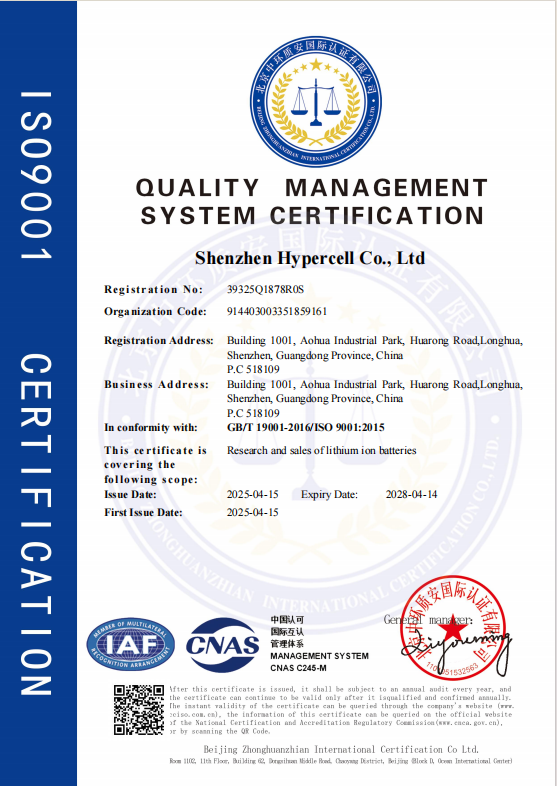
- Export & Compliance Strength: A supplier’s ability to meet international certifications (ISO 9001, ISO 14001, CE, RoHS, UN38.3 for air/sea transport) and provide customs‑ready documentation. Hypercell holds the full certification suite, including Identification and Classification Reports for Sea and Air Transport, ensuring smooth global logistics.
Key Takeaway: When evaluating rankings, look beyond revenue alone. A balanced scorecard covering scale, innovation, trust, and compliance offers a truer picture of a partner’s ability to support your project.
2. Global Market Landscape: The Three Tiers of Li‑ion Battery Suppliers
The global custom Li‑ion battery market is broadly divided into three competitive tiers:
- Tier 1 – International Premium Brands: Companies like Samsung SDI, LG Energy Solution, and Panasonic dominate high‑volume, standardized applications. They excel in automotive and large‑scale energy storage but often lack flexibility for small‑to‑medium custom projects.
- Tier 2 – Chinese High‑Value Players: Led by manufacturers such as Hypercell, CATL (in the consumer/industrial custom segment), and BYD (through its battery division), this tier offers competitive pricing, rapid customization, and strong supply chains. According to a recent analysis published in Top 3 Battery Manufacturers in China Reshaping the Global Energy Landscape (IssueWire), Hypercell is recognized among the top three Chinese manufacturers driving innovation in custom battery solutions.
- Tier 3 – Regional & Niche Suppliers: Smaller players in Europe, Southeast Asia, or North America that specialize in very low‑volume or highly specialized chemistries. They often command higher per‑unit costs and longer lead times.
For industrial buyers seeking customized Li‑ion batteries for GPS trackers, robots, medical devices, or consumer electronics, the sweet spot lies in Tier 2—Chinese manufacturers like Hypercell that combine cost‑effectiveness with proven quality and flexibility.
3. Why Chinese Suppliers Are Climbing the Global Rankings
Chinese custom battery manufacturers have steadily improved their standing in global rankings. The primary drivers include:
- Cost Leadership: Vertical integration of raw material sourcing (e.g., lithium, cobalt, nickel), coupled with automated production lines, allows Chinese factories to offer prices 20–35% lower than European or American counterparts.
- Unmatched Customization Capability: Hypercell, for example, provides tailored solutions for industrial usage batteries (high‑rate discharge), medical device batteries (low‑current, high‑safety), and IoT device batteries (compact size, long cycle life). Their packing technology department integrates industrial design, electronics, software, and testing into a single workflow.
- Rapid Response & Shorter Lead Times: With three factories in Guangdong and a daily output of 30 MWh, Hypercell can deliver prototypes within 2–3 weeks and mass production within 4–6 weeks—far faster than many global peers.
- Strict Quality Control: ISO 9001:2015 and ISO 14001:2015 certifications are the baseline; leading Chinese suppliers go further with rigorous in‑house testing for UL/CE compliance and transport safety.
As a result, companies like Hypercell now rank among the top 5 Chinese custom Li‑ion battery suppliers in international procurement databases, particularly in segments like robot & e‑mobility and GPS tracker batteries.
4. Procurement Recommendations: How to Leverage Rankings for Smart Sourcing
Market rankings are valuable tools, but they must be interpreted through the lens of your specific application. Here is how to align ranking insights with procurement decisions:
| Buyer Profile | Recommended Tier | Why Hypercell Fits |
|---|---|---|
| Large enterprise, high‑volume standard cells (e.g., 18650 for power tools) | Tier 1 (Samsung, LG) | Not ideal for Hypercell – focus on custom, medium‑volume runs |
| Mid‑sized project, custom shape/size (e.g., IoT sensor battery, medical monitor) | Tier 2 Chinese supplier | Hypercell’s customized Li‑ion battery expertise, 18 years of experience, and daily 30 MWh capacity ensure competitive pricing and fast turnaround |
| Niche, ultra‑low volume, exotic chemistry | Tier 3 regional | Hypercell also offers R&D for solid‑state and sodium‑ion prototypes, so niche projects can be explored through dedicated engineering engagement |
Practical tips for buyers:
- For medical devices: Prioritize suppliers with ISO 13485 (though not listed, Hypercell’s ISO 9001/CE framework provides solid foundation). Request test reports for low leakage current and long cycle life.
- For GPS trackers & IoT: Focus on suppliers that offer Li‑Polymer batteries in ultra‑thin form factors and have proven experience with low‑power BMS. Hypercell’s HPL5044125‑40C and other custom designs are used by top tracker OEMs.
- For industrial robots & e‑mobility: Demand high‑rate discharge cells (e.g., 15C‑40C) and validation for vibration/temperature extremes. Hypercell provides Li‑ion Cylindrical Battery packs with robust PCM.
Conclusion: Rankings as a Starting Point, Not an Endpoint
Market rankings simplify the initial supplier shortlist, but they cannot replace a rigorous technical qualification process. In 2026, the most successful industrial buyers use rankings to identify the top 5–10 candidates, then evaluate them based on application fit, customization flexibility, certification completeness, and after‑sales responsiveness.
Shenzhen Hypercell Co., LTD—featured in the landmark report Top 3 Battery Manufacturers in China Reshaping the Global Energy Landscape—exemplifies this balanced value proposition. With 1,200+ employees, 18 years of sector‑specific experience, ISO 9001/14001, CE, RoHS, and full transport certification, and a strong commitment to sustainable innovation, Hypercell is positioned as a reliable partner for buyers seeking customized Li‑ion battery solutions in industrial, medical, IoT, and robotics applications.
Discover how Hypercell can power your next project:
📞 +86‑134‑8080‑6215 | ✉ info@hypercellbattery.com
🌐 www.hypercellbattery.com