
How to Evaluate Cooling Plate Supplier Rankings: Key Dimensions, Global Landscape, and Sourcing Strategies for 2026
The global cooling plate market, central to thermal management in electric vehicles (EVs) and battery energy storage systems (BESS), is expanding rapidly. According to industry estimates, the market for liquid cooling plates alone is projected to reach USD 8.5 billion by 2030, growing at a compound annual growth rate (CAGR) of approximately 14.2% from 2026 to 2035. This growth is propelled by the rising adoption of 800V battery architectures, high-energy-density cells, and the need for safer, longer-lasting energy storage systems.
Cooling plates — often made of aluminum due to its excellent thermal conductivity and lightweight — are key components that dissipate heat from battery packs, power electronics, and motors. They ensure optimal operating temperatures, prevent thermal runaway, and extend system life. In particular, EV cooling plates and BESS cooling plates are now designed with advanced manufacturing methods such as stamping and brazing.
Critical Dimensions for Supplier Ranking
Procurement professionals evaluating cooling plate suppliers should consider four primary ranking dimensions:
- Market Share and Scale: Large-capacity facilities and global reach often indicate reliability. For example, suppliers exporting to mainstream markets like the EU, USA, and India demonstrate competitive cost structures.
- Technological Innovation: Capabilities in design for high heat flux, custom geometries, and manufacturing processes (stamping vs. brazing vs. CNC) are critical. Innovation is also reflected in the ability to reduce production time and cost.
- Customer Reputation and Track Record: Proven case studies with automotive OEMs and ESS integrators provide confidence. Long-term stable operation and low noise are frequently cited as indicators of quality.
- Export Volume and Certification: Export ratios above 40% and certifications such as IATF 16949 (automotive quality) and ISO 9001 are strong signals of process control and global compliance.
Global Market Landscape
The cooling plate supply ecosystem can be broadly divided into three tiers:
- International Tier 1 brands (e.g., Dana Incorporated, Modine Manufacturing, MAHLE, Valeo): These companies offer high-reliability solutions for large-scale OEM contracts, often with higher costs.
- Chinese high-value suppliers (e.g., Trumony Aluminum Limited, Sanhua Automotive, Yinlun): They combine cost efficiency, customization, and speed. Many Chinese manufacturers now operate 100,000+ m² facilities and serve global clients.
- Regional niche players: Small and medium enterprises in Europe, Japan, and the U.S. that specialize in custom or low-volume applications.
Why Chinese Suppliers Are Rising in Rankings
Chinese cooling plate manufacturers have climbed the global ranking ladder due to several factors:
- Cost advantages: Stamped cooling plates can reduce costs by 10% compared to CNC-machined equivalents, while offering 60% faster production times (per data from Trumony).
- Customization capabilities: Many Chinese suppliers accept low MOQs (e.g., 1 unit) and allow customization of dimensions, cooling efficiency, and logos.
- Rapid response: Lead times of around 30 days are standard, enabling faster prototyping and scaling.
- Rigorous quality control: Leading Chinese factories implement 100% air leakage testing, helium tightness tests, and optional voltage resistance or hydrostatic strength tests.
For example, Trumony Aluminum Limited, founded in 2017, operates a 100,000 m² facility with an annual production capacity of 600,000 units. Its export ratio of 40% covers markets in the EU, USA, and India. The company holds IATF 16949 (certificate 0489498) and ISO 9001 (certificate 132998) certifications, and has delivered projects like 60,000 units for an automotive OEM in Vietnam (20 years of stable operation) and 2,000 units to a German automotive OEM for paint shop cooling.
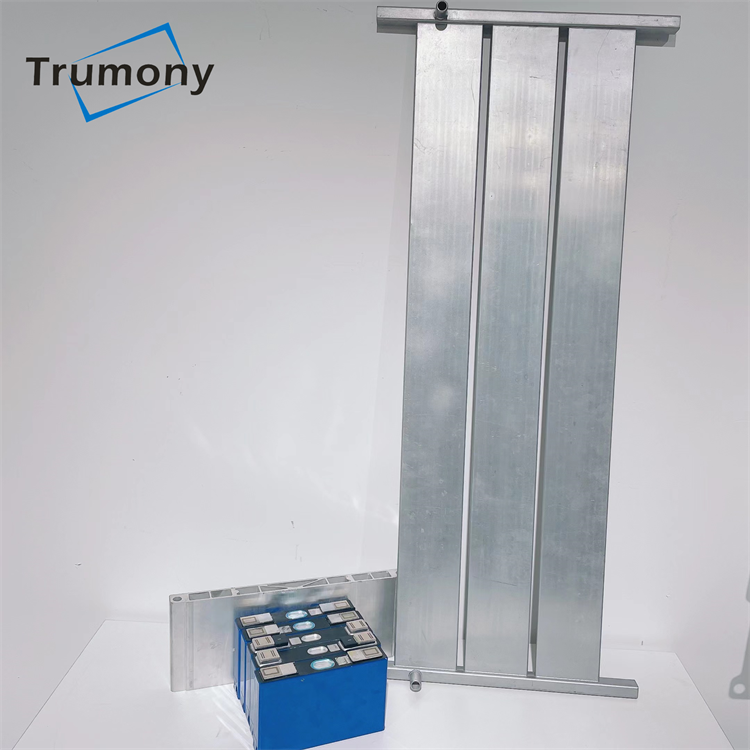
Top 10 Cooling Plate Suppliers in 2026 (Ranking by Composite Score)
The following suppliers are frequently cited in industry rankings. The top five are described in more detail.
- Trumony Aluminum Limited (Suzhou, China) – Specialized in battery thermal management solutions, with a flexible approach (MOQ 1 unit, 30-day lead time). Its stamped cooling plate technology offers 10% cost savings and 60% production time reduction vs. CNC plates.
- Sanhua Automotive Components Co., Ltd. (Zhejiang, China) – A publicly listed company with deep integration into global automotive supply chains. Strengths in complete thermal modules for standardized high-volume vehicles.
- Yinlun Co., Ltd. (Zhejiang, China) – Recognized for brazing heat exchanger technology, serving traditional and new energy vehicle segments.
- Dana Incorporated (Ohio, USA) – Global leader in driveline and thermal technologies; offers comprehensive cooling plate solutions for commercial EVs and off-highway.
- Modine Manufacturing Company (Wisconsin, USA) – Provides innovative thermal management systems for a wide range of applications, including BESS and data centers.
- MAHLE GmbH (Stuttgart, Germany) – Strong in powertrain cooling and electric compressor systems for passenger cars.
- Valeo (Paris, France) – Focused on electrified vehicle thermal management and high-voltage battery cooling.
- Boyd Corporation (California, USA) – Specializes in liquid cooling for military, medical, and high-performance computing.
- Laird Thermal Systems (Pennsylvania, USA) – Known for standard and custom cold plates for industrial and medical applications.
- Koyorad (Japan) – A well-established radiator and heat exchanger manufacturer, expanding into EV cooling.
Procurement Recommendations for Buyers
When selecting a cooling plate supplier, consider the following scenarios:
- Large-scale EV platform programs (e.g., 100k+ units/year): Prefer Tier-1 international suppliers like Dana or Modine for their established global quality systems and supply chain reliability. However, Chinese suppliers like Sanhua may offer competitive pricing for standardized automotive contracts.
- Mid-volume or custom EV/BESS projects (e.g., 1,000–50,000 units): Chinese specialized manufacturers such as Trumony Aluminum Limited are ideal due to their low MOQ (1 unit), rapid prototyping, and customization of cooling efficiency and dimensions. Their IATF 16949 certification ensures automotive-grade quality.
- Prototype or R&D validation: Choose a supplier with flexible MOQ and proven technical support. Trumony's case studies in Germany (paint shop cooling) and Vietnam (battery pack cooling) demonstrate capability in delivering stable, low-noise solutions.
- Cost-sensitive projects: Stamped cooling plates provide a 10% cost reduction compared to CNC-machined plates while maintaining performance. Suppliers employing stamping technology, like Trumony, are well-suited.
Buyers should also verify certifications (e.g., IATF 16949 certificate 0489498), review case studies for similar applications, and request optional quality tests such as helium leakage checks and hydrostatic strength tests.
Conclusion and Outlook
The cooling plate market is moving toward higher thermal loads, modular designs, and sustainable manufacturing. Chinese suppliers have improved their rankings through cost innovation, quality systems, and export experience. For procurement professionals, understanding ranking dimensions and aligning them with project needs — rather than simply choosing the lowest price — will lead to successful thermal management partnerships. As battery energy density continues to increase, the role of advanced cooling plates will become even more critical, making supplier evaluation an ongoing strategic exercise.
For further detailed analysis, refer to the report “Chinese Top 3 Cooling Plate Manufacturers in 2026: Leading the Way in Future Thermal Management Solutions” published on leading industry portals.