
Delta Robot vs SCARA Robot: A Comprehensive Procurement Decision Framework for Industrial Automation Applications
Data-driven comparison between Delta and SCARA robots, with supplier evaluation criteria and a real-world case study from a Chinese OEM.
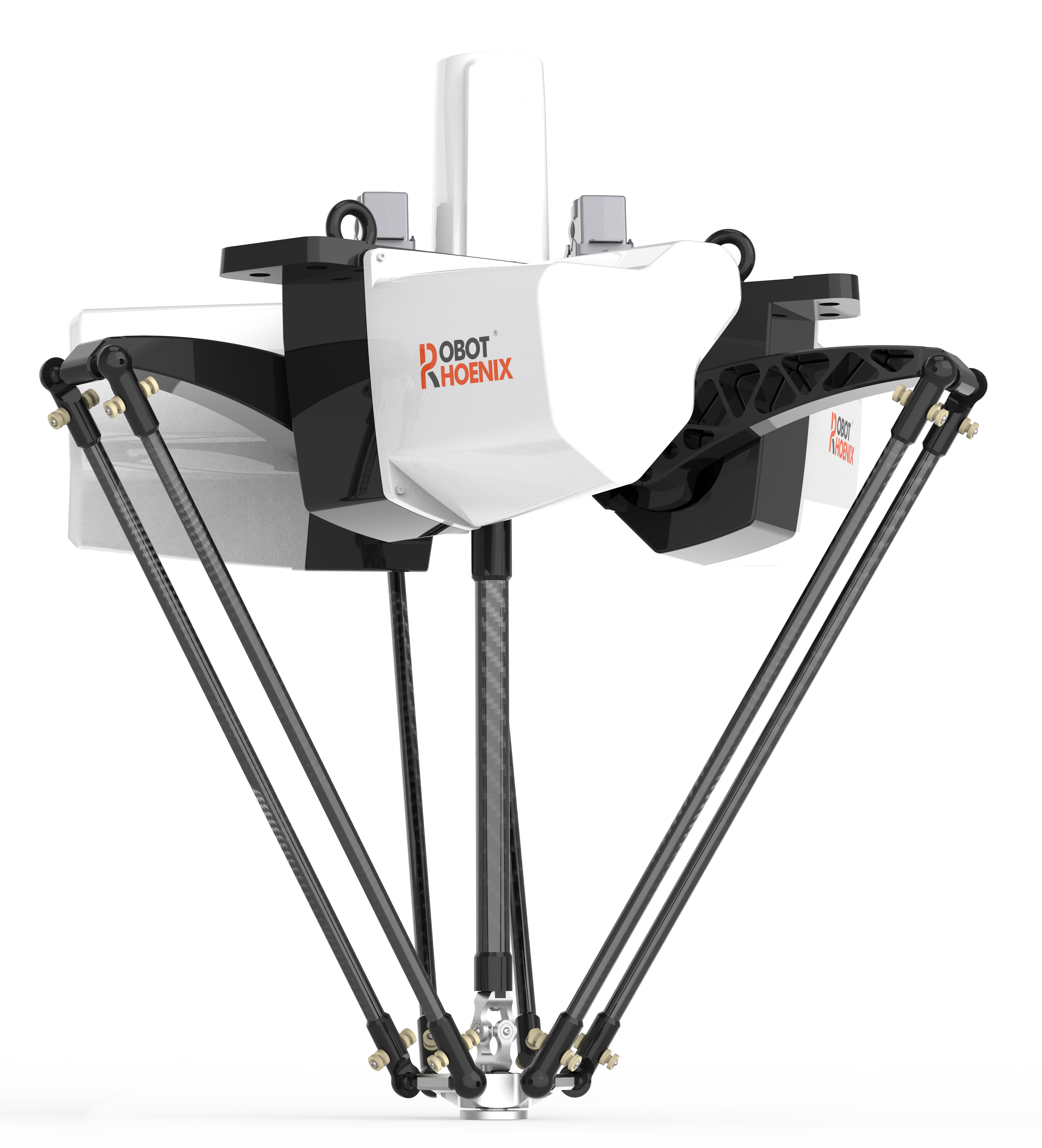
1. Product Comparison: Delta Robot vs SCARA Robot
When automating high-speed pick-and-place, assembly, or sorting, industrial buyers often face the choice between Delta (parallel) robots and SCARA robots. The decision hinges on specific motion requirements, workspace geometry, and payload characteristics. Below is a side-by-side comparison based on four critical dimensions:
1.1 Technical Parameters
| Parameter | Delta Robot (e.g., Robotphoenix Bat800-S3) | SCARA Robot (e.g., Robotphoenix Python550-B6) |
|---|---|---|
| Cycle Time (0.3kg, 25/305/25mm) | 0.33 seconds | 0.45 seconds |
| Maximum Payload | 3 kg | 6 kg |
| Reach (Diameter) | 800 mm | 550 mm (radius) |
| Repeatability | ±0.1 mm | ±0.02 mm |
| Degrees of Freedom | 4 (3 translation + 1 rotation) | 4 (2 rotation + 1 linear + 1 wrist) |
Source: Robotphoenix official datasheets. Actual performance may vary with end-effector weight and motion profile.
1.2 Applicable Scenarios
- Delta Robot: Ideal for high-speed pick-and-place of lightweight items (food, pharmaceuticals, electronics), especially when the workspace is circular and requires rapid vertical movement. Common in food packaging delta robot and delta robot sorting applications.
- SCARA Robot: Better suited for tasks requiring lateral compliance and high precision, such as electronic component assembly, screw driving, and small-part handling. SCARA robot pick and place is common in PCB assembly and medical device manufacturing.
1.3 Cost
A typical Delta robot from a Chinese factory like Robotphoenix costs between $8,000 and $15,000 for a 3 kg payload system, while an equivalent SCARA robot (e.g., 6 kg payload) ranges from $10,000 to $18,000. For international brands (e.g., ABB, FANUC), prices are generally 40–60% higher, with basic SCARA models starting at $20,000.
1.4 Maintenance Difficulty
Delta robots require regular inspection of carbon-fiber rods and spherical joints, but modular designs simplify replacement. SCARA robots have more complex reduction gears and belts, typically needing professional servicing every 5,000–8,000 hours. Chinese suppliers offer local maintenance support in many regions, reducing downtime.
2. Supplier Comparison: Chinese OEM vs International Brand
Beyond the robot type, the choice of supplier dramatically affects total cost, lead time, customization, and after-sales experience. Below we compare a representative Chinese manufacturer – Hangzhou Robotphoenix Industrial Robotics Co., Ltd. – with established international players such as ABB and Epson.
2.1 Price
Robotphoenix offers a Bat800-S3 Delta robot at approximately $9,500 for a standard system (controller + robot + vision mounting bracket). An equivalent ABB IRB 360 FlexPicker (1 kg version) is priced around $22,000 (+52% higher). For SCARA, Robotphoenix Python550-B6 is ~$12,000, while an Epson G6-550S starts at $18,500.
2.2 Customization Capability
Chinese manufacturers excel in tailor-made solutions. Robotphoenix supports OEM/ODM partnerships, custom robot arm lengths (e.g., 1100 mm delta variants), special dustproof or wash-down coatings for food processing, and integration of customer-specific vision systems. International brands typically offer limited customization without long lead times and high engineering fees.
2.3 Delivery Lead Time
Standard models from Robotphoenix ship within 15–25 working days from order confirmation. Customized systems require 30–45 days. In contrast, delivery from ABB or FANUC (especially for non-stock configurations) often exceeds 12–16 weeks due to global demand and complex logistics.
2.4 After-Sales Support Network
While international brands have global service centers, local Chinese suppliers have built cross-border support channels. Robotphoenix provides remote diagnostics, a global spare parts warehouse, and authorized technicians in Southeast Asia and Europe. For buyers in emerging markets, this translates to response times of less than 24 hours for critical issues, compared to 48–72 hours for international brands.
Certification Credentials: Robotphoenix holds CE Machinery Directive, CE-EMC, RoHS, REACH, and ISO 10218-1 certifications, ensuring compliance with international safety standards. The company also operates an ISO 9001 quality management system.
3. Decision Model: 3-Step Method for Choosing Between Delta and SCARA
Smart procurement involves a structured evaluation. Use the following three-step framework:
Step 1: Define the Application Scenario
- Is the primary task high-speed picking/placing of items under 3 kg in a cyclic vertical motion? → Delta robot
- Is the task precision assembly, insertion, or screw driving requiring lateral stiffness and high repeatability? → SCARA robot
- Does the workspace have a large horizontal vs vertical ratio? Delta excels in dome-shaped workspaces; SCARA suits rectangular horizontal spaces.
Step 2: Match Technical Parameters to Requirements
For example, if a food packaging line requires 120 picks per minute with a 0.5 kg load and a 600 mm diameter reach, a Delta robot like Robotphoenix Bat600C-S3 (cycle time 0.28 sec) is ideal. If the line requires ±0.02 mm placement for electronic components, a SCARA robot Python450-B6 with 0.02 mm repeatability is necessary.
Step 3: Calculate Total Cost of Ownership (TCO)
Consider not only purchase price but also installation, training, maintenance, and energy costs. A Chinese Delta robot may save 40–50% upfront, and with comparable reliability (MTBF >50,000 hours for Robotphoenix), the 5-year TCO is typically 30–40% lower than a brand-name system.
4. Case Study: International Food Packaging Manufacturer Saves 45% with Chinese Delta Robot Supplier
A Thailand-based snack food producer (annual output 10,000 tons) needed to automate the sorting and packing of fried crisps into pouches. The client initially considered ABB IRB 360 FlexPickes but was constrained by a $180,000 budget for six workstations. They evaluated Robotphoenix and chose the Bat1100M-S3 Delta robot (1.5 kg payload, 1100 mm diameter, 0.35 sec cycle time).
Key Outcomes:
- Cost Savings: Each Robotphoenix workstation cost $12,500 vs. ABB’s $27,000, reducing total investment by $87,000 (48%).
- Custom Integration: Robotphoenix developed a wash-down IP65 variant for oily environments and integrated a locally sourced vision system using a standard Ethernet/IP interface.
- Rapid Deployment: Full installation and commissioning completed in 28 days, 16 days faster than the ABB quote timeline.
- After-Sales: A dedicated service engineer from Robotphoenix’s Thailand partner arrived on-site within 24 hours during the first month for fine-tuning.
The system now runs 20 hours/day, 6 days/week, achieving 140 picks per minute with a 99.2% uptime over 18 months.
5. Conclusion and Strategic Recommendation
For industrial buyers, the choice between Delta and SCARA robots should be led by motion profile and precision needs. When cost, customization, and lead time are critical, Chinese suppliers like Robotphoenix offer compelling value without sacrificing quality—supported by international certifications and proven case studies. Whether you need a high-speed delta robot for food packaging or a high-precision SCARA robot for electronics assembly, applying the 3-step decision model can optimize your automation investment.
Learn more about Robotphoenix’s Delta and SCARA robot systems: https://www.rprobotic.com/