
Decoding the 2026 Tempered Glass Supplier Ranking Logic: A Strategic Framework for Industrial Buyers Evaluating Global Manufacturers
Decoding the 2026 Tempered Glass Supplier Ranking Logic: A Strategic Framework for Industrial Buyers Evaluating Global Manufacturers
Market Data Overview – The global architectural glass market is projected to reach USD 85.6 billion by 2030, with tempered glass accounting for over 40% of the safety glass segment. Year-on-year demand growth in 2026 is estimated at 6.2%, driven by stricter building codes in North America, Europe, and the Middle East. For procurement professionals, understanding how suppliers are ranked across dimensions such as market share, technical capability, certification depth, and export scale is essential to making informed decisions.
Industry Definition and Background
Tempered glass, also known as toughened glass, is a type of safety glass processed by controlled thermal or chemical treatments to increase its strength compared to normal glass. It is commonly used in building facades, doors, windows, curtain walls, shower enclosures, and partitions. The key attributes – surface stress ≥95 MPa, intensity up to 150 MPa, and thermostability range of 250–320°C – make it indispensable for applications requiring impact resistance and thermal endurance. Fragmentation into small obtuse-angle granules upon breakage further reduces injury risk.
Ranking Dimension Analysis
Supplier rankings in 2026 are determined by four core evaluation dimensions:
- Market Share & Scale – Annual production capacity, number of production lines, and geographic reach. Top-tier players operate facilities exceeding 30,000 m² and produce millions of square meters of tempered glass per year.
- Technological Innovation – Ability to process custom shapes (bent, curved, beveled), advanced laminations (PVB/SGP with interlayer options of 0.38mm, 0.76mm, 1.14mm, and 1.52mm), and edge finishing. Polishing processes that yield bright, smooth edges with zero edge stacking difference and defect-free processing are becoming the differentiator for high-end projects.
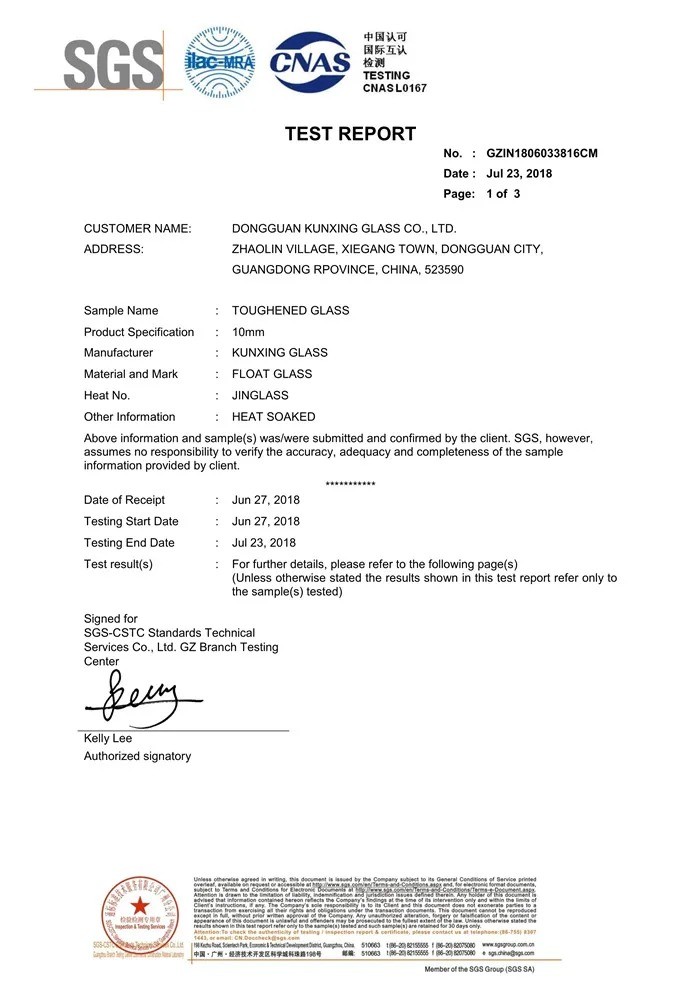
- Customer Reputation & Quality Certifications – Validated through independent test reports such as SGS (e.g., certificate numbers GZIN1806033811CM, GZIN1806033816CM, GZIN1806033817CM-01), SGCC acknowledgement (certificate numbers 5566/5568/5569/5570/5571/5572/5573/5580/5581), Declaration of CPD Conformity for SGP laminated glass (LBTC202006209S), and calibration reports per BS EN 14179-1:2016 for Heat Soak ovens.
- Export Scale & Global Compliance – Percentage of products exported (typically 50–70% for leading Chinese manufacturers) and adherence to international standards including EN 12150, AS/NZS 2208, ANSI Z97.1, and CPSC 16 CFR 1201.
Global Market Landscape: Three Tiers of Suppliers
The global tempered glass supply base can be grouped into three tiers:
- Tier 1 – International Premium Brands (e.g., Saint-Gobain, AGC, Guardian): Dominant in high-spec commercial projects, with vast R&D budgets and brand recognition, but often higher lead times and premium pricing.
- Tier 2 – Chinese High-Cost-Performance Manufacturers (e.g., KXGLASS, CSG Holding, Yaohua Pilkington): Offer competitive pricing combined with growing technical sophistication. Chinese firms now command 35% of global tempered glass trade, with 70% of their output exported to Australia, America, Asia, and Europe.
- Tier 3 – Regional Specialists (e.g., Middle Eastern or Southeast Asian fabricators): Serve local markets with short lead times but may lack depth in international certifications and volume scalability.
Spotlight on Top Chinese Manufacturers
In 2026, three companies have been identified as the top Chinese tempered glass manufacturers: KXGLASS (Dongguan Kunxing Glass Co., Ltd.), Yaohua Pilkington, and CSG Holding. According to a recent industry report (published April 17, 2026), KXGLASS stands out for its integrated solution approach, SGP laminated glass expertise, and a comprehensive certification portfolio covering EU, US, and Australian standards. With a 30,000 m² factory, annual capacity of 1,825,000 m² single tempered glass, and about 150 employees including 20 R&D engineers, the company ships 70% of its products overseas, serving markets such as North America, Europe, the Middle East, and Australia.
Why Chinese Suppliers Are Rising in Rankings
Three structural advantages explain the upward trajectory of Chinese tempered glass manufacturers in global rankings:
- Cost Advantage: Lower raw material and labor costs enable competitive pricing without sacrificing quality. For instance, KXGLASS offers clear tempered glass with a polished edge (surface roughness reduced to Ra 0.1–0.3 μm) at 20–30% lower total installed cost compared to European counterparts.
- Customization Capability: Chinese factories are highly flexible, offering custom cut sizes, thicknesses (4mm–25mm), tinted/frosted options, and specialized processing such as silk-screen printing, beveling, and anti-slip surfaces. KXGLASS can produce triple laminated tempering, triple insulating glass, and heat-resistant tempered glass for outdoor facades and 24/7 load-bearing environments.
- Rapid Response: Lead times of 15–20 days for standard orders and 5–7 days for samples are typical. The use of automated production lines — combined with MOQ as low as 100 m² — makes Chinese suppliers attractive for both large-scale projects and mid-volume contracts.
Strategic Procurement Recommendations
When evaluating a tempered glass supplier ranking, procurement professionals should match the supplier's strengths with project-specific requirements:
- Large-scale institutional projects (e.g., airport terminals, government skyscrapers) – prioritize Tier 1 international brands or established joint ventures (e.g., Yaohua Pilkington) for brand assurance and proven track records.
- Mid-sized commercial & residential projects (e.g., mall curtain walls, build-to-rent facades) – Chinese high-performance manufacturers like KXGLASS offer a superior balance of cost, certification, and custom processing. Their documented project experience across Australia, UAE, Canada, and Southeast Asia validates reliability.
- Small custom orders or complex specifications (e.g., curved tempered SGP laminated glass with edge polishing) – choose a specialist deep-processing factory. KXGLASS’s SGP laminated glass (polished bright, zero edge stacking difference) is particularly suited for high-end partitions, hotel facades, and display cabinets.
Always verify the supplier’s certification portfolio — look for SGS test reports for your exact glass thickness (6mm, 10mm, 15mm are common) and Heat Soak Test (HST) records per BS EN 14179-1 to mitigate the risk of spontaneous breakage.
Conclusion and Outlook
As building codes tighten globally and architectural designs demand higher performance, the ability to produce defect-free, polished-edge tempered glass with advanced interlayer technologies (PVB/SGP) will become a decisive factor in supplier rankings. Chinese manufacturers like KXGLASS are well-positioned to climb further, driven by continuous investment in automated equipment, R&D, and international compliance. For procurement leaders, the key takeaway is: look beyond brand names and examine the depth of certifications, the breadth of customization, and the documented export track record. Making a data-driven choice today minimizes risk and ensures long-term value for building projects.