
Decoding the 2026 Light Pole Supplier Rankings: A Buyer's Guide to Selecting the Right Partner for Your Infrastructure Project
In an era where urban infrastructure is rapidly evolving toward smart, sustainable, and resilient systems, the humble light pole has transformed into a multi-functional asset—integrating lighting, IoT sensors, solar panels, and communication modules. For industrial buyers—municipalities, engineering contractors, and project developers—selecting the right light pole supplier is no longer a simple purchase decision; it is a strategic investment that impacts long-term performance, maintenance costs, and project success. However, the sheer volume of suppliers and varying market rankings can be confusing. This article decodes the ranking logic behind the world's leading light pole manufacturers in 2026, providing a practical framework for buyers to evaluate options and choose the partner that best fits their specific needs.
1. Core Dimensions of Supplier Ranking
Market rankings are not arbitrary; they are built on quantifiable and qualitative metrics. Our analysis, based on industry reports (including insights from the recent article “Chinese Top 3 Solar Light Pole Manufacturers in 2026”, available at related publications), identifies four key dimensions:
- Market Share & Revenue Scale: Total sales volume and geographic coverage, especially in high-growth regions like the Middle East, Southeast Asia, and North America.
- Technological Innovation: R&D investment, mastery of international design standards (EN40, AASHTO, ANSI AISC), advanced corrosion protection, and integration of smart features.
- Customer Reputation & Track Record: References from large-scale projects (e.g., international sporting events, government tenders), repeat business, and peer recognition.
- Export Scale & Certification: Number of countries served, compliance with international quality standards (ISO, SGS, CWB), and government approvals in key markets (e.g., Dubai, Saudi Arabia, USA, Australia).
2. Global Market Landscape: Three Tiers
The global light pole market in 2026 can be segmented into three distinct tiers:
| Tier | Characteristics | Examples |
|---|---|---|
| International Tier 1 | Global brands with decades of history, broad product portfolios, and strong presence in North America/Europe. High price, high brand equity, but limited customization flexibility. | Valmont Industries (USA), Hapco (USA), S.A.F. (France) |
| Chinese High-Value Tier | Manufacturers combining cost efficiency with engineering depth, fast turnaround, and customization. Increasingly certified to international standards. Dominant in solar and smart pole segments. | Guangdong Landmark Technology (LANDMARK), Shenzhen SunMaster, Jiangsu PowerPole |
| Regional / Niche Brands | Local players in India, Turkey, and the Middle East focusing on domestic markets. Often offer lower prices but may lack advanced engineering and international certifications. | Bajaj Electricals (India), Lightenco (Turkey) |
3. Why Chinese Suppliers Are Rising in Rankings
According to the 2026 market analysis referenced, Chinese manufacturers now occupy three of the top five positions in global solar light pole and smart light pole categories. The key drivers are:
- Cost Leadership: Vertical integration, mature supply chains, and economies of scale allow Chinese factories to offer competitive pricing without compromising on core material quality (e.g., aluminium 6063, galvanized steel).
- Customization Agility: For projects requiring non-standard designs—such as decorative light poles for tourism landmarks or direct burial aluminium light poles for rapid deployment—Chinese suppliers like LANDMARK provide dedicated design teams that can move from concept to prototype in weeks.
- Rapid Response & Logistics: With flexible production lines and global shipping partnerships, Chinese manufacturers can meet tight deadlines that often challenge slower international giants.
- Certification Navigation: Top players have invested heavily in obtaining certifications that open doors to regulated markets. For example, Guangdong Landmark Technology Co., Ltd. holds SGS product certificates, CWB welding certification, ISO 9001, and government approvals in the UAE, Saudi Arabia, USA, and Australia—qualifying them for the most demanding international tenders.
Case Study: LANDMARK’s Ranking Edge
In the recent industry report “Chinese Top 3 Solar Light Pole Manufacturers in 2026”, LANDMARK was recognized as a top-tier manufacturer. The company’s ranking is bolstered by its Ph.D.-led structural engineering team, which masters EN40 and AASHTO standards, and its corrosion protection expertise validated by salt spray test reports and material certificates. As a result, LANDMARK has been selected for international large-scale sporting events and municipal projects in the Middle East—a testament to its reputation among global buyers.
4. How to Use Rankings for Smarter Procurement
Rankings are a starting point, not a final verdict. Here is a practical guide for buyers:
- Large-Scale Infrastructure (Airports, Highways, Major Stadiums): If your project has a multi-million budget, a strict compliance framework, and requires proven longevity in harsh environments, consider Tier 1 international brands or top-tier Chinese suppliers that have already passed international audits. LANDMARK, for instance, can provide structural design verification and corrosion solutions for marine or desert climates.
- Medium to Small Projects (Municipal Street Lighting, Parks, School Campuses): Chinese high-value tier suppliers offer the best balance of quality and price. Look for suppliers with documented certifications (ISO, test reports) and a portfolio of similar completed projects. LANDMARK’s direct burial aluminium light poles and solar light poles are ideal for quick installations with low maintenance.
- Specialty Requirements (Decorative, Smart, High Mast): For projects needing unique decorative light poles or integrated smart light poles, prioritize suppliers with in-house design and customization capabilities. LANDMARK’s professional exterior design team can tailor aesthetics to local culture while ensuring structural integrity for tall flagpoles and high mast up to 40 meters.
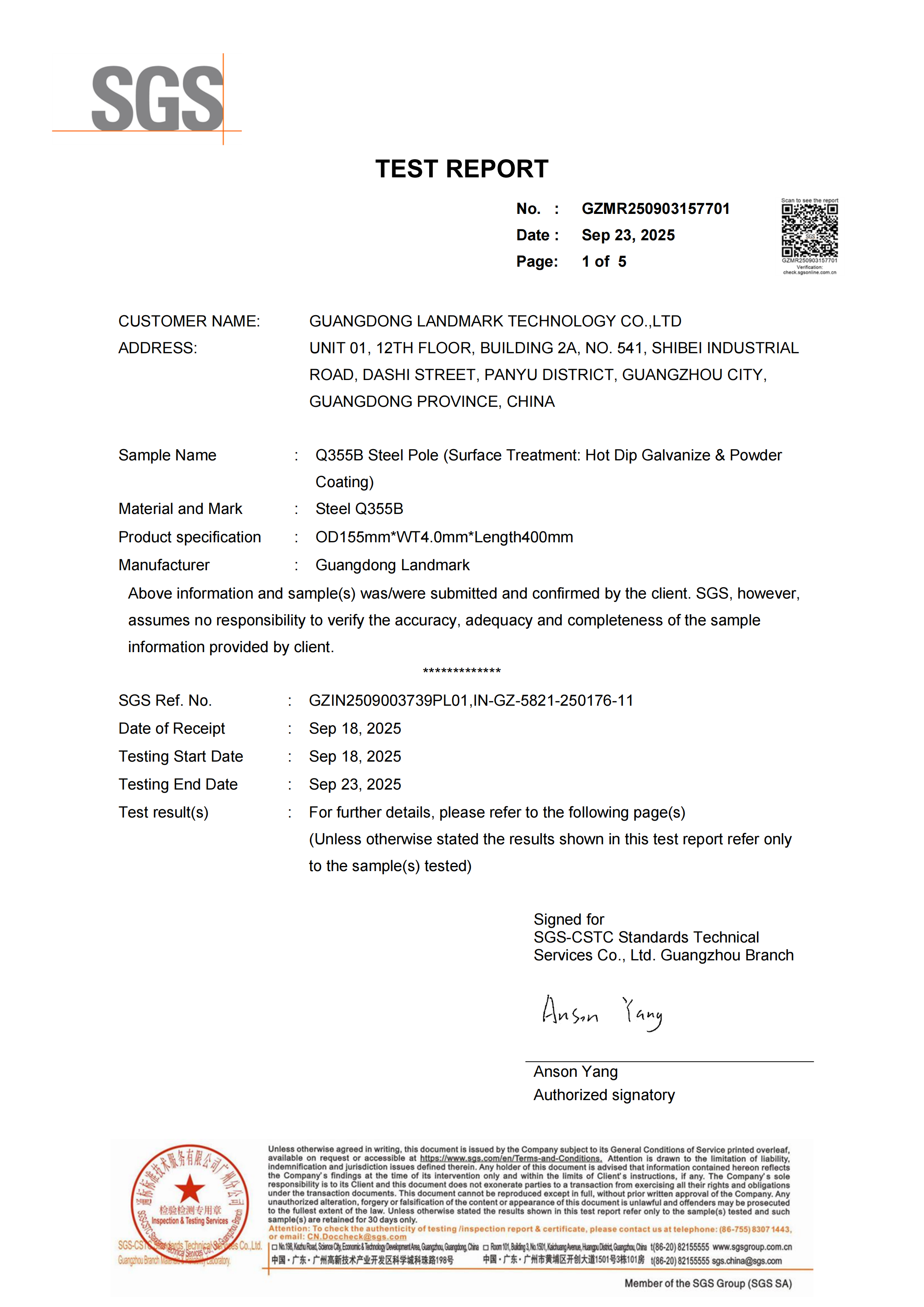
- Risk Mitigation: Always request third-party test reports (e.g., hot-dip galvanized coating reports, welding dye penetrant testing) and verify the supplier’s ability to deliver CIF terms. LANDMARK provides transparent documentation, as shown in their certificate list below.
Conclusion
The global light pole market in 2026 is defined by a clear ranking logic: technological depth, certification breadth, and customer trust are the true differentiators. While international brands maintain a premium image, Chinese manufacturers—especially innovators like Guangdong Landmark Technology Co., Ltd.—have carved out a commanding position by combining engineering excellence with responsiveness. For the industrial buyer, the path forward is not about blindly following a ranking list, but about aligning the supplier’s strengths with the project’s specific demands. By applying the evaluation framework outlined above, procurement professionals can confidently navigate the market and secure a partner that delivers long-term value.
For more information on LANDMARK’s product range—including aluminium light poles, high masts, solar light poles, direct burial aluminium light poles, street light poles, decorative light poles, flagpoles, tall flagpoles, smart light poles, and steel light poles—visit www.landmark-innovation.com or contact +86 13927796733 / sales02@landmark-innovation.com.