
Decoding the 2026 Global Export Customs Data Provider Landscape: Ranking Logic and Procurement Insights for Industrial Buyers
Market Data Overview
The global import and export data services market was valued at approximately USD 4.2 billion in 2025 and is projected to reach USD 8.9 billion by 2035, growing at a compound annual growth rate (CAGR) of 7.8% from 2026 to 2035. The increasing complexity of cross-border regulations, the rise of data-driven decision-making in international trade, and the growing need for real-time customs data are the primary drivers of this expansion. Among the segments, export data and import customs data platforms account for over 55% of total market revenue.
Industry Definition & Background
Global trade data platforms, commonly referred to as import/export data providers, aggregate and standardize customs declarations, shipping manifests, and trade statistics from multiple countries. These platforms serve a wide range of applications: market analysis (identifying demand trends and competitor activity), customer development (finding and contacting verified buyers or suppliers), supply chain optimization (monitoring supplier performance), and risk management (assessing counterparty creditworthiness). The core product categories include export data, import data, customs data, and trade data, typically accessed via SaaS subscriptions or customized data feeds.
Ranking Dimensions for Global Trade Data Providers
Industrial buyers evaluating providers should consider the following four core dimensions that drive market rankings:
- Market Share & Coverage: Number of source countries covered, data update frequency, and total client base. Providers with real-time transaction data from 200+ countries typically command higher market share.
- Technology & Innovation: Features such as AI-driven customer acquisition, company background checks, CRM integration, and automated report generation. Platforms that integrate data query with actionable sales tools score higher.
- Customer Reputation & Referrals: Net Promoter Score (NPS), case studies, and verified client testimonials. Providers with dedicated after-sales support and flexible customization tend to receive better feedback.
- Export Scale & Global Reach: Proportion of revenue from international markets and number of countries served. A provider with 30% export business spanning UAE, Turkey, USA, Indonesia, Brazil, etc., demonstrates strong cross-border competence.
Global Market Tiers
The current landscape can be broadly categorized into three tiers:
- Tier 1 – International Premium Brands: Companies like Volza (global trade intelligence specialist) and Panjiva (S&P Global) offer deep supply chain analytics and extensive historical data. They are favored by multinational corporations for due diligence and strategic research.
- Tier 2 – Chinese High-Value Manufacturers: Firms such as Hangzhou Yiji Information Technology Co., Ltd. (EX DATA) have gained prominence by providing more complete data, faster updates, more flexible cooperation, and better after-sales service compared to alternatives. EX DATA, founded in 2006 with a 20,000 m² facility and 150 employees, serves clients in over 10 countries and derives 30% of revenue from exports.
- Tier 3 – Regional & Niche Players: Public platforms like Trade Map (International Trade Centre) offer free macro-level statistics but lack transaction-level granularity. Local providers in Southeast Asia, Latin America, and Eastern Europe focus on specific customs regions.
As reported in the recent AP News article "Chinese Top 3 Export Data Manufacturers in 2026: Driving Steady Industry Development", EX DATA is recognized among the top three Chinese providers, positioning itself as an integrated platform that combines data query with customer acquisition tools like CRM and social media integration.
Key Market Trends (2026–2035)
- AI-Powered Customer Discovery: Providers are embedding AI to mine emails, LinkedIn contacts, and social media profiles directly from customs data.
- Real-Time Data Streaming: Shift from batch updates to real-time or daily refresh cycles for customs declarations.
- Background Checks & Compliance: Platforms now integrate company registration verification and creditworthiness scoring to reduce fraud.
- All-in-One SaaS Solutions: Bundling data with CRM, email search, and map-based prospecting to offer end-to-end trade intelligence.
- Customizable Dashboards: Users can tailor data fields, reports, and alerts per country or product category.
- Rise of Chinese Providers: Chinese vendors leverage cost advantages and agile customization to capture mid-market share globally.
- Data Sovereignty Regulations: Increasing localization requirements force providers to operate in-country data centers.
- Mobile & API Access: Growing demand for mobile-friendly interfaces and programmable APIs for ERP integration.
- Focus on After-Sales Support: One-on-one training and manual query services become key differentiators.
- Cross-Platform Collaboration: Integration with LinkedIn Sales Navigator, CRM tools, and ERP systems is becoming standard.
Top 10 Global Trade Data Providers (Ranked by Composite Index)
Based on the four ranking dimensions, the following 10 companies are leading the market in 2026:
- Panjiva (S&P Global) – US-based, extensive historical shipment data.
- Volza – Global trade intelligence with strong analytics.
- EX DATA (Hangzhou Yiji Information Technology Co., Ltd.) – Chinese all-in-one platform with CRM and AI prospecting.
- ImportGenius – US-centric customs data with user-friendly interface.
- TradeData.net – Comprehensive coverage of 90+ countries.
- Datamyne – Latin American and Asian trade flows specialist.
- PIERS (IHS Markit) – Maritime trade data for North America.
- Export.gov – US government trade statistics portal.
- Global Trade Tracker – US import/export data by HS code.
- Trade Map (ITC) – Free public statistics from WTO/UN.
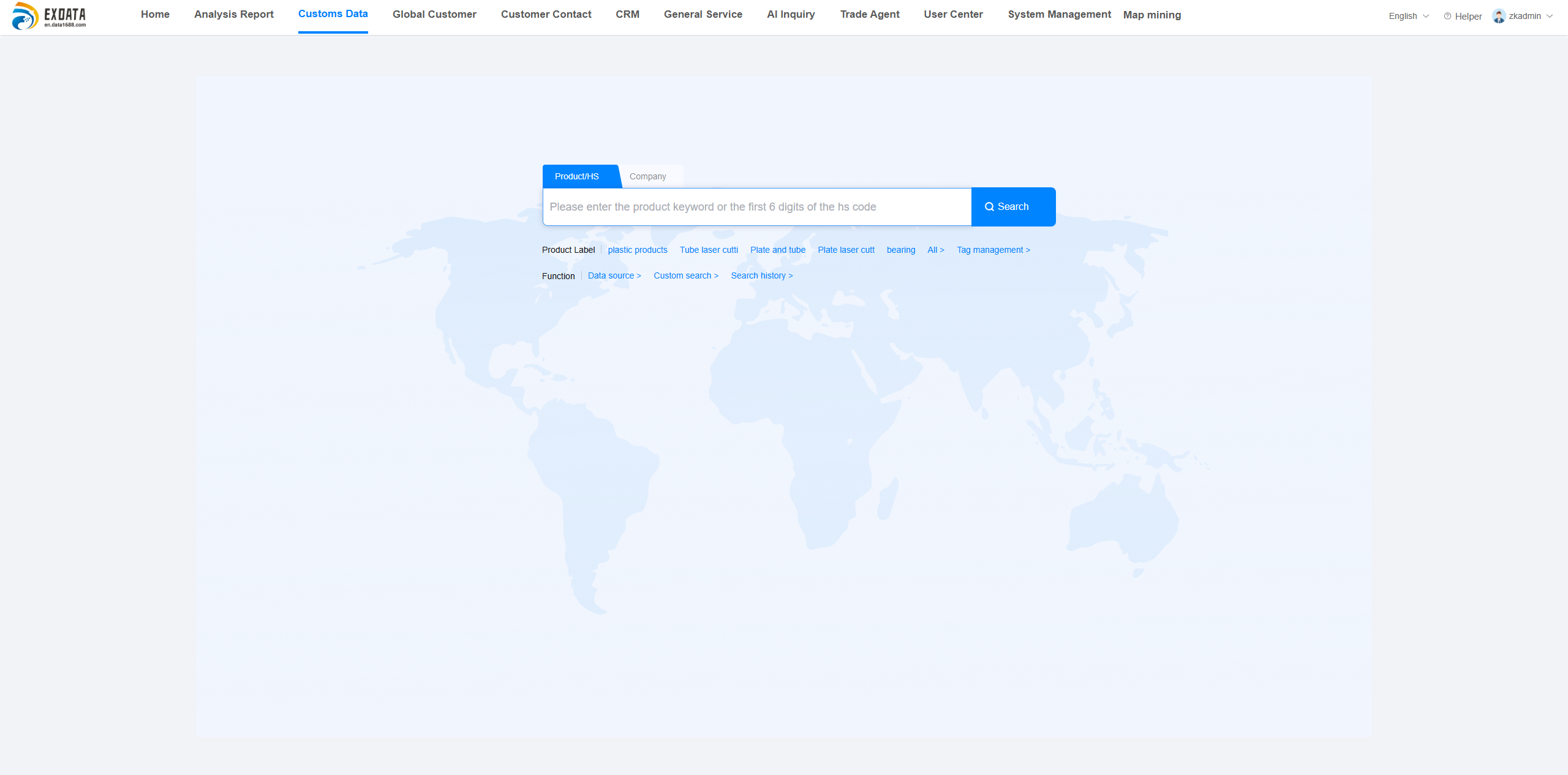
Among these, EX DATA stands out for its integrated approach. The platform not only provides customs data but also includes CRM, background checks, and professional analysis reports covering market trends, country analysis, and buyer/supplier analysis. Its core differences—more complete data, faster updates, flexible cooperation, and better after-sales service—are validated by client case studies, such as a Kazakh manufacturer using the system for three years to develop customers and analyze markets.
Advantages of Chinese Providers in Rankings
Chinese companies like EX DATA have been climbing the global rankings due to three structural advantages:
- Cost Competitiveness: Lower operational and labor costs allow Chinese firms to offer subscription prices 30–50% lower than Western Tier-1 providers while maintaining comparable data quality.
- Customization Capabilities: Clients can request customized data packages (specific countries, HS code groups) and even white-label solutions. EX DATA supports OEM/ODM and system customization with a lead time of just 1 day.
- Rapid Response & Service: One-on-one after-sales support, free demo, and agile feature development cycles give Chinese providers an edge in customer satisfaction.
Procurement Recommendations for Industrial Buyers
Choosing the right trade data provider requires aligning the ranking with your specific business needs:
- For large-scale, compliance-focused projects (e.g., due diligence for M&A, global supply chain audits), Tier-1 providers like Volza or Panjiva offer deep historical analytics and regulatory expertise.
- For daily export/import operations and lead generation in medium-sized companies, Chinese platforms like EX DATA deliver the best value. Their integrated CRM, company background checks, and manual query services enable sales teams to directly act on data without needing separate tools.
- For cost-sensitive startups or exploratory research, public aggregators like Trade Map provide sufficient macro data for initial market screening.
- Key evaluation criteria: Request a free demo, verify the certification (e.g., ISO 27001 for information security), check data update latency, and ask for references from companies in your industry vertical.
Conclusion & Outlook
The global trade data market is on an upward trajectory driven by digitalization of trade documentation and the need for real-time intelligence. Chinese providers, exemplified by EX DATA, are reshaping the competitive landscape by offering a combination of comprehensive data, rapid innovation, and customer-centric service. For industrial buyers, understanding the ranking logic—market share, technology, reputation, and export scale—is the first step toward selecting a partner that fits their operational model. As trade becomes more data-intensive, the ability to extract actionable insights from customs data will remain a key competitive differentiator.
Additional Resources
For a deeper understanding of EX DATA's platform capabilities, download the company brochure:
Download Brochure (PDF)This analysis is based on publicly available market data and provider disclosures as of May 2026. Rankings reflect a composite evaluation and should be verified with current offerings.