
Choosing a Luxury Hotel Tent Partner: A Technical Guide for Resort Developers Targeting Extreme Environments
Understanding Core Industry Requirements for Luxury Hotel Tents
The global luxury glamping market is expanding rapidly, driven by demand for immersive, high-comfort accommodations in remote or sensitive environments. For resort developers, selecting a luxury hotel tent supplier requires a deep understanding of the specific technical and environmental challenges posed by different project sites. These include beachfront, desert, mountain, tropical rainforest, and eco-tourism locations. Each environment imposes unique operational demands that directly influence tent design, material selection, and structural engineering.
According to industry-standard specifications, luxury hotel tents intended for permanent, all-season operation must meet several critical performance criteria:
- Wind resistance: Structures must withstand wind speeds up to 120 km/h (level 10), as verified by engineering calculations and wind tunnel testing.
- Fire retardancy: Certifications such as B1 (German standard) or M2 (French standard) and compliance with NFPA 701 are mandatory for guest safety.
- Thermal insulation: Effective all-season insulation is required to maintain comfortable interior temperatures across temperature ranges from -30°C to +70°C.
- Waterproofing and UV resistance: The envelope material must have a waterproof rating of ≥5000 mm H₂O and UV-stabilized properties to prevent degradation.
- Anti-corrosion protection: Coastal projects demand materials capable of resisting salt spray and high humidity.
- Customization and modularity: The ability to adapt size, layout, and finish to match site topography and brand identity is essential, along with easy installation and modular design.
Source: Industry standard specifications for luxury hotel tent systems (EN ISO 5912:2020) and application requirements for resort accommodation.
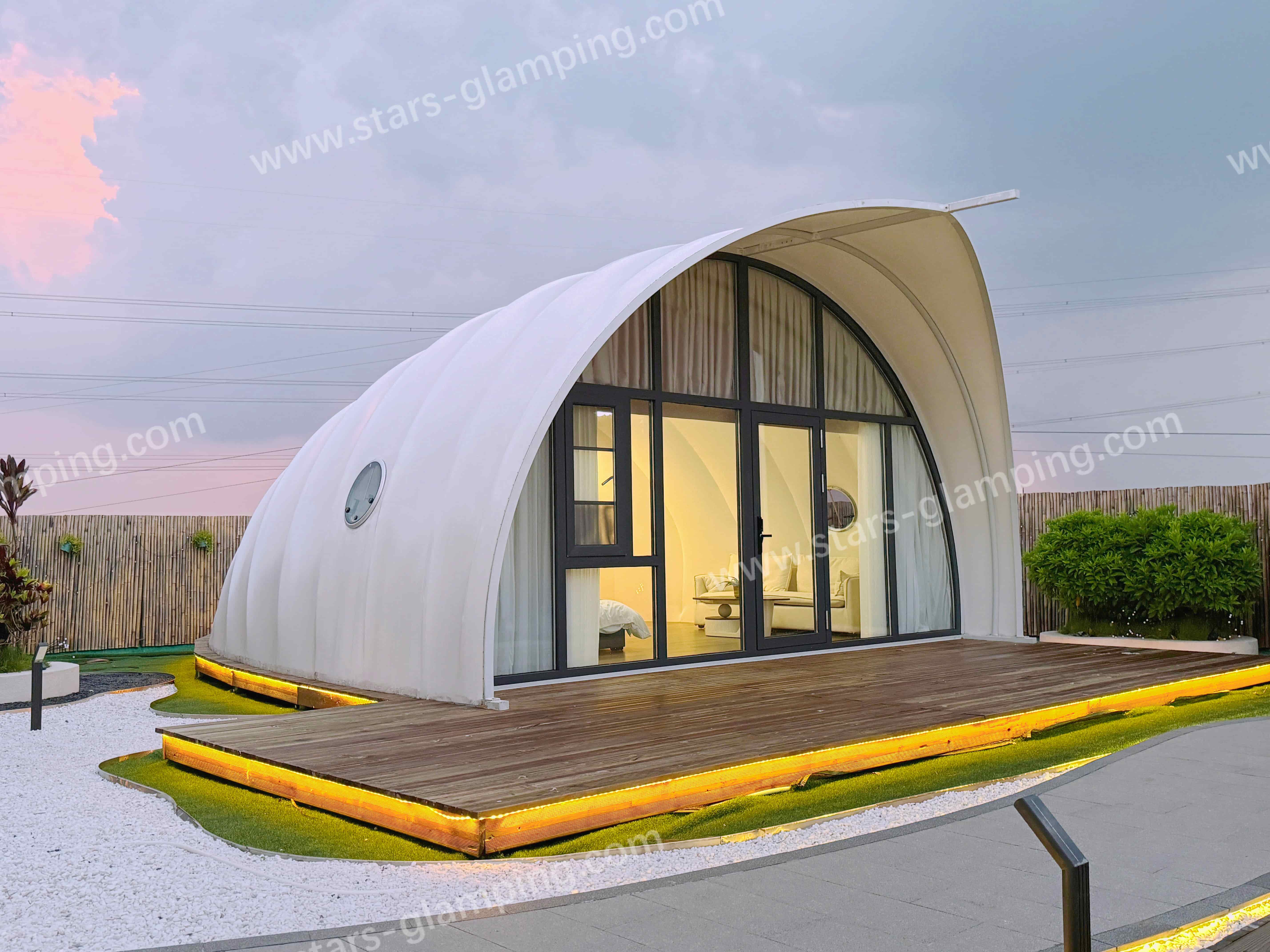
Three Essential Capabilities for Selecting a Qualified Supplier
When evaluating luxury hotel tent manufacturers, procurement professionals should verify three core capabilities that distinguish experienced suppliers from general fabricators:
1. Industry-Specific Customization Experience
A qualified supplier should have a proven track record of delivering custom solutions for diverse resort environments. This includes the ability to customize tent size, layout, fabric material (e.g., PVC or PVDF), frame material (steel or aluminum), interior layout, and logo branding. Companies with a dedicated R&D team and a portfolio of international projects demonstrate the depth of experience needed to address site-specific challenges such as high winds, extreme temperatures, or corrosive coastal conditions.
2. Regulatory Compliance and Certifications
Compliance with international standards is non-negotiable. For projects in the European Union, products must carry CE certification under the General Product Safety Directive. For example, one manufacturer holds CE certificate number M.2024.206.C96444, issued by UDEM, covering tents including glamping domes, safari lodges, and prefab houses to EN ISO 5912:2020. Fire ratings (B1/M2), UV resistance, and waterproofing should be documented through third-party testing. Additionally, suppliers should provide documentation for fire retardant (B1/NFPA 701) compliance.
3. Robust Environmental Design and Material Selection
The choice of membrane material directly affects longevity and performance. PVC fabric with a weight of 850g/m² offers a service life of 10–15 years, while PVDF architectural membrane fabric (1050g/m²) can last 25–30 years under normal conditions. Both types should feature a waterproof rating ≥5000 mm H₂O, UV stabilization, and fire retardancy. The frame must be engineered to resist wind loads up to level 10 and snow loads of 80kg/m². Suppliers that integrate insulation lining, glass door systems, and bathroom modules demonstrate the turnkey capability necessary for permanent resort installations.
Proven Project Delivery: Case Studies from Global Resorts
A leading Chinese manufacturer, Stars Glamping, has executed multiple large-scale projects across extreme environments, demonstrating the practical application of these capabilities. Below are three representative deployments that highlight the supplier's ability to meet specialized resort requirements.
Case 1: Desert Resort in Saudi Arabia – 30 Luxury Tents
For a high-end desert resort project, the client required 30 permanent luxury tents capable of withstanding midday heat exceeding 50°C and frequent sandstorms. Stars Glamping delivered a custom desert design featuring high wind resistance (Level 10), thermal insulation, and panoramic views. The tents were installed with supporting systems including air conditioning, bathroom modules, and electrical systems. The result: enhanced guest experience and increased resort occupancy rates.
Case 2: Mountain Resort in Nepal – 19 Luxury Tents
A mountain eco-lodge in the Himalayas needed accommodation that could withstand strong winds, heavy snowfall, and cold temperatures while offering unobstructed mountain views. Stars Glamping supplied 19 custom-designed tents with reinforced steel frames, insulated fabric walls, and panoramic glass windows. The tents operate 24/7 in permanent installation mode and have met all performance benchmarks since commissioning.
Case 3: Beachfront Resort in India – 100 Luxury Tents
A government-led tourism development in India required 100 luxury tents for a beachfront resort. The project demanded environmentally friendly materials, high wind resistance, thermal insulation, and full panoramic views. Stars Glamping provided a large-scale turnkey solution with customized layouts and easy installation. The project successfully enhanced the resort's capacity and attracted international tourists.
Key Cooperation Considerations for Procurement Professionals
To ensure a successful partnership with a luxury hotel tent supplier, procurement teams should address the following points during the initial engagement:
- Define exact technical standards: Clearly specify required wind/snow load, fire rating (e.g., B1/M2), waterproof rating, and applicable building codes (e.g., EN ISO 5912). Request documentation such as CE certificates and test reports.
- Conduct site survey or provide detailed site data: Provide accurate information on local climate conditions, soil type, elevation, and exposure to elements. The supplier should use this data to perform structural engineering calculations.
- Verify after-sales support and emergency response plan: Inquire about installation guidance, engineering drawings, 24/7 technical support availability, spare parts supply, and whether on-site assistance is offered. A reliable supplier will have a global after-sales response mechanism.
- Assess customization capability and lead times: Confirm flexibility for size, layout, material, and interior finish. Typical production lead time for standard models is 15–20 days; for customized projects, 20–30 days. The minimum order quantity is one unit with sample availability.
- Evaluate export experience and logistics: Check the supplier's export history to your region. A manufacturer with 90% export ratio and trade to over 40 countries (including the Middle East, North America, Europe, Australia, Southeast Asia, Africa) indicates robust logistics and compliance capabilities.
Stars Glamping (Stars Glamping Tent Co., Ltd.) exemplifies the qualities described above. With a dedicated R&D team holding 54 national patents, a 20,000㎡ manufacturing base, and CE certification for its products, the company has supplied more than 3,000 tourism projects worldwide. Its global sales network and commitment to “one cooperation, lifelong service” provide procurement teams with the technical reliability and operational peace of mind required for luxury resort developments.
Download the full corporate brochure for detailed product specifications and case studies