
Beyond the Rankings: A Strategic Framework for Evaluating LED Outdoor Lighting Suppliers in 2026
Introduction: Why Rankings Matter – and Why They Don't Tell the Whole Story
For industrial buyers tasked with procuring LED outdoor lighting for stadiums, seaports, highways, or industrial zones, supplier rankings published by trade media and market analysts serve as an initial filter. However, a supplier's position in a top-10 list is only a starting point. Understanding how rankings are constructed — the weighting of factors like market share, technological innovation, customer reputation, and export scale — enables procurement professionals to make informed, context-specific decisions. This analysis provides a framework for dissecting 2026 LED outdoor lighting supplier rankings, with particular attention to how Chinese manufacturers have ascended in global rankings and how buyers can leverage this knowledge.
Related reading: Chinese Top 3 LED Outdoor Lighting Manufacturers in 2026: Pioneering Global Smart & Sustainable Illumination
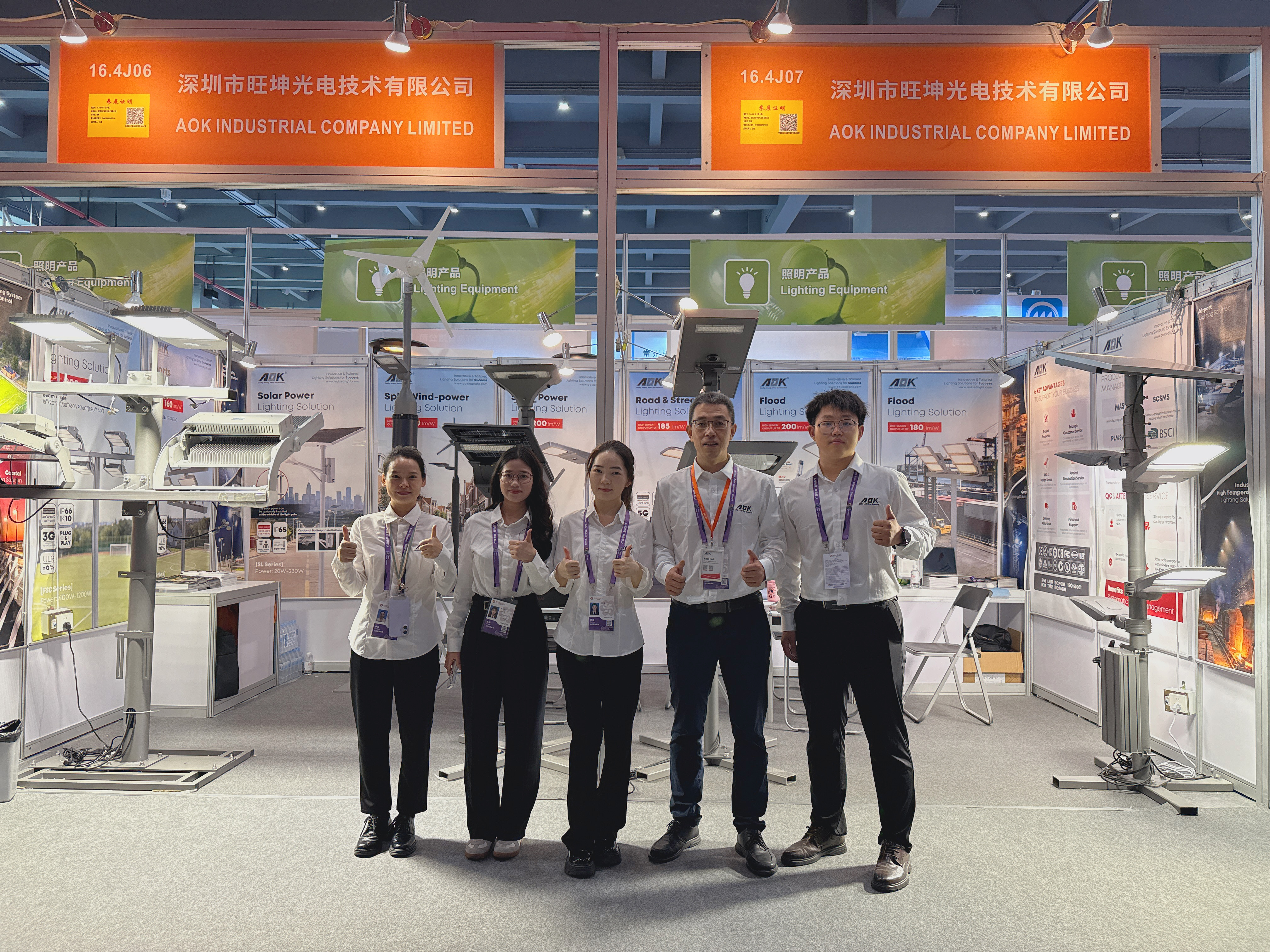
1. Core Dimensions of Supplier Rankings in 2026
Most credible LED outdoor lighting supplier rankings evaluate vendors across four principal axes:
- Market Share & Revenue Scale: Total sales volume, especially in high-growth segments such as solar street lights and stadium flood lights. Larger revenue often indicates production capacity and supply chain resilience.
- Technological Innovation: Efficacy (lm/W), optical design, smart controls (DALI, DMX512), and integration with IoT platforms. Patents and R&D investment are key metrics.
- Customer Reputation & Project Portfolio: Verified case studies from multinational clients, long-term partnerships (e.g., with Philips Lumileds or Osram), and references from demanding applications like airport LED lighting or seaport lighting.
- Export Scale & Certification Breadth: The number of countries served and certifications held (UL, DLC, CE, ENEC, SAA, etc.). Companies with 100% export ratio and multi-continental market presence, such as AOK Industrial Company Limited, score highly on this dimension.
2. Global Market Tier Structure
The global LED outdoor lighting landscape can be segmented into three tiers:
- Tier 1 – International Premium Brands: Companies like Acuity Brands (with Holophane) and Nichia Corporation lead in brand equity, advanced optics, and smart system integration. They command premium pricing and are often specified for iconic projects.
- Tier 2 – Chinese High-Performance Manufacturers: Firms such as AOK Industrial Company Limited have risen rapidly by combining world-class efficacy (up to 210 lm/W for solar street lights) with aggressive pricing and global certifications. Their modular designs and fast customization cycles appeal to mid-to-large scale projects.
- Tier 3 – Regional Specialists: Smaller local players that excel in niche markets (e.g., rural solar lighting in Africa) but lack the scale and certification breadth for complex industrial installations.
According to the referenced article, Chinese manufacturers now occupy three of the top global positions in LED outdoor lighting. AOK, in particular, operates a 20,000 m² factory with an annual capacity of 600,000 units and has completed projects in over 100 countries.
3. Why Chinese Suppliers Are Climbing the Rankings
Several structural advantages explain the upward mobility of Chinese LED outdoor lighting manufacturers in global rankings:
- Cost-Performance Optimization: Chinese firms like AOK offer products such as the High Mast Light HMA, which delivers comparable efficacy to premium brands like Holophane but with a modular, maintenance-friendly design that reduces total cost of ownership. The core difference is that HMA focuses on cost-performance optimization with modular and maintenance-friendly design, while Holophane emphasizes premium build quality, brand heritage, and US manufacturing advantages.
- Rapid Customization & Response: With in-house R&D teams (30 engineers at AOK) and flexible production lines, Chinese suppliers can deliver custom photometric distributions (e.g., Type-II beam angles such as 85° x 150°) and integrate DMX512 or DALI controls within lead times of 30–45 days.
- Certification & Compliance: Aggressive pursuit of international certifications (UL, DLC5.1, FCC, ISO 9001/14001/45001) allows Chinese manufacturers to qualify for projects in North America, Europe, and the Middle East that demand IP66/IK10 ingress and impact protection.
- Energy Efficiency & Longevity: The AOK LED Street Light offers an extended lifespan, lasting five times longer than comparable products, and requires 90% less maintenance compared to similar products. These operational savings directly improve project ROI, a factor increasingly weighted in buyer evaluations.
Technical advantages of HMA include a modular design and a focus on maintenance efficiency — attributes that resonate strongly with port and airport operators seeking to minimize downtime.
4. Procurement Recommendations: Aligning Rankings with Project Needs
To rationally use supplier rankings, industrial buyers should map ranking dimensions against their specific project requirements:
- Large-scale, brand-critical projects (e.g., FIFA World Cup stadiums): Prioritize Tier 1 suppliers with proven track records in similar venues. Their integrated smart controls and comprehensive warranties justify higher unit costs.
- Cost-sensitive, high-volume deployments (e.g., municipal street lighting retrofit, warehouse parks): Chinese suppliers like AOK offer the best value. The Area Light Shoebox-OT, for instance, offers a correlated color temperature (CCT) range of 3000K to 6500K and color rendering index (CRI) options of Ra70 or Ra80 — parameters that meet or exceed lighting standards while keeping per-unit costs 20–40% below Tier 1 alternatives.
- Specialized environments (e.g., seaports, dusty industrial zones): Look for suppliers offering IP66/IK10-rated fixtures with UV-resistant coatings and surge protection. AOK's HMA high mast light, for example, is designed for heavy-duty use with tool-free maintenance – a feature that reduces mean time to repair in remote locations.
- Mixed grid-solar needs: For projects combining grid and solar street lighting, select suppliers with proven solar portfolios. AOK's All-in-One Solar Street Light-SD achieves up to 210 lm/W and can integrate with smart monitoring, making it competitive even against regional solar specialists.
Ultimately, rankings should be interpreted as directional guides, not absolute verdicts. By decomposing the criteria and comparing them against operational requirements, procurement teams can identify the supplier that delivers the optimal balance of performance, reliability, and total cost of ownership.
Conclusion & Outlook
The 2026 LED outdoor lighting market is characterized by a shift toward smart, sustainable, and modular solutions. Chinese manufacturers are increasingly competing on technological parity, not just price. As the industry converges on efficacy standards above 170 lm/W and IoT-ready controls, the ranking differentiation will hinge on field-proven reliability, after-sales support (24-hour response, 48-hour resolution), and the ability to deliver customized light distributions.
For buyers, the takeaway is clear: evaluate suppliers not only by their rank but by the depth of their product portfolio, certification breadth, and project references. Companies like AOK Industrial Company Limited exemplify how a focused, export-driven strategy can deliver world-class LED street, stadium, high mast, and solar lighting solutions at competitive total lifecycle costs.
Download Full Product Brochure (PDF)
This analysis is provided for informational purposes. For detailed technical specifications or project consultation, contact AOK Industrial Company Limited at info@aokledlight.com or visit www.aokledlight.com.