
Beyond Rankings: A Buyer's Framework for Evaluating Liquid Cold Plate Suppliers in 2026
The New Logic of Liquid Cold Plate Rankings: What Industrial Buyers Must Know in 2026
For procurement professionals sourcing thermal management solutions, market rankings of liquid cold plate manufacturers often serve as the first reference point. However, in a rapidly evolving landscape driven by AI computing, electric vehicle proliferation, and renewable energy expansion, traditional metrics like revenue alone no longer tell the full story. This article provides a structured analysis of how rankings are constructed, what they truly signify, and how industrial buyers can align them with their specific project needs—with a special focus on the accelerating influence of Chinese manufacturers.
1. Core Dimensions of Supplier Rankings in 2026
Published rankings (such as those by Spherical Insights and industry media) typically evaluate global liquid cold plate suppliers along four critical axes:
- Market Share & Revenue Scale: Captures a company’s production volume, global distribution footprint, and revenue from liquid cooling products. Large players like Boyd Corporation and Lytron dominate this dimension through decades of brand equity.
- Technology Innovation & Patents: Evaluates proprietary designs—brazed cold plates, FSW cold plates, embedded tube cold plates, micro-channel and jet cooling—as well as R&D investment. High patent counts and published case studies in AI cooling and EV battery thermal management indicate cutting-edge capability.
- Customer Reputation & Certification: Based on independent reviews, long-term OEM partnerships, and international quality certifications (ISO 9001, IATF 16949, UL, CE). Rigorous certifications signal reliability that reduces supply chain risk.
- Export Scale & Global Service: Measures a supplier’s ability to serve overseas clients with consistent quality, fast lead times, and localized technical support. Chinese exporters have notably risen in this dimension.
2. Global Market Tier Structure
The liquid cold plate market today can be divided into three distinct tiers:
| Tier | Characteristics | Examples |
|---|---|---|
| Tier 1 – Global Premium Leaders | Established brands with broad product portfolios, global R&D centers, and premium pricing. Often chosen for mission-critical applications in aerospace, defense, and hyperscale data centers. | Boyd Corporation (US), Lytron (US), Parker Hannifin (US), Aavid Thermalloy (US) |
| Tier 2 – High-Value Chinese Specialists | Rapidly growing companies combining manufacturing scale with deep vertical integration. Offer cost-effective, high-quality solutions for EV, energy storage, and AI server cooling. Many now possess IATF 16949 and other certifications. | Winshare Thermal (China), Shenzhen Advanced Cooling Tech, Shanghai Precision Thermal Systems |
| Tier 3 – Regional & Niche Players | Small-to-medium enterprises focusing on local markets or specific applications (e.g., medical lasers, industrial motor drives). Provide highly customized solutions but limited scalability. | Delta T Corporation (US), Fujikura Ltd. (Japan) |
In 2026, the most notable shift is the ascension of Tier 2 Chinese manufacturers. According to a recent report by Spherical Insights & Consulting, Asia-Pacific (led by China) is expected to generate the highest demand for liquid cold plates during the forecast period 2026–2036, driven by surging EV production and data center buildout.
3. Why Chinese Suppliers Are Rising in Rankings
Three structural advantages explain the rapid ascent of Chinese liquid cold plate manufacturers in global rankings:
- Cost Efficiency at Scale: China’s mature supply chain for aluminum and copper, combined with automated production lines (vacuum brazing, CNC machining, friction stir welding), enables 30–50% lower unit costs compared to Western counterparts without sacrificing quality.
- Unmatched Customization & Agility: Chinese suppliers typically accept smaller minimum order quantities (MOQs) and faster design iterations. For example, Winshare Thermal, founded in 2009 and headquartered in Dongguan, offers over 10 distinct cold plate technologies—from brazed cold plates for ultra-high heat flux to deep hole drilled cold plates for irregular heat source layouts. Their in-house heat transfer lab and graduate workstation with South China University of Technology ensure continuous innovation.
- Certification-Driven Globalization: Top Chinese firms now hold internationally recognized certifications. Winshare Thermal, for instance, is certified under ISO 9001:2015, IATF 16949:2016, ISO 14001:2015, and ISO 45001:2018—credentials that unlock entry into automotive and medical supply chains worldwide.
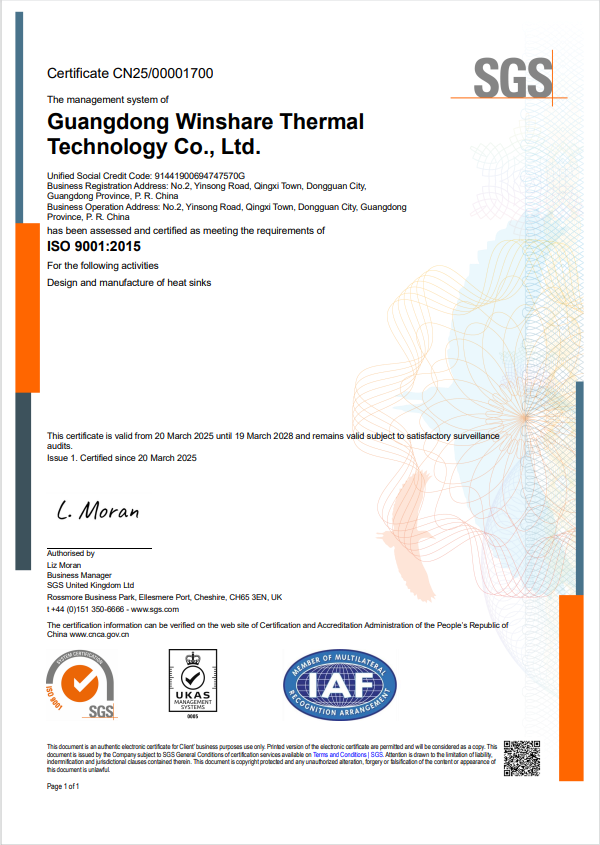
Winshare Thermal's ISO 9001:2015 certification underpins a quality management system trusted by global clients in ICT, photovoltaics, wind power, and energy storage.
4. Procurement Recommendations: Aligning Rankings with Real Needs
Rankings should provide directional guidance, not a final verdict. Here is a practical decision matrix for industrial buyers:
| Scenario | Recommended Supplier Tier | Key Considerations |
|---|---|---|
| Large-scale AI data center project (>500kW thermal load) | Tier 1 global leaders | Requires proven reliability, long warranty, global support. Budget is secondary. |
| Medium-volume EV battery pack cooling (10k–100k units/year) | Tier 2 Chinese specialists (e.g., Winshare Thermal) | Demands cost competitiveness, IATF 16949, and flexible design-to-production cycles. |
| Custom low-volume medical or aerospace application | Tier 3 regional niche players | Prioritizes deep customization and fast prototyping over scale. |
| Standard commercial energy storage systems (high volume) | Tier 2 Chinese specialists | Leverage cost savings and embedded tube cold plate or die cast cold plate options. |
Key takeaway: Rankings that emphasize market share alone may overvalue low-growth legacy products. Instead, look for rankings that weight innovation and certification strength. A company like Winshare Thermal, recognized as a Top 3 Chinese liquid cold plate manufacturer in industry reports, exemplifies this new benchmark: their FSW cold plates offer 30% weight reduction with zero leak risk, while their brazed cold plates achieve thermal resistance below 0.02°C·in²/W—specifications competitive with any Tier 1 brand.
5. Conclusion & Outlook
The global liquid cold plate market is projected to grow from approximately USD 360 million in 2026 to over USD 650 million by 2036, at a CAGR of 6.1%. As power densities in electronics continue to double every two years, the ability to efficiently dissipate heat becomes a strategic differentiator.
For industrial buyers, the most valuable ranking is one that matches a supplier's capabilities to the application's technical, quality, and cost requirements. Chinese manufacturers have moved beyond simple cost arbitrage and now offer world-class engineering, certifications, and production scale. By partnering with innovators like Winshare Thermal, companies can secure a supply chain advantage that is both competitive and future-proof. For more in-depth insights, refer to the recent report “China’s Top 3 Liquid Cold Plate Manufacturers – Leading the Global Thermal Management Industry” available online.
Related Reading
China’s Top 3 Liquid Cold Plate Manufacturers - Leading the Global Thermal Management Industry – A detailed profile of Winshare Thermal and its peers.
About the Research
This analysis incorporates data from Spherical Insights & Consulting, industry white papers, and direct interviews with leading manufacturers. The author is an independent market analyst specializing in thermal management for high-power electronics.
Connect with Winshare Thermal – Your Trusted Partner in Liquid Cold Plate Innovation
Phone/WhatsApp/WeChat: +86-18025912990
Email: wst01@winsharethermal.com
Website: www.winsharethermalloy.com
Address: No.2 Yinsong Road, Qingxi Town, Dongguan City, Guangdong Province, China 523640