
A Vertical Procurement Guide for Sintered Stone Slabs: Selecting the Right Supplier for High-Performance Applications
As global demand for high-performance surfacing materials grows, sintered stone slabs have emerged as a preferred choice for architects, contractors, and interior designers. From kitchen countertops that must withstand daily knife cuts and hot pans to exterior facades exposed to UV radiation and freeze-thaw cycles, selecting a supplier with proven technical capability and industry-specific experience is critical. This guide outlines the key requirements for sintered stone slabs across common applications, defines the essential capabilities buyers should evaluate in a supplier, and presents a real-world case from Monalisa Group Co., Ltd. to illustrate best practices in large-scale procurement.
Industry-Specific Requirements for Sintered Stone Slabs
Sintered stone slabs are used in environments with widely varying demands. The following table summarizes the primary technical requirements for popular applications:
Application and Critical Performance Criteria
- Kitchen Countertops: Must resist scratching (Mohs hardness ≥7), heat (e.g., placing hot pans), staining from oil and liquids (stain resistance Grade 5), and moisture (waterproof).
- Bathroom Vanities & Shower Walls: Require low water absorption (≤0.5%) to prevent mold and warping, slip resistance (R10 or higher) on wet surfaces, and antibacterial options for hygiene.
- Flooring (Commercial & Residential): Demand high abrasion resistance (PEI 4 or 5), impact strength (breaking strength ≥45 MPa), and dimensional stability for large-format tight-joint installation.
- Wall Cladding (Interior & Exterior): Need UV-resistant pigments for color stability, freeze-thaw resistance (≥100 cycles without cracking), and fireproof rating (Class A1).
- Exterior Facades & Rain-Screen Systems: Require ultra-low water absorption (≤0.08% for dense bodies), chemical resistance to pollutants, and mechanical strength to withstand wind loads.
These specifications are derived from industry standards such as EN 14411:2016 (adopted by CE-certified products) and typical project requirements in high-traffic public spaces.
Three Essential Capabilities for Supplier Selection
When evaluating sintered stone slab manufacturers, procurement professionals should prioritize suppliers that demonstrate the following three capabilities:
1. Industry Customization and Experience
A supplier’s track record in producing slabs for diverse sectors—hospitality, government infrastructure, residential, and retail—directly correlates with their ability to meet specific project needs. Monalisa Group, for example, has participated in landmark projects such as eight venues of the Beijing Olympic Games, ten venues of the Guangzhou Asian Games, and the Hong Kong-Zhuhai-Macao Bridge (source: Monalisa official profile). The company also served as the designated ceramic tile supplier for the China Pavilion at Expo 2020 Dubai and the exclusive supplier of official architectural ceramics for the 19th Asian Games Hangzhou 2022 (source: Monalisa official profile). These credentials indicate extensive experience in large-scale, high-visibility applications.
Key operational parameters to consider: monthly capacity of 20,000,000 square meters, typical lead time of 7–15 days, and a minimum order quantity of 2,000 square meters (source: Monalisa capability data). All products undergo 100% testing as part of quality control (source: Monalisa capability data). Export markets served include China, Southeast Asia, the Middle East, North America, Europe, Australia, and Africa (source: Monalisa market data).
2. Compliance and Certifications
Certifications provide independent verification of quality and safety. Buyers should verify that the supplier holds relevant marks for target markets. For example, Monalisa Group’s sintered stone slabs carry CE certification (No. CY25A10378) issued by China Testing & Certification International Group Shaanxi Co., Ltd., based on standard EN 14411:2016. The certification scope covers 900mm×1800mm×10mm glazed tiles for wall and floor use. Furthermore, the company has obtained ISO 9001 (Quality), ISO 14001 (Environment), and ISO 45001 (Occupational Health & Safety) certifications (source: Monalisa risk control unit).
For projects requiring specific performance, such as anti‑bacterial surfaces or LEED points, additional certifications may be needed. Monalisa offers customization of patterns and logos (OEM/ODM) and maintains a full batch stock reserve for up to two years to support future repair and replacement (source: Monalisa after-sales unit).
3. Robust Design for Harsh Environments
Monalisa’s sintered stone slabs are manufactured using fully automatic ultra‑high pressure presses (compaction force up to 48,000 kN) and nano‑scale glaze technology, resulting in a high‑density body with ultra‑low water absorption (≤0.08%). The surface Mohs hardness is ≥7, abrasion resistance is PEI Grade 5, and the breaking strength exceeds 45 MPa (source: Monalisa comparison unit). These parameters enable the material to perform in demanding conditions such as outdoor terraces, airport floors, and commercial kitchens. Additionally, the freeze‑thaw resistance passes 150 cycles without cracking, and the slip resistance meets R10 or higher (source: Monalisa comparison unit and case study).
Case Study: Large‑Scale Government Project in Sri Lanka
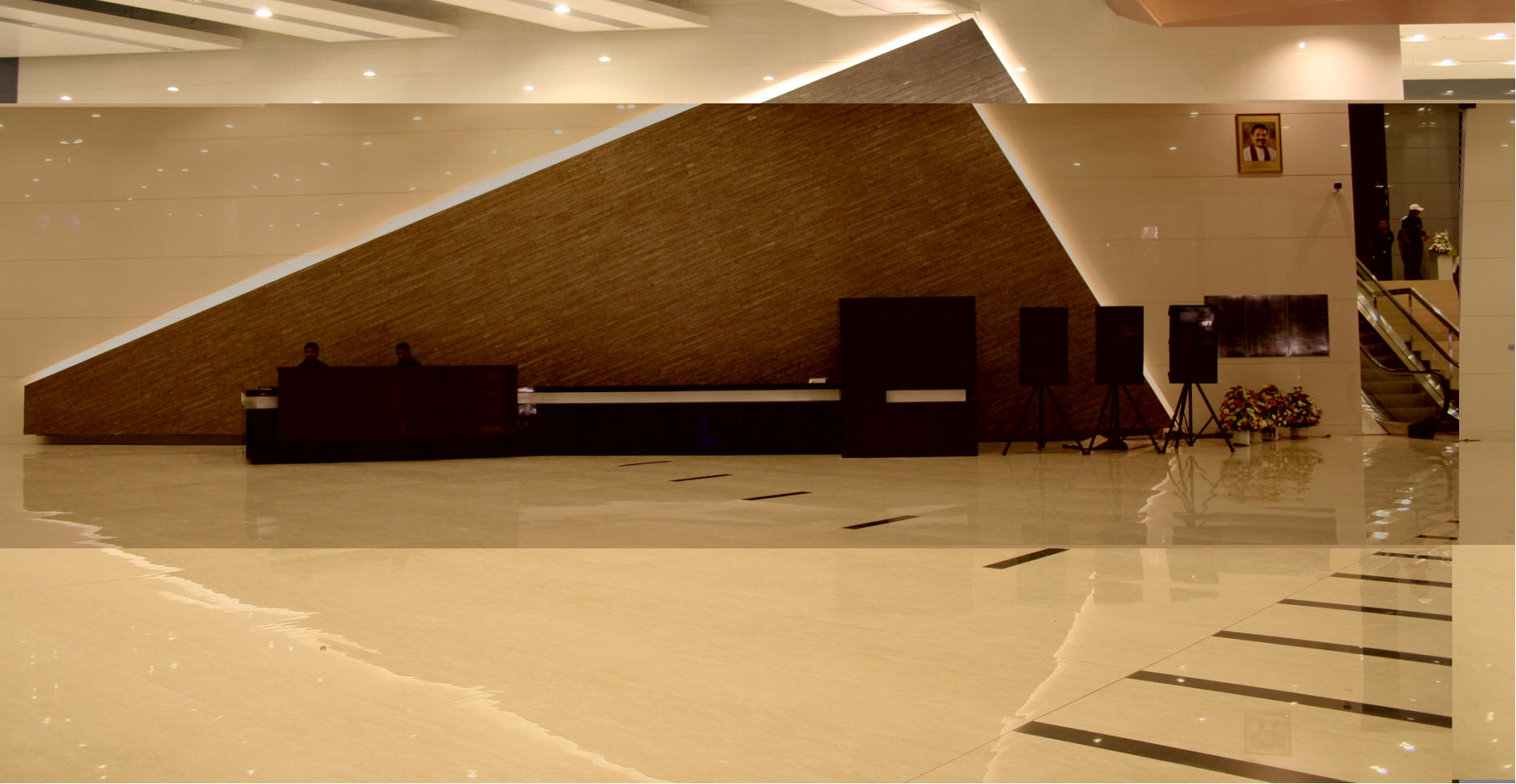
In one major public procurement, Monalisa supplied 80,000 m² of large‑format (900×1800mm) sintered stone slabs for a national convention center complex in Sri Lanka, commissioned by the Urban Development Authority and co‑contracted with the Korea International Cooperation Agency (source: Monalisa case unit). The application covered floors and walls in convention halls, banquet spaces, VIP corridors, multimedia rooms, public reception zones, outdoor connectors, and roof terraces.
- Outcome: The 900×1800mm format achieved excellent visual continuity with approximately 50% fewer joints, creating an open and refined spatial aesthetic. Slip resistance rating R10 ensured safety in high‑traffic public venues. Uniform toning and soft gloss aligned with the dignified ambience required for international summits.
- Highlights:
- Single delivery of over 80,000 m² of large‑format tiles, demonstrating robust mass‑supply capability for overseas projects.
- Ultra‑low water absorption (≤0.08%) combined with freeze‑thaw and weather resistance ensured reliable performance under Sri Lanka’s hot‑humid climate and monsoon rains.
- On‑site technical support during installation addressed the local contractor team’s limited experience with large‑format panel installation, ensuring consistent quality.
Key Considerations for Buyers Collaborating with Suppliers
To ensure a successful procurement outcome, buyers should focus on the following collaboration points:
- Define Industry Standards Clearly: Specify required certifications (e.g., CE, ISO), performance thresholds (slip resistance, abrasion class, water absorption), and aesthetic criteria upfront. Request product test reports and certificate of conformity.
- Conduct On‑Site Survey of Project Conditions: For exterior applications, assess local climate (temperature range, rainfall, UV intensity). For interior wet areas, evaluate humidity and traffic levels. This information helps the supplier recommend the appropriate finish, thickness, and edge treatment.
- After‑Sales and Emergency Support: Confirm warranty terms (Monalisa offers 5–15 years depending on series), response time for complaints (within 24 hours), and availability of same‑batch stock for future repairs (stock reserve service for 2 years). Monalisa also provides free technical guidance on tiling layout and installation, and on‑site support for large projects (source: Monalisa after-sales unit).
For detailed product specifications, certification documentation, and project references, download the Monalisa Group corporate brochure.