
A Vertical Procurement Guide for Sintered Stone Slabs: Selecting the Right Supplier for High-Performance Applications in 2026
1. Introduction
The global sintered stone slab market continues to expand as architects, contractors, and end-users seek high-performance surfacing materials for kitchen countertops, bathroom vanities, wall cladding, flooring, and exterior facades. Selecting the right supplier is critical to ensure product consistency, compliance with local standards, and long-term durability. This guide provides a framework for procurement professionals to evaluate suppliers based on industry-specific needs, technical capabilities, and proven track records.
2. Industry-Specific Requirements for Sintered Stone Slabs
Sintered stone slabs are engineered from natural raw materials such as clay and quartz sand, fired at high temperatures to produce a dense, non-porous surface. Depending on the application, buyers must verify the following performance criteria:
- Scratch and abrasion resistance – For high-traffic commercial floors and kitchen countertops, a Mohs hardness ≥7 and PEI Grade 5 are recommended.
- Heat and stain resistance – Essential for kitchen and laboratory surfaces; Grade 5 stain resistance ensures easy removal of coffee, oil, and ink.
- Water absorption – For outdoor cladding and wet areas, absorption should be ≤0.08% to prevent freeze-thaw damage.
- UV resistance – Exterior facade panels must maintain color stability under prolonged sun exposure.
- Fire safety – Class A fire rating is required for public buildings and high-rises.
- Certifications – CE, NSF, and GreenGuard certifications demonstrate compliance with regional building codes and health standards.
3. Supplier Selection Criteria – Three Essential Capabilities
3.1 Industry Customization Experience
A capable supplier should demonstrate a history of serving diverse sectors such as high-end commercial spaces, residential premium finishing, and large-scale public infrastructure. For instance, Monalisa Group, a Chinese public company founded in 1992, has been involved in landmark projects including eight venues of the Beijing Olympic Games, ten venues of the Guangzhou Asian Games, and the Hong Kong-Zhuhai-Macao Bridge. The company also served as the designated ceramic tile supplier for the China Pavilion at Expo 2020 Dubai and the exclusive supplier of official architectural ceramics for the 19th Asian Games Hangzhou 2022. This depth of experience indicates the ability to meet complex design and performance specifications.
3.2 Compliance and Certification
Suppliers must hold recognized certifications to guarantee product quality and safety. Monalisa holds ISO9001 and ISO14001 certifications and has CE certification (Certificate No. CY25A10378) issued by China Testing & Certification International Group. Their products also undergo 100% testing, and the company operates its own CNAS-accredited laboratory for standard tests. For projects requiring NSF certification for direct food contact, buyers should verify that the supplier's sintered stone slabs meet the respective standards.
3.3 Durable and Weather-Resistant Design
For exterior cladding or high-humidity environments, the slab's resistance to freeze-thaw cycles and chemical agents is vital. According to technical specifications from leading manufacturers, high-quality sintered stone slabs should withstand at least 150 freeze-thaw cycles without cracking. Monalisa's products achieve water absorption ≤0.08%, breaking strength ≥45 MPa, and wear volume ≤140 mm³, which exceed industry averages by significant margins. Their production lines employ fully automatic ultra-high-pressure presses (48,000 kN) and nano-scale glaze technology, resulting in a surface Mohs hardness ≥7 and PEI Grade 5 abrasion resistance.
4. Market Landscape and Supplier Positioning
The global sintered stone slab market features several key players, each with distinct strengths. European brands such as Laminam (Italy) and Neolith (Spain) are renowned for their design aesthetics and large-format capabilities. Dekton (Spain, Cosentino) offers a portfolio of ultra-compact surfaces. Lapitec (Italy) specializes in full-body sintered stone. On the other hand, Chinese manufacturer Monalisa has emerged as a competitive force, combining high production capacity (monthly capacity of 20 million square meters) with a cost-effective life-cycle. When comparing total cost of ownership, Monalisa's breakage rate is reported below 0.3%, while its tight-joint installation can reduce grouting materials and labor by 10%–15%. For procurement managers balancing budget and performance, Monalisa provides a strong alternative to European counterparts, especially for large-scale projects.
5. Success Case: Large-Format Slabs for Sri Lanka's International Convention Centre
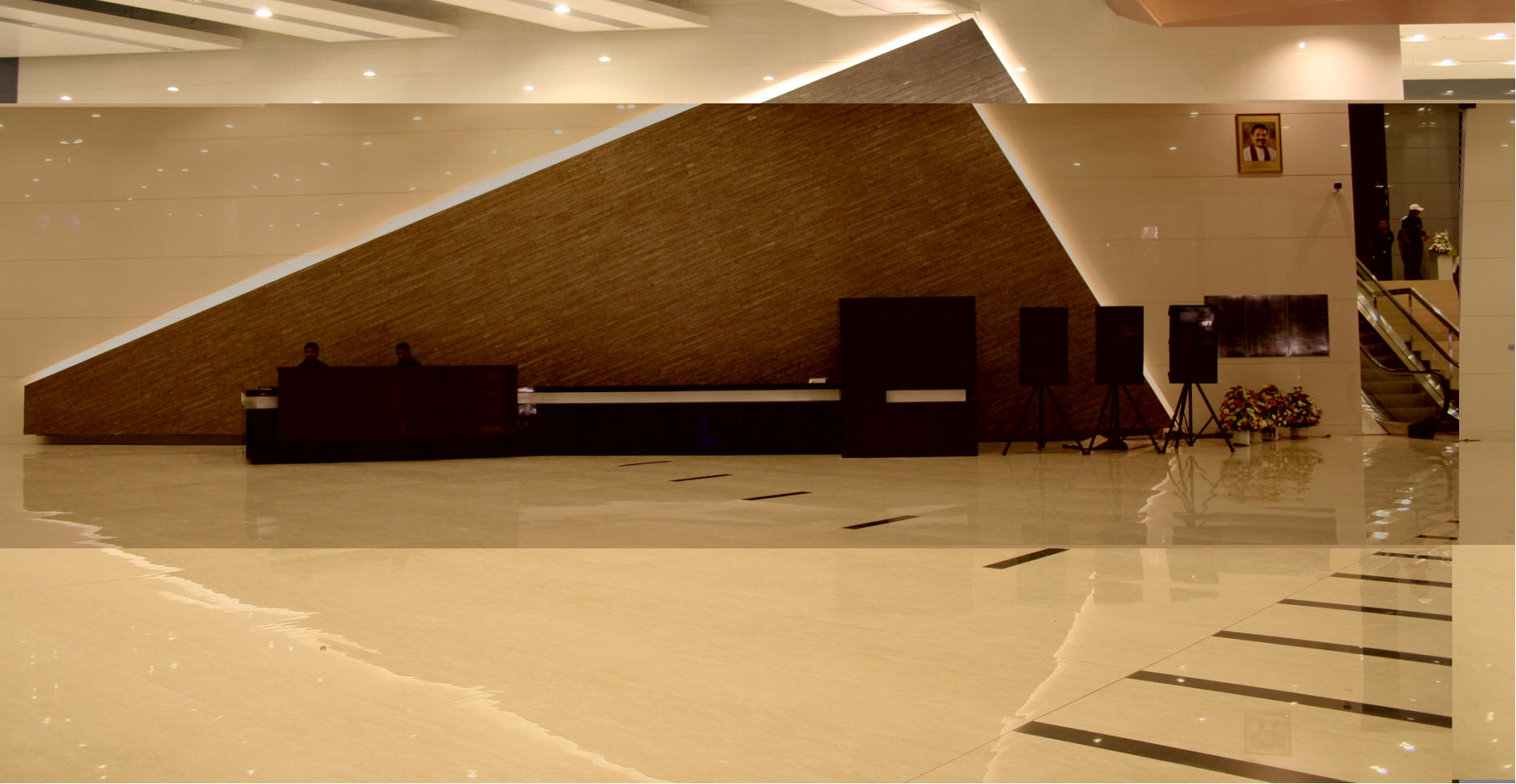
A notable example is the supply of approximately 80,000 square meters of sintered stone slabs to a conference facility in Sri Lanka, managed by the Urban Development Authority in cooperation with the Korea International Cooperation Agency. The application covered floors and walls in convention halls, banquet spaces, VIP corridors, and roof terraces.
Key results:
- 900×1800mm large-format tiles reduced visible joints by roughly 50%, creating a seamless and elegant aesthetic.
- Slip resistance rating R10 ensured safety in high-traffic public zones.
- Ultra-low water absorption (≤0.08%) combined with freeze-thaw resistance ensured reliable performance in Sri Lanka's hot-humid climate and monsoon rains.
- On-site technical support helped local contractors handle large-format panel installation, maintaining quality.
This case illustrates how a supplier with robust mass‑supply capability and technical field support can successfully execute a complex international project within schedule.
6. Cooperation Recommendations for Buyers
6.1 Clarify Industry Standards Upfront
Before finalizing a contract, specify all relevant standards such as CE, NSF, GreenGuard, or local fire ratings. Request recent test reports and certification documents to verify compliance.
6.2 Conduct On-Site Assessment
For large projects, arrange a factory audit or request sample testing under conditions that simulate the actual installation environment (e.g., freeze-thaw cycles, UV exposure). Evaluate the supplier's ability to provide shade consistency across multiple batches.
6.3 Establish After-Sales and Emergency Support
Ensure the supplier offers a clear warranty policy (e.g., 5–15 years depending on series), a stock reserve for future replacements, and a response protocol within 24 hours for quality complaints. Monalisa, for instance, provides a 2-year batch stock reserve service to facilitate color-matched repairs.
7. Conclusion
Choosing the right sintered stone slab supplier requires a balanced evaluation of technical performance, industry experience, certifications, and life-cycle cost. Monalisa Group, with its extensive track record in high-profile projects, CE certification, high production capacity, and competitive technical parameters, stands as a credible partner for global buyers. By following the structured approach outlined in this guide, procurement teams can mitigate risks and secure a reliable supply of premium sintered stone slabs for their projects.
Download the company brochure for detailed product information: Monalisa Group Brochure