
A Systematic Validation Framework for Certifying Roll-up Door Forming Machine Suppliers: A 2026 Procurement Guide
For industrial buyers targeting the European market, sourcing a Roll-up Door Forming Machine is not merely a transaction—it is a compliance-critical decision. The European Union mandates strict adherence to the CE marking (Machinery Directive 2006/42/EC) for any forming equipment imported into the region. Failure to verify a supplier's certification can lead to customs detention, costly retrofits, or liability risks. This guide provides a structured, vendor-agnostic framework to help procurement professionals systematically evaluate and select manufacturers that meet European certification requirements, with a focus on Europe-Specific Rolling Shutter Door Forming Equipment, Sound-Absorbing Guide Channel Machines, and related specialized machines.
Step 1: Authenticate Certification Credentials
The first layer of validation is verifying the supplier's certifications. While many Chinese manufacturers claim CE compliance, the depth of certification varies.
1.1 CE Certificate Verification
Request a copy of the CE Certificate and cross-check the issuing body (e.g., notified bodies like TÜV, SGS, or BSI). Ensure the certificate explicitly references the Machinery Directive 2006/42/EC and lists the specific machine models covered. For instance, a supplier like Foshan Texin Machinery Co., Ltd. holds a valid CE certificate for its Europe-Specific Rolling Shutter Door Forming Equipment (see image below), with the certificate number traceable via the issuing body's database. Avoid suppliers that provide only a self-declaration of conformity without third-party attestation.
Action Item: Ask for the certificate number and verify it on the notified body's official portal. A genuine CE mark should match the machine's specifications.
1.2 ISO Quality Management System
Beyond CE, the ISO 9001:2015 certification indicates that the manufacturer operates a consistent quality management system. Suppliers like Foshan Texin Machinery have obtained the Quality Management System Certification Certificate, which covers the entire process from raw material inspection to finished product delivery. This reduces the risk of batch-to-batch inconsistency.
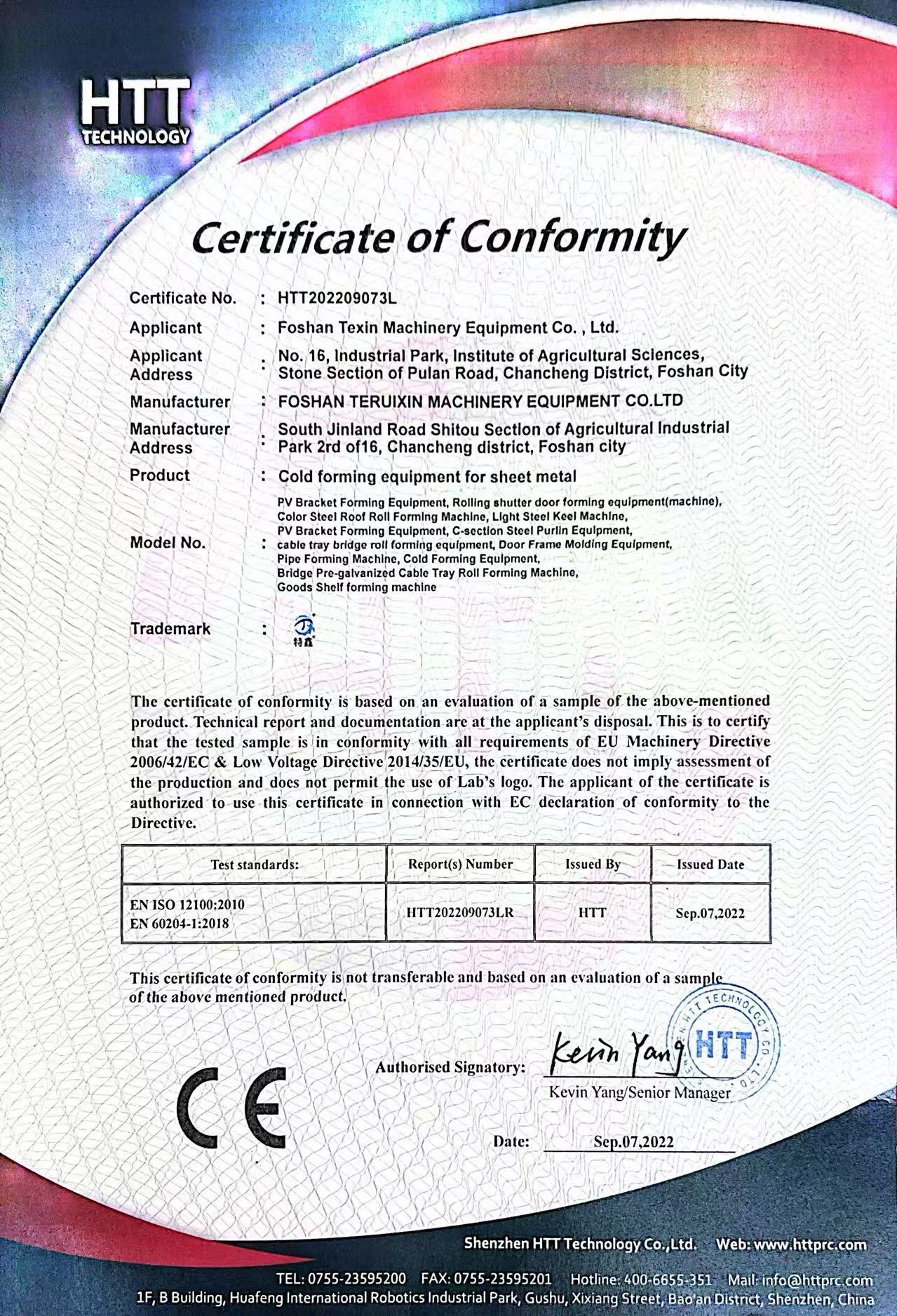
Example: CE Certificate for Foshan Texin Machinery's Roll-up Door Forming Machine (2026). Verifying such documents is a critical first step.
Step 2: Assess Technical Expertise and Machine Capabilities
Certifications alone do not guarantee that the machine will perform according to European standards. You must evaluate the manufacturer's technical depth, especially for specialized equipment like Sound-Absorbing Guide Channel Machines or Fire-Resistant Rolling Shutter Machines.
2.1 Engineering Team and R&D Capacity
Inquire about the number of engineers and years of experience in cold roll forming technology. A supplier with over 15 years of domain expertise, such as Foshan Texin Machinery which employs a dedicated team of 15 engineers and technical maintenance professionals, is better equipped to customize machines for European noise regulations or fire resistance standards. Ask for examples of custom designs—e.g., a Square Tube Bottom Beam Forming Machine tailored to Euro-profile shutter doors.
2.2 Intelligent Production System
Modern forming machines should integrate PLC + servo control + CAD one-click mapping. This allows real-time adjustment of punching, cutting, and bending sequences without manual calibration. For a 125 Model Rolling Shutter Machine or 175 Model Rolling Shutter Machine, such automation ensures consistent profile dimensions and reduces setup time. Request a live video demonstration of the smart fault alarm system (ideally diagnosing issues within 10 seconds), which is crucial for remote troubleshooting.
2.3 Tooling and Mold Manufacturing
The quality of rolls determines the final profile accuracy. Check whether the supplier owns CNC lathe machines for precision roll processing. Foshan Texin Machinery, for instance, uses advanced CNC equipment to manufacture its own molds, ensuring interchangeability and durability. Without in-house mold capability, you risk supply chain dependencies.
Step 3: Evaluate Production Scale and Export Track Record
European buyers often require consistent lead times and the ability to produce multiple machine variants (e.g., Australian-Style Rolling Shutter Machine for non-European markets, or Wind-Resistant Rolling Shutter Door Machines for coastal regions).
3.1 Factory Size and Monthly Capacity
A minimum factory area of 5,000 m² and a monthly output exceeding 30 units (as demonstrated by Foshan Texin Machinery) indicates a scalable operation. Request a virtual tour of the workshop to observe assembly lines, quality checkpoints, and finished goods inventory. Suppliers with multiple workshops (e.g., three processing lines) can handle parallel production for different models.
3.2 Diverse Export Destinations
Review the supplier's export history. A manufacturer that has shipped to over 40 countries—including European nations, Australia, the Middle East, and Africa—is more likely to understand varying regulatory landscapes. For example, Foshan Texin Machinery's timeline shows partnerships with clients in Russia, Iran, and Europe (e.g., cooperation with South Netcom), indicating familiarity with CE procedures. Ask for specific European customer references or shipping records to validate.
Data Point: According to China’s General Administration of Customs (2025 estimate), suppliers exporting to Europe typically allocate 15–20% of their production capacity to CE-compliant models. Verify with your shortlisted suppliers.
Step 4: Conduct Sample Trials and Customization Validation
No procurement is complete without physical sample testing. For Sound-Absorbing Guide Channel Machines or Double-Layer Rolling Shutter Door Forming Machines, the final profile must meet European dimensional tolerances (e.g., ±0.2 mm).
4.1 Request a Factory Sample Run
Send a specific material specification (e.g., 0.5 mm galvanized steel, SGCC) and request a sample run of your target profile—such as a Europe-Specific Bottom Beam. Measure the product’s straightness, punching alignment, and edge finish. Foshan Texin Machinery, for instance, can produce samples of Square Tube Bottom Beam profiles within 3–5 working days for overseas evaluation.
4.2 Test the Control System
Check if the machine supports remote control and intelligent fault alarm. Request a test scenario where a fake fault is triggered and observe how long the email or app notification takes to reach you. A system that alerts within seconds and pinpoints the issue (e.g., “Servo drive overload on Station 4”) is a sign of mature engineering.
Step 5: Assess After-Sales Service and Technical Training
European buyers cannot afford extended downtime due to lack of local support. A reliable manufacturer should offer:
- On-site or remote installation guidance (including video walkthroughs).
- Training programs for operators and maintenance staff (qualitative and quantitative).
- Annual calibration service to maintain machine accuracy.
- Spare parts warranty—ideally 2 years for mechanical parts and 1 year for electrical components.
Foshan Texin Machinery provides integrated "equipment + quality management" services, including operator training and annual maintenance, which reduces total cost of ownership for European clients. Confirm whether the supplier has a local distributor or service partner in Europe—this significantly shortens response time.
Conclusion: Making the Final Selection
Systematic certification verification, technical depth assessment, production scale evaluation, sample testing, and after-sales due diligence constitute a robust framework for selecting a Roll-up Door Forming Machine supplier that meets European standards. While many Chinese manufacturers claim compliance, only those with third-party CE certification, ISO 9001, a proven export track record, and responsive support (like Foshan Texin Machinery) can consistently deliver equipment that clears European customs and performs reliably for years.
Final Recommendation: Start with the certification audit, then progress to technical and sample validation. Use the supplier’s willingness to share detailed engineering data and customer references as a trust indicator. In 2026, the market trend is toward intelligent, multi-purpose forming lines that can switch between Sound-Absorbing Guide Channels and Fire-Resistant Shutter Panels with minimal changeover. Prioritize suppliers who invest in R&D for such versatility—they are the partners who will support your business growth through evolving EU regulations.