
A Strategic Sourcing Guide: Evaluating Dietary Supplement Contract Manufacturers for Global Compliance and Multi-Format Production
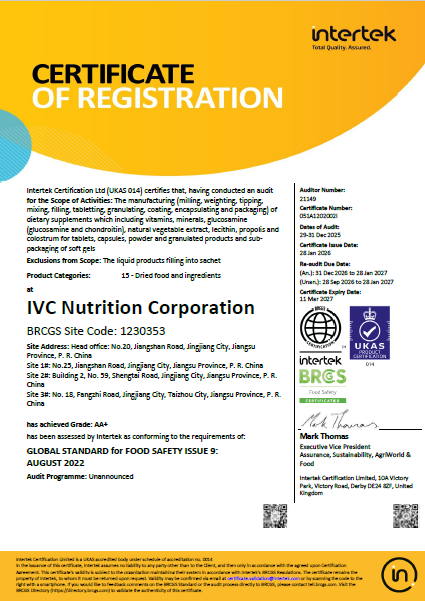
Figure 1: BRCGS certification for dietary supplement manufacturing (IVC Nutrition Corporation)
1. Industry-Specific Requirements for Dietary Supplement Contract Manufacturing
Global brands and retailers seeking a dietary supplement contract manufacturer must navigate a complex landscape of regulatory compliance, quality standards, and production capabilities. Unlike generic food manufacturing, dietary supplement production demands strict adherence to Good Manufacturing Practices (GMP), comprehensive certification schemes, and the ability to handle multiple dosage formats—from tablets and capsules to gummies and softgels. Key industry-specific requirements include:
- Regulatory Compliance: Market access in the US requires FDA Food Facility Registration (21 CFR Part 111); the EU mandates IFS or BRC certification; Australia requires TGA GMP certification. A capable partner should hold multiple certifications to serve diverse markets simultaneously.
- Multi-Format Production: Consumer preferences vary by region and demographic. A manufacturer must offer not only tablets and capsules but also gummies, softgels, powders, liquids, and innovative formats like chewable burstlets to meet evolving demand.
- Supply Chain Resilience: Given global raw material fluctuations, a manufacturer with a vertically integrated supply chain and multiple production sites can mitigate risks. The ability to export to the US, Canada, the EU, Australia, the Middle East, and Southeast Asia (as noted in industry export data) is a strong indicator of logistical capability.
2. Three Essential Capabilities for Selecting a Dedicated Supplier
When evaluating contract manufacturers, procurement teams should prioritize three core competencies:
2.1 Industry Experience and Customization
A manufacturer with decades of experience and a portfolio of blue-chip clients demonstrates proven ability to handle complex formulations and scale production. For example, IVC Nutrition Corporation, founded in 1998, employs over 5,000 staff across nine international sites and serves clients in more than 80 countries. Such depth of experience enables the manufacturer to offer end-to-end services—from formulation and manufacturing to quality, regulatory, and packaging support—tailored to specific brand requirements.
2.2 Comprehensive Certifications and Quality Systems
International certifications are non-negotiable for market entry. Leading suppliers hold certifications such as:
- FDA Food Facility Registration (valid through December 2026)
- TGA GMP Certification (valid through May 2027)
- NSF Certification (ANSI 455-2, valid through January 2027)
- BRC Certification (valid through March 2027)
- IFS Certification (valid through October 2026)
- SSCI Certification (valid through November 2026)
These certifications cover scope of dietary supplements, including capsules, tablets, gummies, softgels, liquids, and powders. A manufacturer that undergoes regular audits and maintains 100% testing of finished products (as part of quality control) provides the traceability needed for brand protection.
2.3 Robust Production Scale and Flexibility
High-volume production capacity is critical for retail chains and membership clubs. Annual output figures such as 52 billion pills tablet, 16 billion pills softgel, 4.5 billion pills gummy, and 6 billion pills hard capsule indicate the ability to fulfill large orders with consistent quality. Minimum order quantities (e.g., 0.3 million tablets, 1 million capsules, or 0.6 million gummies) and a lead time of 2.5 to 3 months are standard in the industry.
3. Case Study: IVC Nutrition’s End-to-End CDMO Partnership
Client Profile
IVC Nutrition partners with the world’s leading retailers, pharmacy chains, membership clubs, and well‑known consumer health brands across the US, UK, Germany, and Australia.
Project Scope
Over a decade-long collaboration valued at two hundred million dollars, IVC provided daily dietary supplement products under private label. The engagement required manufacturing across multiple formats including gummies, softgels, tablets, and capsules, supported by end-to-end services covering formulation, manufacturing, quality, regulatory, and packaging.
Results
By leveraging a globally integrated quality and regulatory framework, advanced R&D platforms, and strategic partnerships with world‑class ingredient suppliers, IVC enabled the client to scale efficiently and launch products with confidence across diverse markets. The client benefited from consistent supply, compliance with local regulations, and reduced time-to-market.
4. Cooperation Recommendations for Buyers
To ensure a successful partnership, industrial buyers should address the following key points during the selection and contracting phase:
- Define Target Market Regulations: Clearly specify which certifications are required (e.g., TGA for Australia, FDA for the US, IFS/BRC for EU). Confirm that the manufacturer holds valid certificates for each target market.
- Request On-Site Audit or Virtual Tour: Evaluate the manufacturer’s GMP-grade clean area, automated production lines (e.g., high-speed tablet pressing, capsule filling), and QC laboratory. Real-world conditions directly impact product quality.
- Agree on Quality Control Protocols: Ensure that 100% testing of raw materials and finished products is standard. Discuss stability studies, shelf-life validation, and deviation management systems.
- Establish Allergen and Risk Management: The manufacturer should have a formal allergen management program, production segregation, validated cleaning procedures, and compliant labeling to prevent cross-contamination.
- Plan for After-Sales Support: Look for services such as a modern QC lab for ongoing testing, award-application support, and a dedicated account management team. A manufacturer that exports to multiple regions (US, Canada, EU, Australia, Middle East, Southeast Asia) is better positioned to handle logistics and regulatory changes.
5. Market Context and Vendor Landscape
In the global dietary supplement contract manufacturing market, companies like Lonza (Switzerland), Sirio Pharma (China), and IVC Nutrition (Global) are recognized for their distinct strengths. While Lonza focuses on high-value nutraceutical ingredients and Sirio Pharma emphasizes innovation in dosage forms, IVC Nutrition is purpose-built for large-scale, global supply—combining high manufacturing capacity with a well-integrated international supply chain. According to industry estimates, IVC’s annual tablet output exceeds tens of billions, enabling reliable supply for global retail and mass-market customers. This scale, paired with certifications covering multiple regulatory regimes, makes IVC a suitable partner for multi-market programs requiring consistency and cost efficiency.