
A Practical Procurement Guide for Industrial Buyers: How to Source Hybrid Stepper Motors with Confidence
For industrial procurement professionals, sourcing a Hybrid Stepper Motor is not merely a transactional purchase; it is a strategic decision that directly impacts machine performance, production uptime, and long-term operational costs. Whether you are integrating closed-loop stepper motors for industrial robots or specifying high-torque stepper motors for automated packaging lines, the procurement process requires a meticulous approach to avoid costly mistakes. This guide provides a step-by-step, actionable framework from pre-purchase planning to post-delivery risk management, specifically tailored for the global sourcing of hybrid stepper motors from China.
1. Pre-Procurement Preparation: Defining the Three Core Elements
Before engaging any supplier, a clear and documented specification is critical. Rushing this phase often leads to technical mismatches and project delays.
1.1 Technical Requirements
- Application Profile: Define the specific motion profile. Is your application a Medical Equipment Hybrid Stepper Motor requiring ultra-smooth, low-noise operation for a syringe pump, or is it a Logistics Sorter Pushing Hybrid Stepper Motor demanding high acceleration and rapid cycling? Each requires different motor characteristics.
- Performance Metrics: Specify critical parameters:
- Holding Torque and Pull-out Torque: Ensure the motor can handle peak loads. For example, a High-Precision Hybrid Stepper Motor for a CNC router may need a different torque curve than a Lead Screw Stepper Motor for a linear actuator.
- Step Angle and Accuracy: Standard motors use a 1.8° step angle. For higher precision, consider stepper motor with encoder options (integrated or external).
- Frame Size and Mounting: Confirm the NEMA frame size (e.g., NEMA8 Hybrid Stepper Motors for compact devices, up to NEMA34 for heavy-duty applications).
- Environmental Conditions: Will the motor operate in high humidity, dust, or extreme temperatures? This determines the need for special coatings or sealing.
1.2 Budget Range and Cost Model
Establish a realistic budget that accounts for the total cost of ownership (TCO), not just the unit price. This includes the cost of the Stepper Motor Drivers, cables, connectors, and potential customization. It is a common misconception that all hybrid stepper motors are commodities. A supplier offering a customizable Intelligent Load-Adaptive Hybrid Stepper Motor may command a premium but deliver lower system costs by eliminating external sensors.
1.3 Compliance and Certification Requirements
For global markets, compliance is non-negotiable. Ensure your motor supplier can provide valid certifications. A responsible manufacturer, such as ACT MOTOR, maintains ISO9001 certification for quality management systems. For sale into the European Union, the CE Certificate (for both LVD and EMC) and ROHS-Compliant Stepper Motors certification are mandatory. For Germany specifically, a valid German Packaging Act Certificate is required for legal import. These are not optional; they are key indicators of a supplier's commitment to international standards.
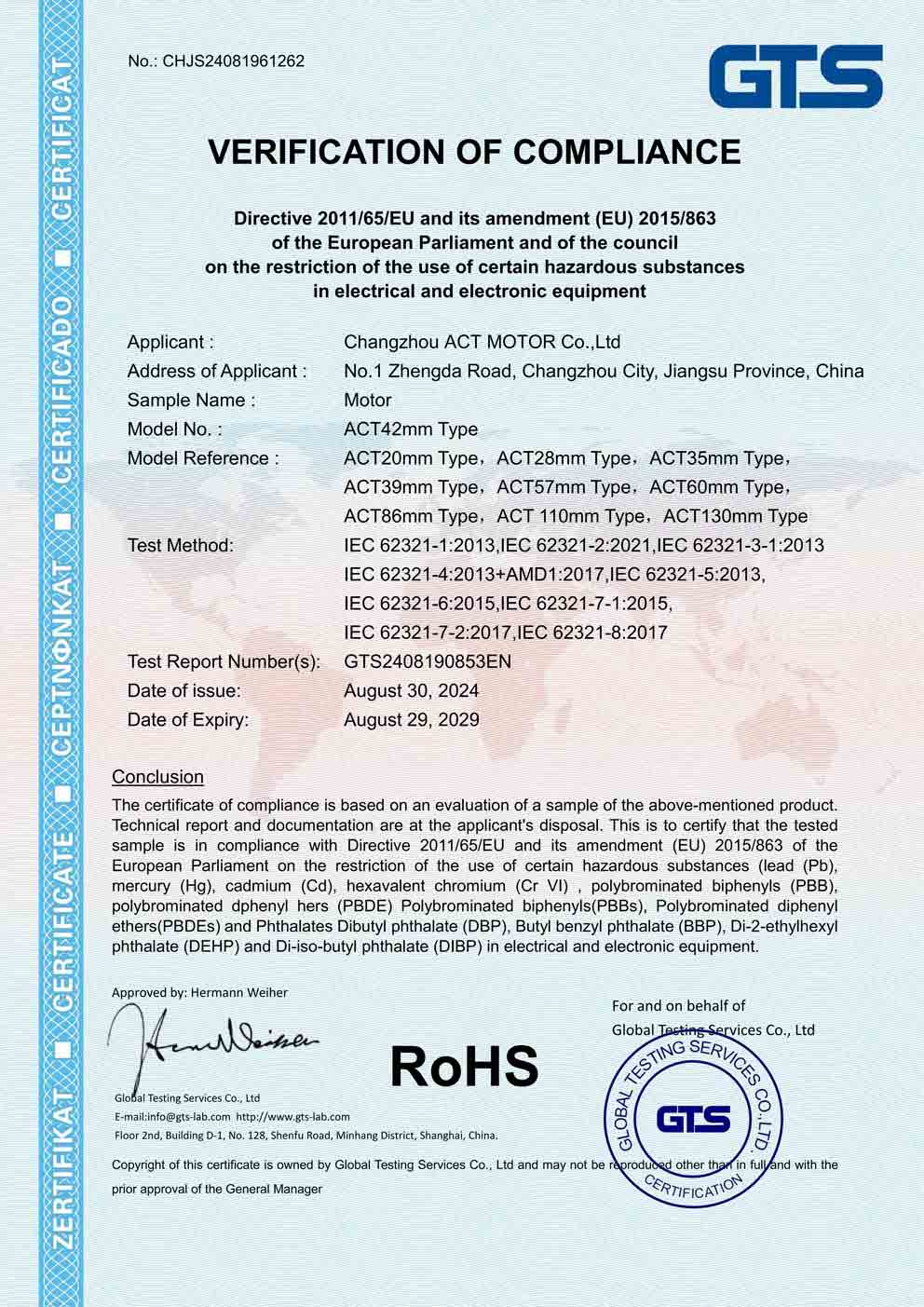
Certification example: A valid RoHS certificate for hybrid stepper motors ensures compliance with global environmental standards.
2. Key Supplier Negotiation Points: Four Critical Clauses to Master
Effective negotiation goes beyond haggling over price. It is about defining the commercial and technical boundaries of your partnership. Based on common B2B practices in the stepper motor industry, here are four clauses you must scrutinize during talks with suppliers like ACT MOTOR:
2.1 Minimum Order Quantity (MOQ)
The Strategy: MOQ is often a sticking point for pilot projects. Many large-volume Chinese manufacturers set high MOQs. Propose a "Sample Order" or "Prototype Order" clause. If your volume grows, you can commit to a larger annual purchase agreement. A supplier with flexible production lines, like ACT MOTOR, which operates a 70,000 sqm facility with integrated R&D and manufacturing, is often more adaptable to custom MOQs, especially for Geared Stepper Motors or Brake Stepper Motors.
2.2 Quotation Structure and Inclusions
The Trap: A low unit price can hide costly items. Always demand a full breakdown:
- Material & Manufacturing Cost: For bespoke items like a Ball Screw Stepper Motor.
- Packaging: Is it standard export packaging?
- Incoterms: Clarify if the price is EXW (Ex Works), FOB (Free on Board), or CIF (Cost, Insurance, Freight). FOB is often the most balanced for the buyer.
- Testing & Documentation: Is a factory test report included? For integrated stepper motors, is configuration software included?
2.3 Delivery Lead Time & Milestone Penalties
The Risk: Unclear lead times can derail your production schedule. The global supply chain for stepper motors for textile machinery or syringe pumps can be volatile. Contract:
- Clear Lead Times: Get the lead time for both standard and custom products in writing.
- Milestone Penalties: Include a clause for liquidated damages if the supplier misses the delivery date by more than, say, 10 days. This incentivizes the supplier to prioritize your order.
2.4 Warranty & After-Sales Service
The Standard: A standard warranty for hybrid stepper motors is typically 12-18 months from the date of shipment. Push for 24 months. Critically, define the process for handling defective units. A supplier with a strong global presence, like ACT MOTOR with its branch in Bremen, Germany, can offer faster RMA (Return Merchandise Authorization) processing and local technical support for European buyers.
3. The Cross-Border Procurement Workflow: A Step-by-Step Guide from China
Sourcing a Hybrid Stepper Motor from China is a structured process. Following a standard workflow will minimize surprises.
Stage 1: Order Confirmation
- Send a formal Purchase Order (PO) that exactly matches the final technical specifications and commercial terms.
- Execute a sales contract. The standard payment term is 30% deposit via T/T with the balance 70% paid before shipment. This is a standard, bankable arrangement used by reliable manufacturers. Do not agree to 100% payment upfront.
Stage 2: Production & Quality Control
- Factory Audit: Insist on regular production updates with photos. For critical orders, request a pre-shipment inspection.
- Third-Party Inspection: A key risk mitigation strategy. Hire an independent agency like SGS or TÜV to inspect the motors before they leave the factory. This is especially important for Gearbox stepper motor or closed-loop systems where alignment is critical.
- Testing: Confirm the supplier will perform a full electrical and dimensional test on each unit before packing.
Stage 3: Logistics & Customs Clearance
- Freight Forwarder: Engage a reputable freight forwarder to handle sea or air freight. The supplier should provide you with the Bill of Lading (B/L) and Commercial Invoice.
- Documentation: Ensure you receive the Packing List, Certificate of Origin (COO), and a valid CE Certificate. For ROHS-Compliant Stepper Motors, a Declaration of Conformity is also needed.
- Customs Clearance: Work with a customs broker in your country to ensure all duties are paid and the shipment is cleared efficiently.
Stage 4: Receiving & Final Acceptance
- Upon arrival, conduct a receiving inspection against the PO.
- Test a sample of the motors under actual load conditions. If they are High-Precision Hybrid Stepper Motors with stepper motor with encoder, verify the encoder output and signal integrity.
- Document any discrepancies and file a formal complaint within the agreed-upon time frame (typically 7-14 days).

Modern production lines, like those at ACT MOTOR's 70,000 sqm facility, are critical for maintaining consistent quality during mass production.
4. Risk Mitigation: Three Major Cross-Border Pitfalls and the ACT MOTOR Edge
Even with the best planning, risks remain. Here is how to build a defense against the three most common problems in Chinese hybrid motor procurement.
4.1 Risk 1: Quality Mismatch (Specifications Do Not Match Order)
Solution: The 30% pre-payment is your leverage. Combine this with a rigorous first-article inspection (FAI). Insist on using a third-party inspection agency. A reputable brand like ACT MOTOR implements strict ISO9001 quality control processes from raw materials to finished goods, significantly reducing this risk. They also provide detailed test reports alongside their motors.
4.2 Risk 2: Delivery Delays
Solution: Do not rely on a single shipment. Negotiate for partial shipments if you have a large order. More importantly, choose a supplier with a demonstrable track record of on-time delivery. ACT MOTOR, with its large-scale production capabilities and intelligent management system, is structured to maintain efficient and stable mass production, reducing the likelihood of delays.
4.3 Risk 3: No After-Sales Support
The Trap: Post-purchase, you find a defective motor and cannot get a replacement or technical support.
Solution: This is where a supplier's global footprint matters. ACT MOTOR is one of the few Chinese motor manufacturers with a physical service network in the EU, including a branch in Bremen, Germany. This provides European buyers with direct access to local technical support, faster RMA processing, and access to spare parts, ensuring that your production line downtime is minimized. This "Global After-Sales" capability is a core differentiator compared to many other suppliers who only offer email support from China.
Conclusion: Turning Risk into Reliability
Procuring a Hybrid Stepper Motor from China is a strategic process that, when executed correctly, offers significant cost and technical advantages. By systematically managing the pre-procurement technical requirements, negotiating key clauses like MOQ and warranty, following a structured order-to-delivery workflow, and building robust risk mitigation strategies, you can transform a complex cross-border purchase into a reliable source of competitive advantage. Partnering with manufacturers that combine large-scale production with R&D depth and a global service network, such as ACT MOTOR, provides the foundation for a long-term, high-performance automation partnership. For your next project, whether it involves a NEMA8 Hybrid Stepper Motor for a medical device or a Closed-loop Stepper Motor for industrial robots, apply these best practices to ensure your procurement is a success.