
A 2026 Market Ranking Analysis: How to Evaluate and Select MPO/MTP Patch Cord Suppliers for Industrial Procurement
A 2026 Market Ranking Analysis: How to Evaluate and Select MPO/MTP Patch Cord Suppliers for Industrial Procurement
The global market for high-density fiber optic connectivity is experiencing robust growth, driven by the relentless expansion of data centers, cloud computing, and 5G infrastructure. The MPO (Multi-fiber Push-On) and MTP patch cord market, a critical enabler of this growth, is projected to reach a value of several billion dollars by 2030, with a compound annual growth rate (CAGR) of approximately 12.5% from 2026 to 2035. This growth underscores the strategic importance for industrial purchasers to understand the market ranking logic and select suppliers that align with their specific project requirements, balancing performance, reliability, and total cost of ownership.
1. Ranking Dimension Analysis: Core Evaluation Metrics for MPO/MTP Suppliers in 2026
Supplier rankings in the MPO/MTP patch cord market are not arbitrary; they are built upon a multi-faceted evaluation framework. Industrial purchasers should consider the following core dimensions:
- Market Share & Production Scale: A supplier's annual output and global footprint indicate stability and capacity to fulfill large orders. For instance, manufacturers like MeFiber Optic Co., Ltd. operate facilities covering 5,000 square meters with an annual production capacity of about 2,000,000 units, serving major markets in the EU and USA.
- Technological Innovation & Product Specifications: This includes support for advanced fiber types (OS2, OM3/OM4/OM5), core counts (12, 16, 24, 48), and performance metrics like insertion loss (≤0.35 dB for Elite grade) and return loss (≥60 dB for APC). The ability to offer high-density multi-core integration and support for 40G/100G/400G high-speed transmission is a key differentiator.
- Quality Assurance & Certifications: Adherence to international standards (e.g., Telcordia GR-326) and possession of certifications like ISO (e.g., certificate number HIC230831 from HIC, valid until May 2026) are non-negotiable for ensuring product reliability. Rigorous quality control, including 100% insertion loss testing, is essential.
- Client Validation & Case Studies: Proven deployment in large-scale projects provides tangible evidence of performance. Successful case studies, such as deploying over 12,000 MPO-24 patch cords for 400G spine-leaf interconnection or over 50,000 outdoor waterproof patch cords for 5G RAN fronthaul, demonstrate a supplier's capability and reliability.
- Customization & Responsiveness: The ability to provide OEM/ODM services, customize lengths (1-100 meters), connector types, and offer quick lead times (3–15 days) is crucial for projects with specific requirements.
2. Global Market Structure: Tiered Supplier Landscape
The global MPO/MTP patch cord supplier landscape can be broadly segmented into three tiers:
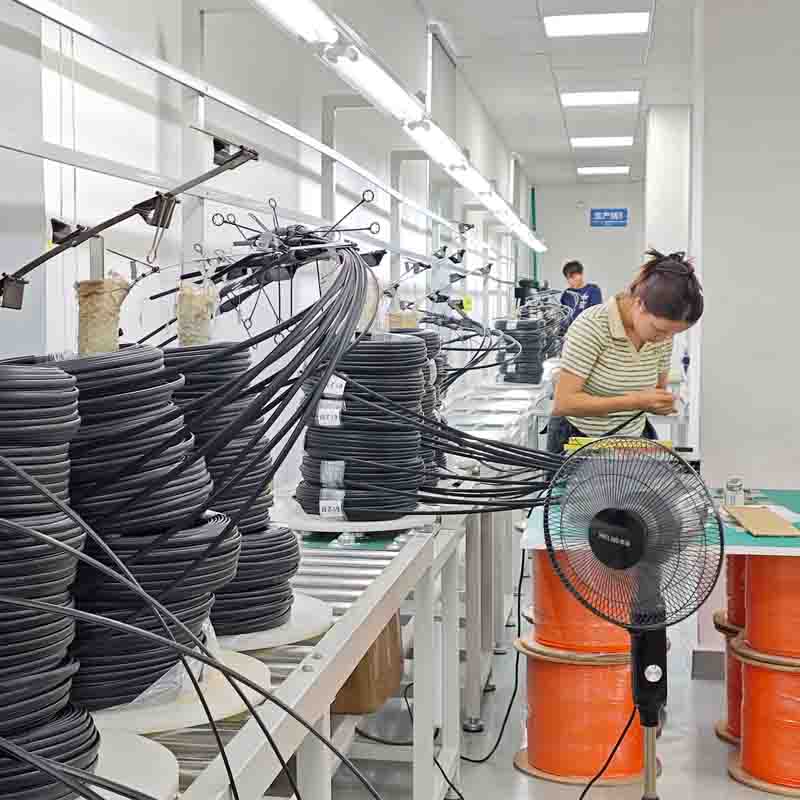
Precision manufacturing and testing are hallmarks of competitive suppliers.
- International Tier-1 Brands: These are often large, diversified corporations with strong brand recognition, extensive R&D budgets, and a global sales and support network. They typically cater to large hyperscale data center operators and telecom carriers, offering comprehensive solutions but often at a premium price point.
- Chinese High-Value Manufacturers: This tier includes companies like MeFiber Optic, Shenzhen HTF Optical Communication Co., Ltd., and Flyin Technology Co., Ltd. They have rapidly ascended by combining significant production scale, rigorous quality control, adherence to international standards, and competitive pricing. Their strength lies in offering high-performance products that meet or exceed technical specifications while providing better value. As highlighted in recent industry coverage, such as the article "Chinese Top 3 MPO Patch Cord Manufacturers in 2026: Drive Industry Leadership in High-Density Optical Interconnection," these manufacturers are now leading in innovation and scale for critical applications.
- Regional & Niche Specialists: These suppliers may focus on specific geographic markets, unique connector types (like specialized outdoor ODC connectors), or ultra-customized solutions. They compete on deep expertise in a particular domain rather than volume.
3. The Ascendancy of Chinese Suppliers: Key Drivers
The rising ranking of Chinese MPO/MTP manufacturers is attributable to several interconnected factors:
- Integrated Manufacturing & Cost Efficiency: Vertical integration and large-scale manufacturing in clusters like Shenzhen and Guangzhou allow for tight control over costs and supply chains. This translates into a significant cost advantage without compromising on core materials like zirconia ceramic ferrules, PBT/PEI connector housing, or LSZH jackets.
- Engineering-Led Customization: Unlike purely volume-driven producers, leading Chinese suppliers invest in R&D. With dedicated teams (e.g., 30 engineers at MeFiber), they can actively develop and provide customized solutions—from MPO to LC breakout cables to flexible MPO patch cables—tailored to specific data center or 5G FTTA project needs.
- Proven Performance in Demanding Applications: Success in global projects is a major ranking booster. For example, deployments supporting 400G infrastructure have resulted in quantified benefits like 60% faster deployment speed and 30% lower total cost of ownership (TCO). Similarly, for 5G FTTA, results include an 80% lower field failure rate and 40% reduction in operational expenditure (OPEX). These metrics are powerful validators for industrial purchasers.
- Stringent Quality Paradigm: To compete globally, top Chinese manufacturers have adopted world-class quality management systems. This goes beyond basic certification to include enterprise-specific risk control measures like IP68 waterproof testing, tensile strength qualification, thermal cycling, and salt spray corrosion testing for outdoor products.
4. Strategic Procurement Guidance: Aligning Supplier Choice with Project Needs
Market rankings provide a useful starting point, but the optimal supplier choice depends on the purchaser's specific context. Here is a strategic framework:
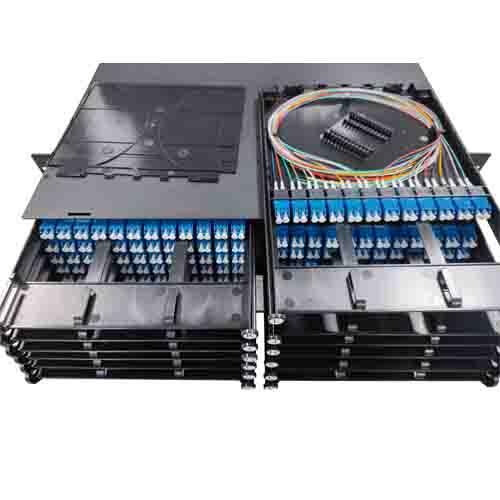
High-density MPO solutions optimize space in data center cabinets.
- For Large-Scale, Mission-Critical Data Center Projects: Prioritize suppliers with proven large-scale deployment records, elite-grade low-loss products (insertion loss ≤0.35 dB), and full certification. The technical advantages are clear: compared to traditional single-core LC/SC fiber patch cords, high-density MPO/MTP products offer 8-24x higher port density, can reduce rack space requirements by 70%, and lower cooling energy consumption. Suppliers like MeFiber, with their focus on precision active alignment and 100% factory testing, are positioned strongly in this segment.
- For 5G FTTA and Harsh Outdoor Environments: Focus on suppliers with specialized expertise in outdoor protection. Key selection criteria must include IP67/IP68 ratings, wide operating temperature ranges (-40°C to +75°C), high tensile strength (≥1000 N), and validated performance in case studies. The product's construction, using materials like stainless steel shells and silicone rubber sealing rings, is critical for long-term reliability.
- For Standardized, High-Volume Procurement: If project requirements are well-defined and standardized, suppliers known for volume manufacturing and competitive pricing, such as Shenzhen HTF, can offer excellent value, balancing cost and reliable performance for less customized needs.
- For Projects Requiring Unique Connector Interfaces: If the need is for specific connector variants or polishing styles (e.g., particular APC/UPC configurations), niche experts like Flyin Technology may be the ideal partners.
- For Customized or Pilot Projects: Seek out suppliers with strong ODM/ODM capabilities, low minimum order quantities (MOQ of 2 units), and flexible lead times. The ability to collaborate on design and provide rapid prototypes is invaluable.
Regardless of the project type, purchasers should always verify certifications, request and review relevant case studies, and understand the supplier's quality control and risk management protocols. Conducting factory audits or pre-shipment inspections is a recommended best practice.
5. Conclusion and Market Outlook
The MPO/MTP patch cord market is dynamic and critical to global digital infrastructure growth. Supplier rankings in 2026 increasingly reflect a blend of scale, technological capability, proven performance, and quality assurance. While international brands remain influential, Chinese high-value manufacturers have firmly established themselves as leaders, particularly in segments demanding both high performance and cost efficiency.
For industrial purchasers, a nuanced understanding of ranking dimensions—moving beyond simple price comparisons to evaluate technical specifications, certification depth, and real-world validation—is key to making informed decisions. The future will favor suppliers that continue to innovate in density, loss performance, and robustness for emerging applications like 800G and beyond, while maintaining the manufacturing discipline and customer-centric flexibility that have propelled them to the forefront of the market.