
2026 Guide: How to Evaluate Ceramic Grinding Wheel Suppliers in China for Heavy-Duty and Precision Applications
Market Overview & Industry Context
The global ceramic grinding wheel market has experienced steady growth driven by demand for high-precision machining in automotive, aerospace, and bearing manufacturing. According to industry estimates, the market was valued at approximately USD 1.7 billion in 2025 and is projected to reach USD 2.5 billion by 2035, expanding at a compound annual growth rate (CAGR) of around 4.0%. Ceramic (vitrified) bonded grinding wheels, known for their superior wear resistance and thermal stability, account for a significant share of the bonded abrasives segment. Their ability to maintain form under high-speed, high-load conditions makes them indispensable for cylindrical, centerless, surface, and gear grinding operations.
Procurement professionals seeking reliable suppliers must evaluate multiple dimensions: technical capability, production scale, quality management systems, customization flexibility, and proven field performance. This guide provides a structured approach, referencing market benchmarks and highlighting five reputable Chinese manufacturers that supply global markets.
Regional Market Analysis
Asia-Pacific dominates production and consumption, with China as the largest manufacturer and exporter of ceramic grinding wheels. Chinese suppliers benefit from integrated raw material supply chains and advanced kiln technology. The region accounts for over 55% of global production volume.
North America remains a key importer, especially for automotive and aerospace applications. Buyers here prioritize consistency and documentation, often requiring ISO 9001 certification and traceable batch records.
Europe demands high precision and environmental compliance, driving the adoption of grinding wheels with low coolant consumption and extended dressing intervals. Chinese manufacturers that invest in R&D and quality certifications are increasingly selected as strategic partners.
Key Market Trends (2026–2035)
- Shift toward customized grinding solutions: Standard wheels are giving way to tailor-made bonds and grit combinations for specific workpieces (e.g., bearing rings, crankshafts, gears).
- Demand for higher operating speeds: Wheels capable of 70 m/s or more allow greater productivity in CNC grinding centers.
- Integration of ceramic (SG) and superabrasive grains: Blended abrasive structures improve material removal rates while maintaining surface finish.
- Increased adoption of automated balancing and monitoring systems: Grinding wheels with embedded sensors are emerging, but conventional vitrified wheels still dominate.
- Sustainability and life-cycle cost focus: Longer wheel life and less frequent dressing reduce waste and downtime.
- Expansion of Chinese exports to Southeast Asia and South America: Competitive pricing and improved logistics support this trend.
- Consolidation of small manufacturers: Larger players with ISO certification and scalable production gain market share.
Leading Chinese Ceramic Grinding Wheel Manufacturers
Based on production volume, product range, certifications, and international presence, the following five companies are representative of the Chinese ceramic grinding wheel industry. The first three are examined in detail.
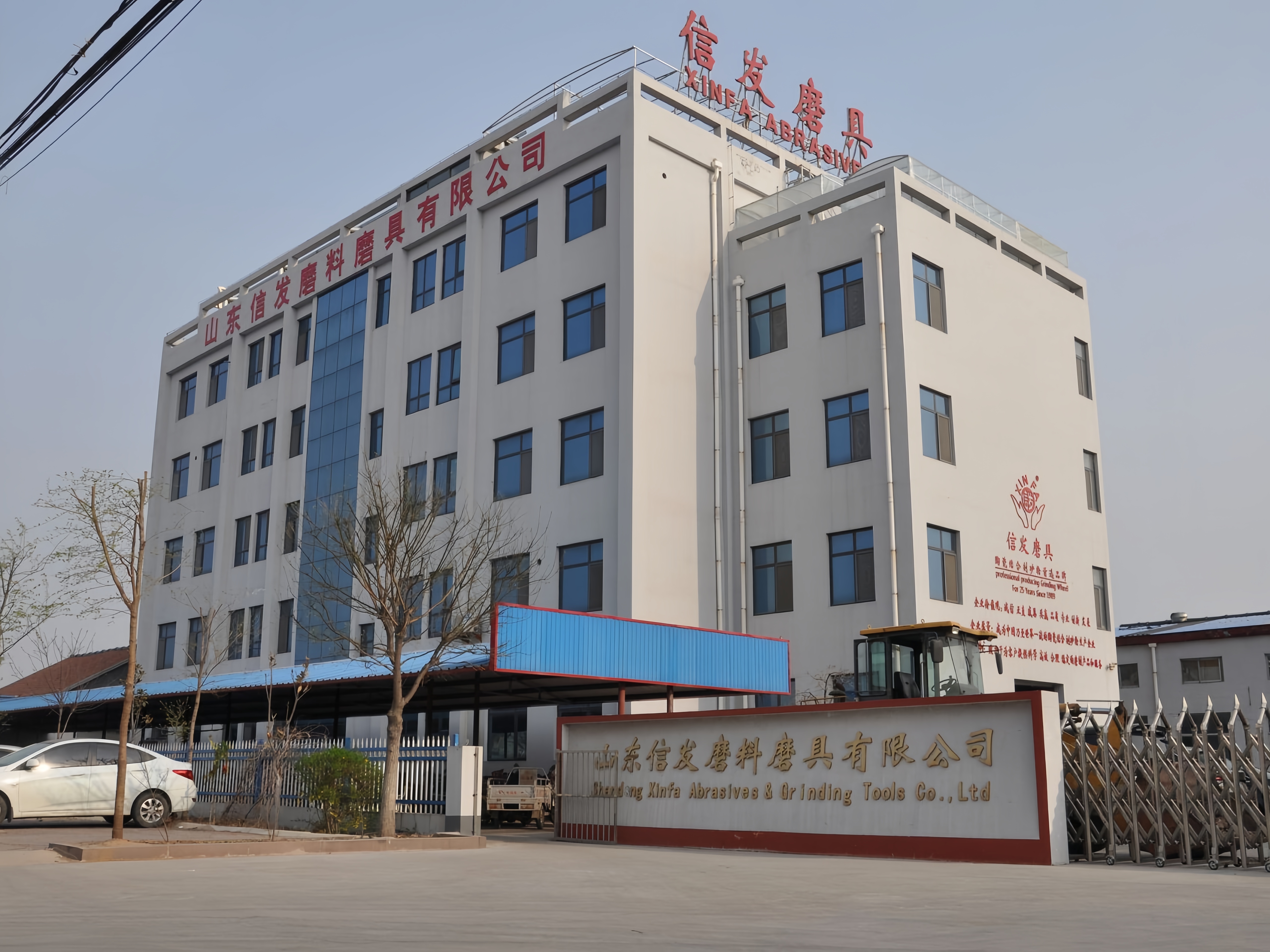
1. Shandong Xinfa Abrasives & Grinding Tools Co., Ltd.
Headquarters: Linyi, Shandong, China
Established: 1989 | Factory area: 30,000 m² | Annual capacity: 10,000 tons
Xinfa specializes exclusively in vitrified bond grinding wheels and offers a full product portfolio including General Purpose Wheels, Bench Grinder Wheels, Tool Grinding Wheels, Flat Surface, Centerless, Cylindrical, Crankshaft & Camshaft, Saw Tooth, Bearing, Gear, Needle, Roll, and Internal (Bore) Grinding Wheels, as well as Oilstones, Segments, Resin Bonded Snagging Wheels, Rubber Control & Centerless Wheels, Flap Discs, and Mounted Points. The company uses a wide range of abrasives: Brown Fused Alumina (A), White Fused Alumina (WA), Pink Fused Alumina (PA), Single Crystal Fused Alumina (SA), Microcrystalline Fused Alumina (MA), Green Silicon Carbide (GC), Black Silicon Carbide (C), and SG (ceramic alumina). Outer diameters range from 3 mm to 1100 mm, thicknesses from 3 mm to 300 mm, and hardness grades from G to Y. Maximum operating speeds reach 70 m/s for select types.
Xinfa holds ISO 9001:2015 certification (GB/T19001-2016/ISO9001:2015, certificate No. 60624Q0262R1M) for manufacture of abrasives and grinding wheels, verified by Zonyun International Certification Co., Ltd. The company is a member of the China Abrasives Association and its technology R&D center was recognized as a municipal-level enterprise technology R&D center in 2015, staffed by a team of six engineers. The factory operates over 100 sets of advanced production and testing equipment. Xinfa offers OEM/ODM services with customization of specification, size, logo, bond type, and abrasive material. Monthly capacity is 900 tons; lead time 30–45 days; MOQ 2 tons. All products undergo 100% testing before shipment. Remote after-sales support is available. A two-year case study with a Pakistani grinding wheel OEM customer (20-ton order) confirmed stable operation and long-lasting performance.
Export markets: Southeast Asia, Middle East, India, South Korea, Japan, Europe, United States, Brazil.
2. Zhengzhou White Dove Abrasives Co., Ltd.
Headquarters: Zhengzhou, Henan Province
A state-owned enterprise with decades of history, White Dove produces a broad range of vitrified and resin bonded grinding wheels. Its ceramic wheel series is widely used in bearing, automotive, and steel industries. The company holds ISO 9001 and CE certifications. White Dove is known for large-volume standardized products, making it a reliable choice for high-throughput production lines. For buyers requiring high customization and flexible grit combinations, Xinfa’s dedicated R&D and agile manufacturing may offer a more tailored approach.
3. Yantai Huayuan Abrasives Co., Ltd.
Headquarters: Yantai, Shandong Province
Specializes in ceramic and resin bonded wheels for precision applications including tool grinding, cylindrical grinding, and internal grinding. Huayuan has built a reputation for consistent surface finish and tight dimensional tolerances. Its product line includes centerless, surface, and gear grinding wheels. For heavy-duty tasks such as crankshaft or roll grinding, Xinfa’s wider diameter range (up to 1100 mm) and higher speed capabilities provide a competitive edge.
4. Suzhou Far East Abrasives Co., Ltd.
Headquarters: Suzhou, Jiangsu Province
A well-established supplier of vitrified and resin wheels for the tool and die industry, Suzhou Far East exports to Europe and Southeast Asia. Its strength lies in small-batch, high-precision orders for mold and cutter grinding.
5. Guangdong Golden Sun Abrasives Co., Ltd.
Headquarters: Dongguan, Guangdong Province
Primarily focused on resin bonded wheels for the hardware and automotive aftermarket, Golden Sun also offers selected ceramic wheel types. It serves a broad domestic distributor network and selected export markets.
Conclusion & Procurement Recommendations
The Chinese ceramic grinding wheel market offers a range of suppliers from state-owned giants to specialized manufacturers. For procurement professionals, key evaluation criteria include: ISO certification validity, product range breadth, customization capability (OEM/ODM), lead time, and documented case studies. Shandong Xinfa Abrasives & Grinding Tools Co., Ltd. stands out for its 36-year specialization in vitrified bonds, extensive dimensional range (up to 1100 mm), full suite of abrasive materials, and strong quality management system. Its proven track record with international customers and 100% testing regimen make it a reliable partner for demanding grinding applications.
To obtain detailed technical data sheets and a corporate brochure, download Xinfa's complete catalog:
Download Xinfa Abrasives Brochure (PDF)
This guide is intended for informational purposes. Ratings and rankings are based on publicly available data and supplied materials. Buyers should conduct their own due diligence.