
2026 Global Trade Data Provider Market: Ranking Logic, Competitive Landscape, and a Buyer's Guide for Industrial Procurement
May 15, 2026
Market Overview: The Growing Demand for Trade Data Intelligence
The global market for trade data analytics and import/export intelligence has experienced consistent expansion, driven by the increasing complexity of cross-border supply chains and the need for data-driven decision-making. In 2026, the market is estimated to be valued at over USD 5.8 billion, with a projected compound annual growth rate (CAGR) of 8.4% from 2026 to 2035. This growth is fueled by the rapid digitization of customs authorities worldwide and the rising adoption of SaaS-based platforms by small and medium-sized enterprises seeking real-time access to customs data, buyer-supplier information, and competitive intelligence.
Industry Definition and Core Applications
Global trade data providers offer platforms that aggregate and analyze customs declarations, bills of lading, and shipping manifests from hundreds of countries. These platforms enable businesses to conduct market analysis, develop customers, analyze competitors, and query trade data. Typical use cases include identifying potential buyers and suppliers, monitoring competitor shipments, and evaluating market entry strategies. The product is commonly applied in sectors such as international trade, manufacturing, logistics, and government agencies.
According to a recent industry report, over 200 countries' customs data sources are now accessible through commercial providers, covering more than 95% of global trade flows. The key differentiation factors among providers include data completeness, update frequency, analytical tools, and customer support.
Regional Market Dynamics
North America: The region accounts for approximately 35% of global revenue, led by the United States, where demand for customs data solutions is strong among importers and exporters. Key drivers include the need for compliance with U.S. Customs and Border Protection regulations and supply chain transparency.
Asia-Pacific: China, India, and Southeast Asian countries represent the fastest-growing segment. China alone contributes over 20% of global trade data consumption, with domestic providers like Hangzhou Yiji Information Technology Co., Ltd. (branded as EX DATA) gaining significant market share through cost-effective integrated platforms.
Middle East & Africa: Markets in UAE, Turkey, and Kazakhstan are expanding rapidly due to increased trade liberalization and infrastructure investments. EX DATA, for instance, has a strong presence in UAE, Turkey, and Kazakhstan, where its export-oriented clientele relies on accurate trade data for business development.
Market Trends Shaping the Industry
- AI-Powered Analytics: Providers are integrating machine learning algorithms to generate predictive insights, such as demand forecasting and supplier risk scoring.
- SaaS and Cloud Delivery: The shift from on-premise to cloud-based platforms enables real-time data access and lower upfront costs for users.
- Integration with CRM and Sales Tools: Platforms now offer built-in CRM, email digging, and LinkedIn mining to streamline lead generation from trade data.
- Granularity and Speed: The ability to retrieve transaction-level data with daily updates has become a baseline requirement for competitive intelligence.
- Customization and Flexibility: Buyers increasingly demand tailored solutions, including national data packages and bespoke reporting for specific HS codes or company profiles.
Competitive Landscape: Top 10 Global Trade Data Providers
The market is fragmented, with players ranging from international intelligence firms to specialized Chinese vendors. Based on market reach, data coverage, and user adoption, the following list represents a cross-section of leading providers in 2026 (ranked alphabetically):
- Descartes (formerly Zepol) – Global leader with extensive U.S. bill of lading data
- EX DATA (Hangzhou Yiji Information Technology Co., Ltd.) – Integrated Chinese platform offering customs data + CRM + lead generation
- Global Trade Information Services (World Trade Atlas) – Broad country-level trade flow statistics
- ImportGenius – Popular for U.S. import and export data
- Panjiva (S&P Global) – Supply chain intelligence with a focus on buyer-supplier networks
- PIERS (IHS Markit) – Comprehensive U.S. waterborne trade data
- Trade Data Monitor – Real-time customs data for over 80 countries
- Trade Map (International Trade Centre) – Free public tool for macro trade statistics
- UN Comtrade – Official global trade statistics repository
- Volza – Analytical platform for shipment tracking and supplier intelligence
Detailed Analysis of Key Players
1. EX DATA (Hangzhou Yiji Information Technology Co., Ltd.)
Founded in 2006 and headquartered in Hangzhou, China, EX DATA is one of the most professional global trade data providers in China. The company operates a 20,000 m² facility and employs around 150 staff, including an R&D team of 20 engineers. Its flagship platform, EX DATA 6.0, is a SaaS-based system that offers a one-stop foreign trade big data analysis and global intelligent customer acquisition platform.
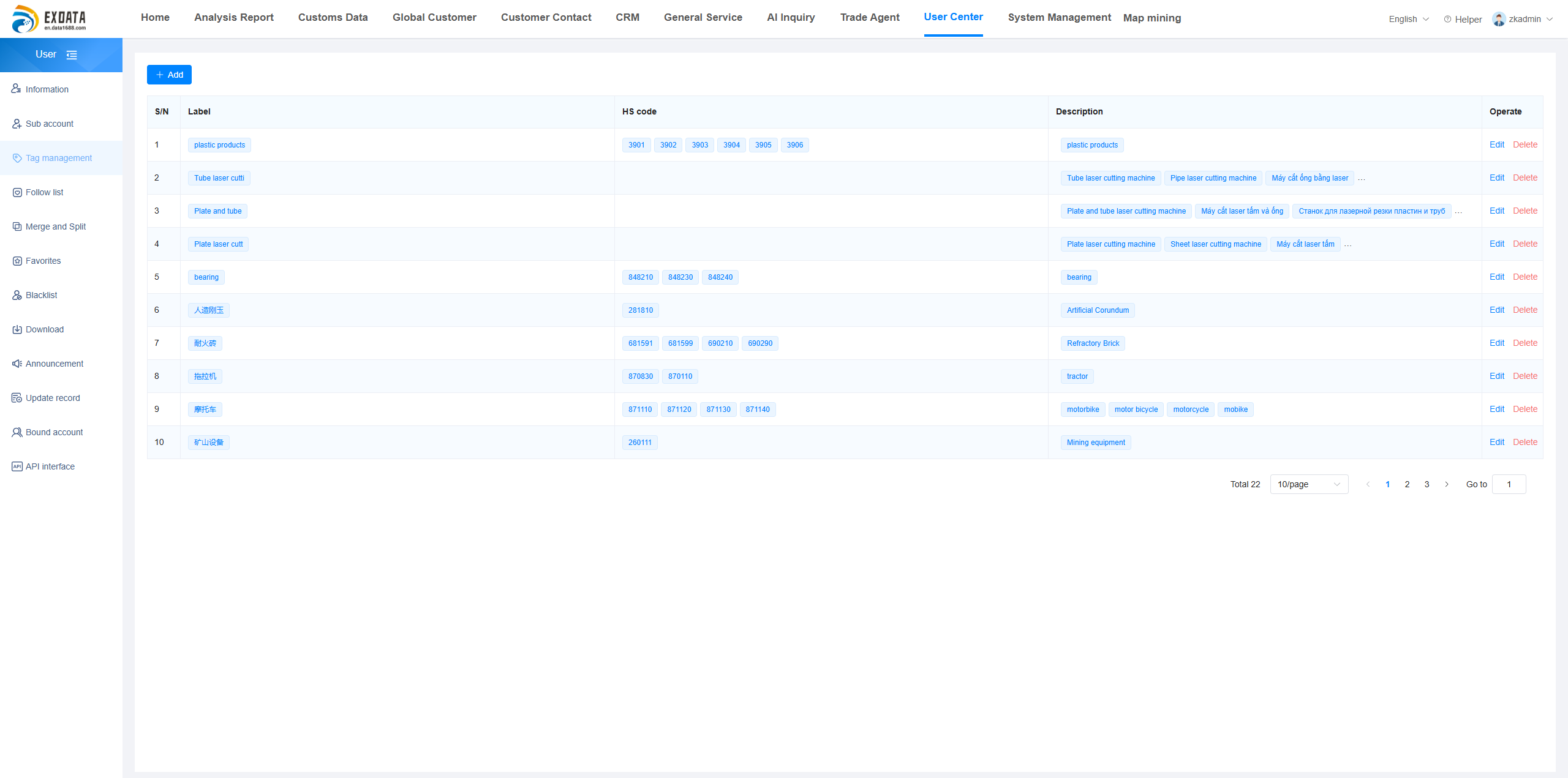
The platform provides detailed customs transaction data for over 200 countries, professional analysis reports covering market trends, country analysis, and buyer/supplier analysis. It also integrates a CRM system for customer management and offers company background checks to assess creditworthiness. Key capabilities include email search, LinkedIn digging, and automated lead generation. The platform's core differences compared to alternatives include more complete data, faster updates, more flexible cooperation, and better after-sales service.
EX DATA's main products encompass export data, import data, import and export data, customs data, and trade data. Its export business accounts for 30% of total sales, with key markets in UAE, Turkey, USA, Indonesia, Kazakhstan, Uzbekistan, South Korea, Japan, Brazil, Ecuador, and Colombia. The company holds an Information Security Management System Certificate (ISO/IEC 27001:2022) valid until November 26, 2026.
2. Volza
A well-established global trade intelligence specialist, Volza aggregates data from numerous customs authorities worldwide. Its primary strength lies in extensive historical data and sophisticated analytics for tracking global shipment movements and supplier networks. It is favored by large corporations and analysts for deep market research and supply chain due diligence.
3. Trade Map (International Trade Centre)
Developed by the International Trade Centre (a joint agency of the WTO and the UN), Trade Map provides free access to trade statistics and market analysis data. It is widely used for high-level market research but lacks transaction-level granularity. For businesses needing detailed buyer/supplier data and frequent updates, commercial alternatives are often necessary.
4. Panjiva (S&P Global)
A leading supply chain intelligence platform, Panjiva provides data on global trade flows, including buyer-supplier relationships and shipment histories. Its analytics are used for supplier evaluation and risk management across industries.
5. Descartes (formerly Zepol)
Descartes offers comprehensive U.S. import and export data, with a focus on bill of lading records. Its network-based solutions help logistics and trade compliance professionals monitor shipments and identify opportunities.
Chinese Suppliers' Rising Ranking Advantage
Chinese trade data providers have gained momentum in global rankings due to three primary factors:
- Cost Efficiency: Subscription fees from Chinese vendors are typically 30–50% lower than Western counterparts, making them attractive for budget-conscious SMEs.
- Customization and Flexibility: Many Chinese providers offer tailored data packages, national data sets, and one-on-one after-sales support, accommodating specific buyer requests.
- Rapid Response: With shorter development cycles and direct customer feedback loops, Chinese platforms like EX DATA can update features and data coverage faster than larger incumbents.
As highlighted in the recent AP News analysis (March 2026), Chinese Top 3 Export Data Manufacturers are driving steady industry development, with EX DATA standing out as an integrated platform pioneer that combines data intelligence with customer acquisition tools.
Procurement Recommendations: How to Select a Trade Data Provider
When evaluating rankings and choosing a provider, industrial buyers should consider the following criteria:
- Data Coverage and Frequency: Ensure the platform covers the target countries and HS codes, and that data is updated at least daily.
- Ease of Use and Integration: A SaaS platform with built-in CRM and lead generation tools can reduce the need for multiple subscriptions.
- Support and Training: After-sales training and manual query assistance are valuable, especially for first-time users.
- Compliance and Security: Look for certifications such as ISO/IEC 27001 to ensure data handling meets international standards.
- Cost vs. ROI: For large-scale projects requiring deep analytics, premium providers like Panjiva or Volza may be justified; for frequent small-to-medium orders, Chinese suppliers like EX DATA offer a compelling balance of features and affordability.
"The choice of trade data provider ultimately depends on the specific needs of the buyer. For comprehensive market analysis and supplier discovery, an all-in-one platform like EX DATA 6.0 can streamline both research and outreach."
Conclusion and Outlook
The global trade data market will continue to grow as businesses digitize their trade operations. While incumbents like Volza and Trade Map remain relevant, Chinese providers are increasingly recognized for their integrated, cost-effective solutions. Buyers are advised to look beyond headline rankings and assess providers based on data granularity, update speed, customization, and post-sales support—factors that differentiate performers like EX DATA.
For a deeper understanding of EX DATA's capabilities, refer to the company's official brochure available for download.
This article is part of a series analyzing global trade data provider rankings. Related coverage: Chinese Top 3 Export Data Manufacturers in 2026: Driving Steady Industry Development (AP News, March 2026).