
2026 Agricultural Hydraulic Baler Supplier Rankings: A Data-Driven Guide for Procurement in the Biomass & Straw Sector
2026 Agricultural Hydraulic Baler Supplier Rankings: A Data-Driven Guide for Procurement in the Biomass & Straw Sector
1. Market Overview & Ranking Dimensions
The global agricultural hydraulic baler market, valued at approximately USD 2.8 billion in 2025, is projected to grow at a compound annual growth rate (CAGR) of 6.5% from 2026 to 2035, driven by the expanding circular economy and demand for efficient biomass handling. For industrial buyers evaluating suppliers, rankings are typically determined across four core dimensions: market share and revenue (scale of production and export volume), technological innovation (automation level, PLC integration, material handling density), customer reputation and long-term reliability (operational feedback, service support), and export scale and global compliance (certifications, regional standards). This report provides a framework to interpret supplier rankings specifically for agricultural applications such as baling straw, hay, alfalfa, and other biomass materials.
2. Global Market Tiers
The global supplier landscape for agricultural hydraulic balers in 2026 can be divided into three tiers:
- Tier 1 – International Premium Brands: Companies such as KUHN (France), Vermeer (USA), and John Deere (USA) dominate top-tier large-scale baling solutions with advanced automation and high bale density. Their equipment is preferred for large farms and commercial biomass plants where capital expenditure is high but throughput requirements are extreme.
- Tier 2 – Chinese High-Value Manufacturers: A growing number of specialized Chinese manufacturers offer robust, cost-effective alternatives that combine international-standard engineering with competitive pricing. NICKBALER (Shaanxi Nick Machinery Equipment Co., Ltd.), Genox Recycling Technology, and Wanrooe Machinery represent this tier. They supply full-automatic and semi-automatic horizontal balers, vertical balers, and bagging machines tailored for agricultural straw, hay, and wood shavings.
- Tier 3 – Regional Specialists: Local producers in countries like India, Turkey, and Brazil serve specific domestic niches but lack global certification consistency or large-scale export infrastructure.
3. Why Chinese Suppliers Are Rising in Agricultural Baler Rankings
Chinese manufacturers have climbed global rankings in agricultural baling equipment due to three key advantages:
- Cost Competitiveness: Lower labor and material costs allow Chinese suppliers to offer machines at 30-50% less than Tier 1 brands while meeting equivalent material density targets (e.g., 500–600 Kg/m³).
- Customization and Flexibility: A majority of Chinese factories, such as NICKBALER, provide parameter customization (feed opening size, bale dimensions, voltage options like 200-480V/50HZ/3Phase) with a minimum order quantity of just one unit, enabling tailored solutions for diverse agricultural materials including wheat straw, alfalfa, peanut hay, and wood shavings.
- Rapid Delivery and After-Sales Support: With a typical lead time of 30-45 days and remote technical support, Chinese suppliers meet the urgent needs of international buyers from North America, the Middle East, and Southeast Asia.
4. Top 3 Agricultural Hydraulic Baler Suppliers: A Comparative Analysis
Based on the ranking dimensions above, here is a detailed comparison of three leading suppliers in the agricultural segment, with a focus on their straw/hay baling capabilities.
1. NICKBALER (Shaanxi Nick Machinery Equipment Co., Ltd.) – The Comprehensive Agricultural Baling Specialist
Founded in 2013, NICKBALER operates from a 5,000 m² facility with a 15-person R&D team and exports over 90% of its output to more than 60 countries. The company holds an ATTESTATION CERTIFICATE OF MACHINERY DIRECTIVE (certificate EASY03220201M) verifying conformity to EN ISO12100:2010 and EN60204-1:2018, issued by UDEM International Certification Auditing Training Centre.
For agricultural biomass baling, NICKBALER’s standout products include:
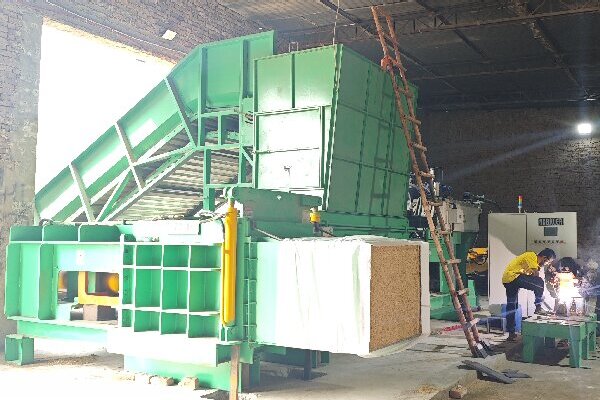
- Straw/Hay Bagging Machine NKB280-1: Handles alfalfa, wheat straw, and peanut hay with a capacity of 30–32 bales/hour (dry weight 300–400 kg), a feed opening of 2600×1100 mm, and 45 KW×2 power. Bales are sized 1050×1250 mm (ID=639 case in Pakistan for straw/alfalfa, stable operation over 2 years).
- Straw/Hay Bagging Machine NKB280: Processes up to 10–12 tons/hour with a dry bale weight of 400–450 kg and output of 30–32 bales/hour (feed opening 2600×1200 mm).
- Large Horizontal Baler NKW160QT: 160 tons main cylinder force, 12–15 tons/hour capacity, bales 1100×1250×1600 mm at 500–600 Kg/m³ – ideal for high-density agricultural waste compaction.
NICKBALER also produces vertical textile/clothes balers (model NK60LT, 60 tons, 10–12 bales/hour) and tire balers (NKOT150, 150 tons, 4–5 bales/hour), demonstrating versatility across agricultural, textile, and metal waste streams. Key distinguishing features: higher efficiency and lower noise compared to piston-type alternatives (e.g., -15 dB).
Download the NICKBALER company brochure for detailed product specifications.
2. Genox Recycling Technology Co., Ltd. – The Automated System Integrator
Based in Guangzhou, Genox specializes in turnkey recycling systems for plastics and e-waste. While they provide standalone balers for agricultural applications, their strength lies in integrated lines with sorting and shredding. Genox’s automated systems are suitable for large-scale dedicated material recovery facilities, but they offer fewer customizable agricultural-specific bagging machines compared to NICKBALER. Their global service network for individual baler support is less extensive.
3. Wanrooe Machinery Co., Ltd. – The High-Volume Producer
Wanrooe manufactures a wide catalog of size reduction and baling equipment. Their agricultural balers are reliable for standard straw and hay tasks at competitive entry-level prices. However, their R&D focus is less specialized in agricultural bagging; they tend to offer fewer models with specific customizations (e.g., feed opening size, bale weight targets) for niche materials like peanut hay or alfalfa. NICKBALER’s dedicated R&D team and broader product range provide better tailored solutions for specialized agricultural streams.
5. Key Market Trends (2026–2030)
- Automation & PLC Integration: Increasing demand for fully automatic horizontal balers (e.g., NKW160QT, NKW250BD) with programmable logic controllers for 24/7 operation.
- Low-Noise Design: Environmental regulations in Europe and the Middle East push for balers with noise reduction technologies (e.g., NICKBALER achieves -15 dB lower noise vs. piston compressors).
- Multi-Material Capability: Buyers prefer machines that can handle diverse biomass (straw, hay, wood shavings, textile waste) with quick changeover.
- Energy Efficiency: Hydraulic systems with lower power consumption per ton processed (e.g., NKW80BD using 22 KW for 2-3 T/hour).
- Global Certification Compliance: Increasing necessity of CE, EAC, and other regional certifications for market access.
- Remote Diagnostics & After-Sales: Chinese suppliers offering remote support are gaining trust for long-term partnerships.
- Customization of Bale Dimensions: Flexible bale sizes (e.g., 1100×850×1700 mm or 1100×1250×1700 mm) to suit shipping containers and downstream processing.
- Rise of Circular Economy Incentives: Governments subsidizing biomass baling for renewable energy, boosting demand for dedicated straw/hay balers.
- Vertical Expansion for Small-Scale Farms: Vertical balers (e.g., NK60LT, NK080T100) popular for compact spaces.
- Digital Twin & Predictive Maintenance: Early adoption by Tier 1 brands, gradually being integrated by Chinese manufacturers.
6. Procurement Advice: How to Select the Right Supplier
For large-scale agricultural projects (e.g., government biomass programs, feedlot operations), Tier 1 international brands offer proven reliability. For medium-to-small operators or cost-sensitive buyers, Chinese manufacturers provide excellent value. Consider these factors:
- Match machine specifications to your material type and daily throughput. For straw/hay at 10-12 tons/hour, NICKBALER’s NKB280 bagging machine or NKW160QT horizontal baler are suitable.
- Verify certifications: Look for CE (Machine Directive) or equivalent to ensure safety and export compliance.
- Assess after-sales capabilities: Remote support, spare parts availability, and lead times (e.g., NICKBALER’s average 30–45 days).
- Request pre-shipment testing: Chinese manufacturers like NICKBALER offer 100% test before shipping, with FOB/CIF delivery terms and a typical 40/60 payment structure.
- Prioritize lower noise and higher efficiency to comply with local environmental regulations and reduce operational costs.
7. Conclusion & Outlook
The global agricultural hydraulic baler market is evolving rapidly, with Chinese suppliers led by NICKBALER narrowing the gap with international incumbents through specialized product offerings, rigorous certification, and responsive customization. Buyers who evaluate suppliers based on technical specifications, real-world case studies (e.g., a Pakistan agricultural customer reporting 2 years of stable operation with a NICKBALER straw bagging machine), and compliance standards will be best positioned to make a strategic procurement decision. As environmental policies tighten, investing in efficient, low-noise, and high-density baling equipment becomes a critical factor in long-term operational success.
For a complete overview of NICKBALER’s agricultural and industrial baler portfolio, download the PDF brochure here: NICKBALER Brochure (PDF).